
In the beginning, there was the humble water reservoir: clear, placid, minding its own municipal business. Then came PFAS, the comic-book villain that did not need a cape because it already had carbon-fluorine bonds. Tough, slippery, persistent, and annoyingly good at showing up where it should not, PFAS became the sort of contaminant that makes regulators reach for binders, scientists reach for mass spectrometers, and everyone else reach for a water filter.
A new review, Breaking boundaries for PFAS surveillance in water reservoirs: CRISPR-electrochemical synergies from MXene to microfluidics, asks a timely question: what if PFAS monitoring could move from slow, centralized laboratory testing toward portable, highly sensitive systems that can detect contamination closer to the source? In policy terms, that is the difference between “we found out eventually” and “we found out before three committees had to be formed.”
Why PFAS Is Such a Policy Headache
PFAS stands for per- and polyfluoroalkyl substances, a large family of synthetic chemicals used in products that resist heat, oil, stains, grease, and water. That sounds useful, and it has been. PFAS chemistry helped make nonstick cookware, water-resistant fabrics, firefighting foams, and industrial coatings possible.
The problem is that many PFAS compounds are extremely persistent. They are often called “forever chemicals,” which is catchy, accurate enough for public communication, and only slightly less cheerful than naming a tax form after your blood pressure.
Because PFAS can move through water systems and linger in the environment, surveillance is not a luxury. It is the foundation for risk assessment, cleanup priorities, public communication, and enforceable standards. But today’s gold-standard testing methods can be expensive, equipment-heavy, and tied to specialized labs. That model works for confirmatory analysis, but it is less ideal for routine, widespread, rapid screening across reservoirs and water infrastructure.
The Testing Problem: Sensitive, Specific, Cheap, Portable - Pick Too Few
The review centers on a familiar surveillance dilemma. Public health systems want tests that are ultra-sensitive, highly specific, portable, automated, and affordable. In the real world, analytical chemistry often behaves like a public procurement process: you can ask for everything, but the final product may arrive late, cost more, and require a training webinar.
Current PFAS detection methods can be powerful, especially laboratory platforms designed to quantify trace contaminants. But water systems need more than occasional precision. They need scalable monitoring that can help identify contamination patterns, guide follow-up testing, and support faster intervention.
That is where the review’s proposed framework becomes interesting. It brings together three technologies: molecularly engineered sulfonate-MXenes, CRISPR-Cas12a, and microfluidic automation. Each contributes a different part of the surveillance puzzle.
MXenes: Tiny Conductive Platforms With a Talent for Capture
MXenes are two-dimensional materials with excellent electrical properties and tunable surface chemistry. In this review, the focus is on sulfonate-terminated titanium-based MXenes. That sounds like a phrase invented to scare undergraduates, but the basic idea is straightforward: engineer the surface so it can interact more effectively with PFAS molecules.
PFAS detection is hard because these chemicals can appear at very low concentrations, and water samples are messy. Reservoir water is not a pristine chemistry set. It contains minerals, organic matter, microbes, and whatever else the watershed has contributed that week.
A well-designed MXene surface could help concentrate or recognize PFAS-related targets while also serving as an electrochemical platform. Electrochemical detection is attractive because it can be miniaturized, made relatively low cost, and integrated into portable devices. Instead of relying only on large instruments in centralized labs, electrochemical sensors could support field screening if they become reliable enough.
CRISPR-Cas12a: Not Just for Genetics Anymore
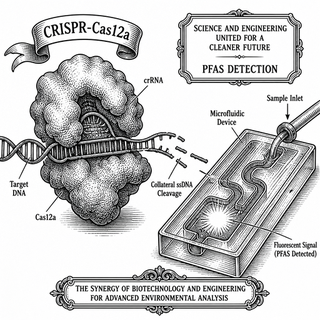
CRISPR is best known for gene editing, but CRISPR systems are also useful for diagnostics. Cas12a, one of the CRISPR-associated enzymes, can be designed to recognize specific nucleic acid sequences and then trigger detectable signal changes. In many diagnostic systems, that signal amplification makes it easier to detect very small amounts of a target.
PFAS molecules are not DNA, so the connection is not as simple as “CRISPR spots PFAS directly.” The value lies in clever assay design. Researchers can pair molecular recognition events with CRISPR-based signal amplification, turning difficult chemical detection into a more readable output. Think of it as giving a quiet contaminant a tiny bureaucratic megaphone, but one that actually improves efficiency.
This is why the review’s “synergy” matters. MXenes can support capture and electrochemical readout. CRISPR-Cas12a can amplify molecular signals. Together, they could help push PFAS surveillance toward higher sensitivity and specificity without requiring every water authority to build a miniature national laboratory next to the pump station.
Microfluidics: The Plumbing Inside the Plumbing Story
Microfluidics adds another important layer. These systems move tiny volumes of liquid through small channels, allowing sample handling, reactions, washing, and detection to happen in a compact automated format.
For PFAS surveillance, microfluidics could reduce sample volume, limit contamination, standardize workflows, and support portable testing cartridges. In a best-case future, water monitoring might involve compact devices that process samples with minimal manual steps, then produce rapid screening data that tells officials where more detailed laboratory confirmation is needed.
That would not replace high-end analytical chemistry. It would help aim it better. A portable screening network could function like radar, identifying hotspots or changes over time, while confirmatory lab testing remains the legal and scientific anchor. Regulators love anchors. They also love appendices, but that is a separate condition.
Why This Could Matter for Public Health Systems
The real promise here is not just a shinier sensor. It is a different surveillance model.
PFAS policy depends on knowing where contamination is, how concentrations change, and whether interventions are working. If testing is slow or sparse, decision-makers are stuck managing uncertainty. That uncertainty can delay cleanup, complicate public messaging, and create uneven protection across communities.
A lower-cost, portable PFAS screening approach could help smaller water systems participate in more frequent monitoring. That matters because environmental health risks often fall hardest on communities with fewer technical and financial resources. A technology that reduces dependence on centralized infrastructure could make surveillance more equitable, provided it is validated carefully and deployed with clear standards.
This is where policy design matters. New sensors do not automatically create better public health outcomes. Agencies would need protocols for calibration, quality control, confirmatory testing, data reporting, and action thresholds. Otherwise, a promising device becomes another gadget in the drawer labeled “pilot program, please do not ask what happened.”
The Caveats: Reviews Point the Way, They Do Not Finish the Road
This paper is a review, not a clinical trial or a finished product announcement. It synthesizes and proposes a framework for next-generation PFAS surveillance, but the hard work remains: validation in real water samples, durability testing, interference testing, manufacturing scale-up, regulatory acceptance, and field usability.
That last item deserves attention. A sensor that works beautifully in a lab but requires a PhD, a vibration-free table, and the patience of a saint may not transform reservoir monitoring. The strongest public health technologies are not just sensitive. They are rugged, understandable, affordable, and compatible with the daily work of environmental monitoring teams.
Still, the concept is compelling. PFAS surveillance needs tools that can bridge the gap between advanced analytical chemistry and real-world water management. A platform combining engineered MXenes, CRISPR-Cas12a signal amplification, and microfluidic automation is exactly the kind of cross-disciplinary approach that could move the field forward.
The Bigger Picture
PFAS contamination is not only a chemistry problem. It is a governance problem, an infrastructure problem, a data problem, and a trust problem. Communities want to know whether their water is safe. Agencies need defensible data. Utilities need practical tools. Scientists need methods that perform outside idealized conditions.
That is why this review is intriguing. It points toward surveillance systems that could make PFAS monitoring faster, more distributed, and more responsive. The technology is still developing, but the direction is right: bring the test closer to the water, automate what can be automated, amplify weak signals, and give public health officials better information before the next meeting agenda becomes sentient.
The villain in this origin story is persistent. The monitoring tools will need to be just as persistent, only more useful and with fewer fluorinated bonds.
This blog post discusses research findings and should not be taken as medical advice. If you have concerns about PFAS exposure or drinking water quality, please consult a healthcare provider or your local public health authority. Research discussed here represents ongoing scientific investigation and field validation is still in progress.
All images used in this post are decorative illustrations only and do not represent or reflect the accuracy, reality, or correctness of the referenced research.
Primary Source: Breaking boundaries for PFAS surveillance in water reservoirs: CRISPR-electrochemical synergies from MXene to microfluidics- A review. PubMed Record ID 42070443. PubMed