
A vaccine enters the body and fizzles before immune cells really notice it. A promising immune-boosting molecule shows up, but not in the right place or at the right intensity. A beautifully designed antigen gets delivered like a package with no street number, and the immune system just sort of shrugs. That, in miniature, is the logistics problem this paper is trying to solve. And like many good engineering stories, the answer involves assembling a tiny team where each member does one job well, like the world’s nerdiest superhero trio.
The basic idea: one nanoparticle, three useful parts
The study, indexed in PubMed as record 42050105, describes a nanoparticle system with three components:
- Mesoporous silica nanoparticles (MSNs), which are good at carrying cargo because they have high loading capacity
- Graphene quantum dots (GQDs), a carbon-based nanomaterial known for low toxicity, good biocompatibility, and stable behavior in solution
- Glucosamine sulfate (GS), which the authors describe as having immunomodulatory properties
Put those together and you get graphene quantum dot-coated mesoporous silica loaded with glucosamine sulfate, abbreviated as MSN-G-Q.
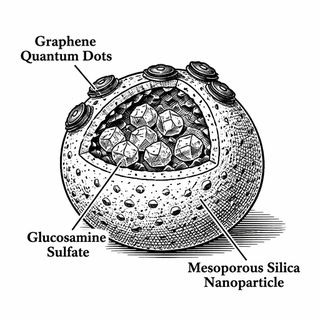
That name is not exactly built for marketing, but the design logic is clean. Mesoporous silica acts like the cargo van. Glucosamine sulfate is part of the payload with immune-related activity. Graphene quantum dots add a surface feature that may improve how the whole package interacts with cells. If you like systems thinking, this is catnip.
Why antigen delivery is such a hard problem
Immune activation is not just about having the right antigen. Timing matters. Location matters. Cellular uptake matters. Whether immune cells get sufficiently excited without going completely off the rails also matters.
A lot of biomedical research boils down to improving signal-to-noise ratio. You want immune cells to notice the important thing, respond robustly, and build useful defenses. You do not want a weak whisper, and you also do not want a fire alarm in a library.
That is why delivery systems matter so much. A strong delivery platform can make an otherwise modest immune stimulus more visible, more durable, or more effective. The numbers are rarely kind to molecules that have to survive transport, distribution, cellular entry, and biological indifference all at once.
What the study actually tested
The researchers evaluated the immunoactivation effects of MSN-G-Q in vitro and in vivo.
From the summary provided, the in vitro findings included:
- Enhanced macrophage uptake activity
- Increased nitric oxide (NO) production
- Upregulation of CD80 as an immune activation marker
Those are not trivial outputs. Macrophages are among the immune system’s professional engulfers. If they take up more of a delivery system, that is a strong early sign the platform may be doing its job better than a passive particle would.
Nitric oxide production is also worth noticing. In immune biology, NO often shows up when cells are activated and participating in defense-related signaling. It is not the whole story, but it is a meaningful piece of the pattern.
Then there is CD80, a co-stimulatory molecule involved in T-cell activation pathways. When CD80 goes up, it suggests immune cells may be shifting toward a more activated, communicative state. Translation: the system is not merely arriving, it may be making itself known.
Why this combination is interesting
The most compelling part of this paper is not any single ingredient. It is the architecture.
Mesoporous silica nanoparticles are already attractive because they can carry a lot of material. That is the storage advantage. Graphene quantum dots bring material properties that researchers like for biomedical use, especially low toxicity and stability. Glucosamine sulfate adds an immunomodulatory angle that the authors wanted to amplify.
So the hypothesis here is basically: can we build a smarter carrier that does more than just transport cargo? Can the delivery vehicle itself improve uptake and stimulate a stronger immune response?
That is a bigger leap than it sounds. In drug and vaccine delivery, the dream is often to make the carrier pull double duty. Not just a box, but a box with GPS, high-visibility tape, and a polite but persistent knock at the door.
The macrophage angle matters more than it may seem
If I were sketching the data story on a whiteboard, macrophages would be in a large circle near the center.
Why? Because uptake is a gating step. If the particles are not getting into the right immune cells efficiently, downstream effects are capped. You can have elegant chemistry and beautiful particle design, but if biology treats it like junk mail, the campaign is over.
The reported increase in macrophage uptake suggests the nanoparticle surface and composition may be changing that first interaction in a useful way. That matters because better cellular entry can amplify everything that follows, from antigen presentation to co-stimulatory signaling.
It is the biological equivalent of improving open rates before arguing about conversion metrics. Scientists do not usually phrase it that way, but the funnel is the funnel.
What real-world impact could this have?
If follow-up studies validate and extend these findings, systems like MSN-G-Q could matter in areas where strong, targeted immune activation is useful. That includes vaccine adjuvant design, antigen delivery platforms, and possibly therapeutic immunology applications.
The appeal is straightforward:
- Improve how well immune cells take up the payload
- Increase activation signals at the cellular level
- Potentially get stronger responses with more efficient delivery
That does not guarantee clinical success. Biology loves a plot twist. But the direction is rational.
The broader pattern here is that next-generation immune technologies are increasingly being built like layered platforms rather than single molecules. Researchers are combining cargo capacity, surface engineering, and biological signaling into one compact system. The more we learn, the less “just inject the thing” feels like a serious plan.
What this study does not settle
This is where the spreadsheet brain kicks in.
Early immune activation results are encouraging, but they are not the same as proven clinical benefit. Increased macrophage uptake, nitric oxide production, and CD80 expression tell us the system is biologically active. They do not yet tell us:
- How durable the immune response is
- Whether the response is precisely targeted
- How the platform behaves across different antigens or disease contexts
- What the long-term safety profile looks like
- Whether the same benefits hold up in humans
That gap is normal. It is not a flaw in the study. It is the usual sequence in translational science: first demonstrate the mechanism, then test whether the mechanism cashes out into meaningful outcomes.
There is also a balancing act with immunoactivation. Stronger is not automatically better. The sweet spot is effective stimulation without excessive inflammation or off-target effects. The immune system is brilliant, but it can also be a bit of a drama department when overstimulated.
Why this paper is worth watching
What stands out here is the attempt to engineer a potent antigen delivery system by combining material science with immune biology in a very deliberate way. The study is not merely asking whether one molecule works. It is asking whether the structure of the delivery vehicle itself can reshape the immune response.
That is a high-value question.
When a paper shows improved uptake plus multiple activation-related signals, I pay attention, because those effects often travel together for a reason. The pattern suggests the platform is influencing several steps in the immune activation chain, not just one isolated marker.
For now, this looks like a promising preclinical strategy with a tidy design rationale and encouraging early signals. Tiny particles, yes. Tiny ambitions, absolutely not.
This blog post discusses research findings and should not be taken as medical advice. If you have concerns about vaccines, immune health, or related treatments, please consult a healthcare provider. Research discussed here represents ongoing scientific investigation and clinical validation is still in progress.
All images used in this post are decorative illustrations only and do not represent or reflect the accuracy, reality, or correctness of the referenced research.
Primary Source: Graphene quantum dot-coated mesoporous silica loaded with glucosamine sulfate as a potent antigen delivery system for immunoactivation. PubMed Record 42050105. Source