
Under 30 seconds. That is how quickly this experimental hydrogel reportedly helped stop bleeding in preclinical testing. For anyone who has ever watched a paper towel lose a fight with a kitchen spill, that number sounds almost suspiciously neat. But in trauma medicine, especially non-compressible hemorrhage, fast clot control is not a luxury feature. It is the whole game.
The study, published in PubMed under the title Modular alginate-based hydrogels embedding multilayer nanofibers: A synergistic strategy for hemostasis, antibacterial, and immunomodulatory therapy, describes a multifunctional wound material called GT-F. It is built to do several jobs at once: stop bleeding, stick to tissue, resist infection, calm excessive inflammation, and support healing. That is a crowded resume for one squishy material, so yes, skepticism is warranted. Biomedical materials sometimes arrive dressed like superheroes and later discover that real wounds are less impressed than lab models.
Still, this one has some interesting engineering under the hood.
Why Non-Compressible Bleeding Is So Hard to Handle
Many bleeding wounds can be managed by pressure. Apply gauze, press firmly, wait, and hope biology gets its act together. Non-compressible hemorrhage is different. It often happens inside the body or in areas where direct pressure is difficult or impossible, such as liver injury, deep penetrating trauma, or irregular internal tissue surfaces.
That creates a nasty chain reaction. Ongoing blood loss can lead to shock. Tissue damage can invite infection. Inflammation can go from helpful cleanup crew to overexcited demolition team. If the injury is severe enough, the whole body can spiral toward organ dysfunction.
So researchers are interested in materials that do more than plug a hole. The dream product would behave like a smart emergency patch: adhesive, flexible, antibacterial, mechanically tough, biodegradable, and friendly enough to wounded tissue that immune cells do not immediately treat it like an uninvited guest wearing muddy shoes.
What This Hydrogel Is Made To Do
The GT-F hydrogel is based on alginate and gelatin-derived components. Alginate is a natural polymer often associated with seaweed-based biomaterials, while GelMA, or gelatin methacryloyl, is widely used in tissue engineering because it can form cell-compatible hydrogels.
The researchers modified alginate with dopamine chemistry, producing dopamine-modified methacrylate alginate. Dopamine-inspired chemistry is popular in adhesives because mussels use related chemistry to cling to wet surfaces. That is useful because the human body, inconveniently, is not a dry countertop.
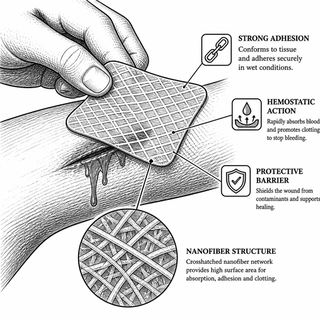
The hydrogel also contains tranexamic acid, a drug already known for helping reduce bleeding by slowing clot breakdown. Then the team reinforced the gel with a multilayer nanofiber framework made from polycaprolactone, or PCL. These nanofibers also carried curcumin and an antibacterial quaternary ammonium compound called HDEAB.
In plainer terms: the researchers built a sticky gel scaffold, strengthened it with tiny fibers, and loaded it with agents meant to support clotting, reduce oxidative stress, and fight microbes. It is a bit like packing a first-aid kit into a flexible jelly, which sounds silly until you remember that biology itself is mostly wet logistics.
The Mechanical Results Are Worth Noticing
One of the stronger parts of this study is that it does not only ask, “Does the gel look promising?” It looks at physical performance too.
Compared with a conventional GelMA hydrogel, the GT-F material reportedly had nearly four times the compressive strength and more than three times the tensile strength. That matters because wound materials are not used in polite conditions. They may be squeezed, stretched, soaked, shifted, and exposed to active bleeding. A gel that performs beautifully in a dish but falls apart in tissue is not a therapy. It is a mood.
The team also found that increasing the modified alginate content within an optimal range improved crosslinking density, reduced pore size, and lowered swelling. That is a useful detail. Hydrogels can swell dramatically, and while swelling can help absorb fluid, too much swelling may weaken structure or disrupt tissue contact. This is the kind of formulation work that rarely makes flashy headlines but often determines whether a material has a realistic future.
The Biological Claims: Promising, But Preclinical
The hydrogel reportedly showed good biocompatibility, degradability, antimicrobial activity, antioxidant properties, and wound-healing effects. In a rat liver puncture model, GT-F outperformed commercial gauze in stopping bleeding. It also reduced macrophage inflammatory infiltration, increased PCNA expression, and accelerated repair.
Let’s translate part of that. Macrophages are immune cells that help clean up damage but can also contribute to prolonged inflammation. PCNA, or proliferating cell nuclear antigen, is associated with cell proliferation, which can be a sign that tissue repair processes are active. So the researchers are not just saying “the bleeding stopped.” They are arguing that the wound environment looked more favorable for healing afterward.
That is encouraging. It is also where we keep both feet on the floor.
Rat liver puncture models are useful, but they are not the same as human trauma care. Human wounds vary wildly in size, contamination, blood pressure, clotting status, medication use, and timing. A material that works in a controlled animal experiment may run into trouble in real emergency settings, where the wound did not read the protocol and the patient may be cold, acidotic, anticoagulated, or all of the above.
The Antibacterial Angle Is Interesting, With Caveats
Adding antimicrobial properties to hemostatic materials makes sense. Trauma wounds can become infected, and infection can derail healing. HDEAB, a quaternary ammonium antibacterial agent, is included for that purpose, while curcumin contributes antioxidant and anti-inflammatory potential.
But combination materials can be tricky. Each added ingredient brings possible tradeoffs: release rate, local toxicity, degradation behavior, manufacturing complexity, and regulatory burden. A hydrogel with multiple active components may be more capable, but it may also be harder to standardize and approve. Biomedical engineering loves multifunctionality. Regulators tend to ask where every ingredient goes, how long it stays there, and whether it behaves badly at 3 a.m. in a messy real-world wound.
That is not a criticism of the study. It is just the toll booth between clever biomaterial and actual clinical product.
What Would Need To Happen Next?
The next steps would likely include larger animal studies, testing under more realistic bleeding conditions, longer-term safety evaluation, dose and degradation studies, and comparison against more advanced commercial hemostatic products, not just standard gauze.
Researchers would also need to show that the material can be manufactured consistently. Hydrogels with embedded multilayer nanofibers sound elegant, but scale-up can turn elegant into expensive faster than a hospital billing department finds a modifier code.
Questions worth watching include:
- How well does GT-F work in high-pressure arterial bleeding?
- Does it perform in anticoagulated or coagulopathic subjects?
- How predictable is the release of tranexamic acid, curcumin, and HDEAB?
- Does the antibacterial component affect healthy host cells at higher exposures?
- Can it be stored, transported, and applied easily in emergency settings?
- How does it compare with leading trauma hemostatic dressings?
These are not “gotcha” questions. They are the normal obstacle course for a serious medical material.
The Bottom Line
This research is intriguing because it treats hemorrhage as a messy biological problem, not just a plumbing leak. The GT-F hydrogel combines mechanical reinforcement, adhesion, hemostatic drug delivery, antimicrobial action, and immune modulation in one platform. The reported under-30-second hemostasis and major gains in strength over conventional GelMA are the headline numbers, and they deserve attention.
But this is still early-stage, preclinical work. The rat liver model is useful evidence, not a clinical verdict. The material looks promising, but promising is not the same as ready for trauma bays, operating rooms, or battlefield kits.
For now, the sensible response is neither hype nor dismissal. It is cautious interest. The hydrogel did several hard things well in controlled experiments. Now it needs to prove it can keep doing them when biology stops being tidy.
This blog post discusses research findings and should not be taken as medical advice. If you have concerns about traumatic bleeding, wound care, or infection risk, please consult a healthcare provider. Research discussed here represents ongoing scientific investigation and clinical validation is still in progress.
All images used in this post are decorative illustrations only and do not represent or reflect the accuracy, reality, or correctness of the referenced research.
Primary Source: Modular alginate-based hydrogels embedding multilayer nanofibers: A synergistic strategy for hemostasis, antibacterial, and immunomodulatory therapy. PubMed Record ID 41713983. https://pubmed.ncbi.nlm.nih.gov/41713983/