
Follow a single drop of water as it leaves a freshly cast hemostatic sponge, and you are tracing one of the quietest disasters in materials engineering. The sponge starts life as a wet, airy lattice of polymers, full of promise and full of pores. Then it has to dry. And as that last water evaporates out of each tiny pore, it pulls inward with surprising violence, like a tablecloth yanked from under the dishes. The walls cave. The pores flatten. What you wanted to be a fluffy, blood-drinking structure ends up looking like a forgotten slice of bread that someone sat on. This new study is, at its heart, the story of how a team talked a sponge out of collapsing.
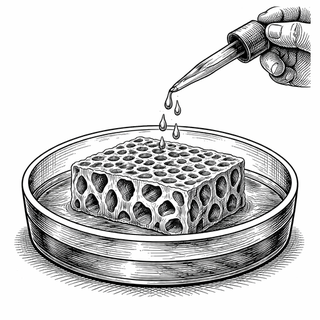
Why Anyone Bothers Drying Sponges the Cheap Way
There are reliable ways to dry a porous structure without wrecking it. Freeze-drying is the industry's favorite: freeze the water solid, then sublimate it away so it never forms those destructive liquid-air interfaces. It works beautifully. It also costs a fortune in energy, runs slowly, and ties up expensive equipment that the accounting department remembers every quarter.
Ambient pressure drying (APD) is the budget option, and the researchers are refreshingly honest about why it matters: low energy consumption, low cost, high safety. In other words, you can make the thing without a lyophilizer the size of a refrigerator humming away for two days. The catch, of course, is the collapse problem. APD is the equivalent of air-drying a delicate pastry on the counter instead of using a temperature-controlled proofing chamber. Cheaper, yes. But physics is waiting to ruin your day.
The Ethanol Swap, or How to Defuse a Capillary
Here is where the work gets clever. The force that crushes the pores during drying is capillary force, and capillary force scales directly with the surface tension of whatever liquid is evaporating. Water has notoriously high surface tension. It is the overachiever of solvents, clinging and pulling and generally making life hard.
So before drying, the team performed a solvent exchange: they coaxed the water out of the wet sponge and replaced it with ethanol, which has substantially lower surface tension. Same evaporation step, far gentler tug on the pore walls. It is a bit like swapping out a heavy cast-iron press for a sheet of parchment before you let your dough rest. The structure survives because nothing is yanking on it anymore.
That single substitution is the difference between a sponge that holds its open, sponge-like architecture and one that arrives at the operating table as a sad flat wafer.
The Recipe: Three Ingredients That Actually Like Each Other
The sponge itself, charmingly abbreviated CSSBT-APD, is a three-ingredient affair, and each one earns its place on the cutting board.
Sodium carboxymethyl cellulose (CMC) is the structural backbone. It is a cellulose derivative, water-loving, film-forming, and already a familiar face in food and pharmaceutical products. Think of it as the flour in the dough, the thing that gives the whole structure something to hold onto.
Sericin (SS) is the silk protein that usually gets thrown away during silk processing, which makes it the kind of cheap, abundant, biocompatible material that gives a procurement manager warm feelings. The study notes that CMC forms electrostatic coordination with sericin, which is the chemistry version of two ingredients binding into something more cohesive than either alone. Less a tossed salad, more an emulsion that finally comes together.
Calcium-based bentonite (ACBT) is the workhorse of the hemostatic side. Bentonite clays are the same family of minerals behind several battlefield-grade clotting agents, and they accelerate coagulation by concentrating clotting factors and activating the cascade through surface contact. It is the salt in the recipe: a little mineral that completely changes the outcome.
Does It Actually Stop Bleeding?
This is the part where a skeptical device person leans back and crosses their arms, because plenty of materials look gorgeous under a microscope and then do nothing useful when blood actually shows up.
The paper reports excellent hemostatic performance alongside excellent biocompatibility, which is the combination that matters. A hemostatic material has two jobs that are weirdly in tension. It has to be aggressive enough to trigger rapid clotting, but gentle enough that it does not irritate, inflame, or poison the tissue it is pressed against. A material that stops bleeding but causes a nasty foreign-body response has simply traded one problem for another.
The mineral clay supplies the clotting punch. The porous architecture, the one we fought so hard to preserve, supplies the surface area and the absorbency, wicking up blood and concentrating the cells and proteins where the clot needs to form. And the protein-polysaccharide matrix of sericin and CMC keeps the whole thing friendly to living tissue. Each ingredient is covering for the others' weaknesses, which is more than you can say for most committees.
Why an Engineer Should Care
Strip away the chemistry and you are left with a genuinely interesting manufacturing story. The bottleneck for a lot of promising biomaterials is not whether they work in a lab. It is whether you can make them at scale without a process that bankrupts you. Freeze-drying works, but every unit carries the cost of that slow, energy-hungry step baked in.
If ambient pressure drying can reliably produce sponges that perform as well as freeze-dried ones, the economics shift in a way that hospitals and manufacturers both notice. Cheaper production means lower per-unit cost, which means the difference between a premium product that only well-funded trauma centers stock and something that ends up in every ambulance, clinic, and first-aid kit. The solvent exchange step adds a wrinkle to the workflow, sure, and someone will have to manage ethanol handling and recovery at volume. But trading a capital-intensive drying suite for a clever chemistry tweak is the kind of bargain that gets a product to market.
It is still early. One paper, lab-stage results, and the long march through scaling, regulatory review, and real-world validation lies ahead. The road from a clever benchtop sponge to a box on a shelf is famously littered with materials that never made the trip. But the core idea here, that you can outsmart a destructive bit of physics with a low-surface-tension solvent instead of an expensive machine, is exactly the sort of pragmatic engineering that tends to survive contact with a budget.
This blog post discusses research findings and should not be taken as medical advice. If you have concerns about wound care or bleeding disorders, please consult a healthcare provider. Research discussed here represents ongoing scientific investigation and clinical validation is still in progress.
All images used in this post are decorative illustrations only and do not represent or reflect the accuracy, reality, or correctness of the referenced research.
Primary Source: Sodium carboxymethyl cellulose/sericin/calcium bentonite rapid hemostatic sponge fabricated by ambient pressure drying with excellent hemostatic performance and biocompatibility. PubMed (Record ID: 41962721). https://pubmed.ncbi.nlm.nih.gov/41962721/