
The mouse on the lab bench has a tumor that's been building its own highway system. Little blood vessels snaking out in every direction, ferrying oxygen and nutrients like a supply chain manager's fever dream. Left alone, those vessels will become the tumor's personal interstate, shipping cancer cells to the lungs, the liver, wherever they feel like setting up franchises. But today, this particular tumor is about to have a very, very bad day.
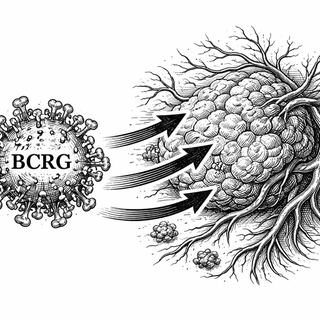
A research team has just injected it with something called BCRG - a nanoparticle roughly 145 nanometers across, built from bovine serum albumin (that's cow blood protein, for those keeping score at home). And this tiny protein bubble is about to wage a three-front war on that tumor simultaneously.
The Problem: Tumors Are Annoyingly Good at Construction
Non-small cell lung cancer (NSCLC) accounts for roughly 85% of all lung cancers, and it has a nasty habit of spreading. The mechanism is straightforward and infuriating: tumors build their own blood supply through a process called angiogenesis. Think of it as the tumor hiring its own plumbing crew. Once those new vessels are in place, cancer cells hop aboard and metastasize to distant organs like tourists on a cruise ship from hell.
The FDA has long recognized that cutting off this blood supply - anti-angiogenic therapy - is a smart move. But here's the catch: anti-angiogenic drugs alone are like cutting one head off a hydra. You stop the supply lines, great. The primary tumor is still sitting there, alive and irritated, and it'll find workarounds. That's why the FDA recommends using anti-angiogenesis alongside other treatments, not as a solo act.
Previous research identified a gene called Gli1 (glioma-associated oncogene 1) as a key player in NSCLC angiogenesis. Block Gli1, and you throw a wrench into the tumor's construction project. The drug GANT61 does exactly that. Problem solved, right?
Not quite. Getting GANT61 to the tumor without it wandering off to harass healthy tissue is like trying to mail a letter to a specific apartment in Manhattan by dropping it from a helicopter. You need a delivery system.
Enter BCRG: The Swiss Army Knife of Nanoparticles
This is where the researchers got creative. They engineered BCRG - a nanoparticle made from bovine serum albumin that does three things at once, which in medicine is roughly equivalent to finding a plumber who also does electrical work AND cooks dinner.
Job 1: Targeted Drug Delivery. BCRG carries GANT61 directly to the tumor site. The bovine serum albumin shell isn't just packaging - it's a homing device. Tumors love albumin (they're hungry, remember?), so they actively pull these nanoparticles in. Once inside, GANT61 gets to work inhibiting Gli1, which shuts down the angiogenic pathway. Specifically, it downregulates Snail and N-cadherin while upregulating E-cadherin. Translation: it reverses a process called epithelial-mesenchymal transition (EMT), which is basically how cancer cells learn to detach and travel. No EMT, no metastasis frequent-flyer miles.
Job 2: Photodynamic Tumor Killing. Here's where it gets fun. BCRG isn't just a delivery truck - it's also a light-activated bomb. Hit it with a laser, and it generates singlet oxygen, which is exactly as aggressive as it sounds. Singlet oxygen tears through tumor cell membranes like a toddler through wrapping paper. This photodynamic therapy (PDT) kills the primary tumor cells directly. No negotiations.
Job 3: Immune System Activation. The PDT doesn't just kill cancer cells - it kills them loudly. The dying cells release danger signals that trigger something called immunogenic cell death (ICD). This is the biological equivalent of a dying tumor cell screaming "OVER HERE!" to the immune system. The immune response that follows doesn't just clean up the mess - it patrols for any surviving cancer cells that might try to stage a comeback. It's like the tumor's death becomes a wanted poster for any remaining cancer cells hiding elsewhere in the body.
The Results: Three Birds, One Very Clever Stone
The team tested a library of BCRG formulations and found the sweet spot at a 1:4 component ratio, producing 145-nanometer particles. In tumor-bearing mice, the results were striking across all three fronts.
The GANT61 delivery successfully modulated the angiogenic pathway. The tumor's blood vessel construction project ground to a halt. The researchers confirmed reduced secretion of basic fibroblast growth factor (bFGF) - one of the key signals tumors use to order new blood vessels - meaning the tumor's supply requisition forms were getting shredded before they left the office.
The photodynamic component generated enough singlet oxygen under laser activation to destroy primary tumor cells directly. And the resulting immunogenic cell death kicked the immune system into gear, providing ongoing surveillance against recurrence.
The combined effect? Primary tumors killed, metastasis actively restricted, and immune memory established to prevent the tumor from pulling a sequel. In the world of cancer treatment, that's what we call the trifecta.
Why This Matters (and Why We're Not There Yet)
The elegance here isn't just in the individual mechanisms - it's in the integration. Anti-angiogenic therapy alone has limitations. PDT alone can't prevent metastasis. Immunotherapy alone may not find every tumor cell. But package all three into a single 145-nanometer protein bubble, and suddenly you've got a treatment that addresses the primary tumor, its escape routes, AND its potential for recurrence.
This is still mouse-model research, which means we're years away from human clinical trials. The jump from mouse to human is littered with the wreckage of promising therapies that didn't survive translation. Delivery efficiency, immune responses, dosing, laser penetration depth, off-target effects - the list of hurdles between "works in mice" and "works in your grandmother" is long and humbling.
But the concept is sound. The FDA has been pushing for combination therapies precisely because cancer is too resourceful for one-trick ponies. A single nanoparticle platform that combines targeted drug delivery, photodynamic therapy, and immune activation represents exactly the kind of multi-pronged approach that might actually keep up with cancer's playbook.
For now, the mice with tumors are having bad days. Hopefully, someday soon, the tumors in human patients will be having worse ones.
This blog post discusses research findings and should not be taken as medical advice. If you have concerns about lung cancer or cancer treatment, please consult a healthcare provider. Research discussed here represents ongoing scientific investigation and clinical validation is still in progress.
All images used in this post are decorative illustrations only and do not represent or reflect the accuracy, reality, or correctness of the referenced research.
Primary Source: Bovine serum albumin-stabilized nano-delivery system potentiates targeted anti-angiogenic therapy and synergistic photo-immunotherapy to restrict lung cancer metastasis. PubMed. 2026. PMID: 41937036