
You probably didn't know this, but your digestive system is less a solo act and more a contract manufacturing arrangement. A large share of what we call "healthy fiber" only becomes useful after microbes in the gut take a crack at it. Humans like to take credit, but biology has always been comfortable outsourcing. That is part of what makes hemicellulose interesting. It is a plant-derived polymer with excellent biodegradability, low toxicity, decent biocompatibility, and a long résumé in agricultural waste streams. In other words, the food industry may be sitting on a pantry staple that has been treated like packaging scrap.
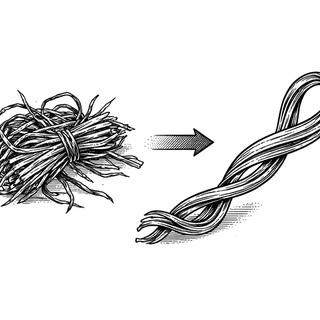
A recent review indexed in PubMed looks at exactly that problem: how hemicellulose can be extracted, modified, and turned into something more functionally valuable for food applications. The paper focuses on three broad modification routes - physical, chemical, and biological - and ties those methods to structure-activity relationships. That phrase sounds a bit like regulatory wallpaper, but it matters. With biomaterials, structure is not decoration. It is the recipe.
Why hemicellulose keeps behaving differently
Hemicellulose is not one neat ingredient. It is a family of plant polysaccharides with different sugar compositions, branching patterns, molecular weights, and degrees of polymerization depending on where it came from. Think of it less like "flour" and more like walking into five factories that all claim to make flour while one is milling wheat, one is grinding chickpeas, one is crushing oats, and one is just standing there holding bark.
That variability is the first business problem and the first scientific opportunity.
If you are designing a food ingredient for texture, stability, emulsification, or film formation, inconsistency is expensive. In medical devices we would call that a materials control headache. In food, people call it formulation trouble, batch drift, and a really unpleasant week in process development. The review makes the practical point that native hemicellulose is useful, but not always useful enough. To improve performance, you have to tune the structure.
The extraction question comes first
Before any modification happens, hemicellulose has to be extracted from agricultural or forestry biomass. That sounds simple until you remember that plants are built like old industrial insulation. Everything is tangled together with cellulose, lignin, and assorted structural chemistry designed by evolution to resist being taken apart.
Extraction methods shape the starting material. They can affect purity, molecular weight, branching, and how much of the original functionality survives the trip. That matters because every downstream modification is limited by what lands in the reactor. If the starting hemicellulose is degraded too aggressively, you may gain yield and lose value. That is the biomaterials version of turning a promising stock into soup.
This is where the engineering angle gets interesting. The food industry does not just need a technically elegant extraction method. It needs something that can survive contact with scale-up, cost pressure, solvent recovery, regulatory scrutiny, and the occasional executive who asks whether it can be "more natural" and "cheaper" at the same time. Those requests usually travel in pairs.
Three ways to modify the molecule
The review organizes hemicellulose modification into physical, chemical, and biological methods. Each route changes structure differently, which then changes performance.
Physical modification
Physical methods can alter particle behavior, solubility, and intermolecular interactions without necessarily rewriting the chemistry in a dramatic way. These approaches are often attractive because they can be simpler from a regulatory and residue standpoint. The tradeoff is that they may offer less precision or less dramatic performance gains.
Still, from an industrial perspective, physical modification has a very respectable appeal. If you can improve handling, hydration, or emulsion behavior without adding a complex reagent train, operations people will at least stop glaring at you in meetings.
Chemical modification
Chemical methods are the sharper kitchen knives. They can attach new functional groups, alter hydrophilic or hydrophobic balance, and more directly reshape how hemicellulose behaves in food systems. According to the review, these modifications can improve emulsifying ability by tuning both water-loving and oil-loving interactions.
That is a big deal. Emulsification is one of those unglamorous functions that quietly holds modern food together. If an ingredient can help stabilize mixed phases more effectively, it becomes useful in beverages, sauces, dressings, encapsulation systems, and edible films. This is not flashy science. It is infrastructure. And infrastructure is where fortunes are usually made, right after people stop calling it boring.
Biological modification
Biological methods use enzymes or microbial processes to tailor the polymer more selectively. In theory, this can offer specificity and milder conditions, which is appealing for sustainability and clean-label positioning. In practice, biology is wonderfully selective right up until it is sensitive to temperature, pH, substrate variability, and the financial patience of the company funding it.
Even so, the biological route may be one of the more strategically interesting options because it aligns with where food innovation keeps drifting: lower-toxicity processing, greener methods, and ingredient stories that sound less like a refinery and more like a fermentation kitchen.
Structure-activity relationship, minus the jargon tax
The core message of the review is that modification changes structure, and structure changes function. That should not be surprising, but it is often where promising biomaterials fall apart commercially. People like the headline, then ignore the process physics.
With hemicellulose, changes in branching, molecular weight, substitution patterns, and surface chemistry can affect solubility, viscosity, film-forming behavior, and emulsification performance. Those are not academic side notes. Those are the knobs a formulation scientist actually needs.
This matters because food systems are annoyingly specific. A polymer that works beautifully in one matrix can fail in another like an overwhipped meringue. The point is not that modified hemicellulose will become a universal ingredient. It is that targeted modification may allow manufacturers to design a more predictable function for a defined use case.
That is a much better business story than "plant fiber, but make it premium."
Where this could matter in the real world
If follow-up development holds up, modified hemicellulose could become useful across several food industry applications:
- Emulsifiers and stabilizers for complex formulations
- Texture and mouthfeel management in reduced-fat or reformulated products
- Biodegradable films and coatings for packaging or edible barriers
- Functional ingredients with improved compatibility in water-oil systems
The bigger attraction is not just functionality. It is feedstock logic. Hemicellulose comes from abundant agricultural and forestry biomass, which means the raw material story is tied to valorizing side streams and reducing waste. That gives it both sustainability appeal and supply chain appeal, assuming processing costs can be controlled and consistency can be engineered rather than wished into existence.
The catch, because there is always a catch
The review is promising, but no sensible operator should confuse "interesting platform material" with "ready for broad deployment." Source variability remains a major issue. Modification methods may improve one property while complicating another. Scale-up can be unpleasant. Regulatory acceptance depends on the chemistry and application. And food manufacturers do not adopt new ingredients because they are charming. They adopt them when performance, price, manufacturability, and labeling line up at the same table.
So the opportunity here is real, but it is not magic. It is process engineering, structure control, formulation fit, and cost discipline. Which, for those of us who spend time around biomaterials, is honestly more convincing than magic anyway.
Hemicellulose may not sound glamorous. Neither does an emulsifier line item or a polymer branching pattern. But the food industry runs on ingredients that do their job without demanding applause. This review suggests hemicellulose, once properly extracted and modified, could become one of those quiet workhorses. A lot of industrial progress looks like that. Not a Michelin tasting menu. More like finally learning what to do with the whole vegetable.
This blog post discusses research findings and should not be taken as medical advice. If you have concerns about digestive health or nutrition-related issues, please consult a healthcare provider. Research discussed here represents ongoing scientific investigation and commercial development is still in progress.
All images used in this post are decorative illustrations only and do not represent or reflect the accuracy, reality, or correctness of the referenced research.
Primary Source: Extraction and modification methods of hemicellulose, modified structure-activity relationship, and applications of modified hemicellulose in the food industry. PubMed. https://pubmed.ncbi.nlm.nih.gov/41719661/