
This research paper is about to be the most shared study in infection prevention circles, and honestly, it should make anyone who has ever touched a bedrail while wearing gloves feel a little queasy.
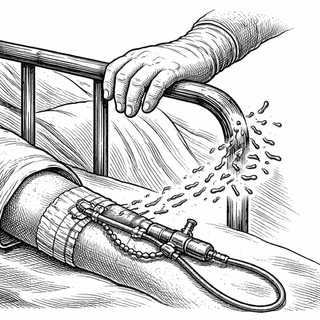
A team of researchers just demonstrated, in controlled lab conditions, that bacteria living on dry hospital surfaces can hitch a ride on healthcare workers' gloves and set up shop inside central venous catheters, urinary catheters, and endotracheal tubes. Think of it as cross-contamination in the kitchen, except instead of raw chicken juice getting on your cutting board, it's methicillin-resistant Staphylococcus aureus getting into your bloodstream hardware.
The Five-Second Rule, Hospital Edition
For years, the infection prevention world has been fixated on wet biofilms - those slimy bacterial communities that colonize the insides of medical tubing like grease buildup in a neglected deep fryer. But dry-surface biofilms (DSBs) are a different beast entirely. These are bacterial colonies that form on dry hospital surfaces - bed rails, tray tables, IV poles - and just sit there, desiccated and seemingly harmless, like forgotten spices in the back of a cabinet.
Previous research had established that DSBs exist and that they're surprisingly resistant to standard cleaning and disinfection protocols. What nobody had convincingly shown was the full transmission chain: surface to glove to invasive device to new biofilm. This study (Feuillolay et al., 2025) built that chain link by link.
The Recipe for Disaster
The researchers used an automated model to grow monobacterial DSBs with five different bacterial species commonly implicated in healthcare-associated infections. Then they ran a simulated transmission sequence: touch the contaminated surface with sterile gloves, then handle an invasive medical device.
The devices tested were the holy trinity of hospital-acquired infection sources - central venous catheters, urinary catheters, and endotracheal tubes. Essentially, the three main pipelines into places where bacteria absolutely should not be setting up a fermentation project.
Here's where it gets interesting. MRSA was the overachiever of the group, successfully transferring from both dry and rehydrated biofilms to every single device type. That bacterium treats glove-mediated transmission like a buffet line - it will jump at any opportunity regardless of how dry the source material is. The other bacterial isolates were pickier, mostly only making the journey when their biofilms were rehydrated first and primarily landing on central catheters and endotracheal tubes.
The Zombie Bacteria Problem
The most unsettling finding involves Pseudomonas aeruginosa. In every DSB the researchers produced, P. aeruginosa showed up as non-culturable on standard growth media. By traditional microbiology standards, these bacteria would be classified as dead - the equivalent of declaring a sourdough starter deceased because it didn't bubble when you poked it.
But here's the thing. When those DSBs were rehydrated and the transmission sequence was run, P. aeruginosa successfully transferred to endotracheal tubes and urinary catheters. Live/Dead staining confirmed these supposedly dead bacteria were actually alive. They were in a viable but non-culturable (VBNC) state - metabolically active but refusing to grow on standard culture plates, like a dormant yeast that just needs the right conditions to wake up and start causing trouble.
This has massive implications for how hospitals assess surface contamination. If your quality control program relies solely on surface swabbing and culture, you could be looking at a "clean" surface that's actually harboring a sleeping army of Pseudomonas. Your test says the kitchen is spotless, but there's mold behind the refrigerator.
Rehydration: Just Add Water (and Regret)
A consistent thread through the findings is that rehydration acts as a bacterial activator. Dry biofilms are bad. Wet biofilms are worse. But dry biofilms that get wet might be the worst of all, because they combine the environmental persistence of desiccation with the transferability of hydration.
Think about what rehydrates a dry hospital surface in practice: a damp cleaning cloth that isn't disinfecting properly, a patient's sweat, condensation, spilled fluids. The study suggests that well-intentioned but inadequate cleaning could actually make things worse by rehydrating DSBs just enough to mobilize their bacterial cargo without actually killing anything. It's the infection prevention equivalent of deglazing a pan - you're not removing the fond, you're just making it easier to spread around.
What This Means for Device Design and Infection Control
From a medical device engineering standpoint, this research adds another variable to the biocompatibility and contamination risk equation. Antimicrobial coatings and catheter surface treatments have traditionally been designed to resist colonization from bacteria already in the patient or in fluids. The DSB-to-device transmission pathway suggests we also need to think about external contamination during handling and insertion.
For infection prevention teams, the VBNC finding is a bitter pill. Standard environmental monitoring may be systematically underestimating surface contamination. Molecular methods like PCR or viability staining could supplement culture-based assessments, but they come with their own cost and complexity baggage.
The practical takeaway isn't revolutionary - it's a reinforcement of what we already know but frequently undercook: hand hygiene, proper glove protocols, evidence-based disinfection of surfaces, and aseptic technique during device insertion. The study just provides a more detailed map of why these practices matter, down to the bacterial species level.
The Bottom Line
This is an in vitro study, so we're still a few steps away from definitive clinical proof that DSB-to-device transmission causes infections in actual patients. But the mechanistic plausibility is strong, and the VBNC angle opens a can of worms that infection preventionists will be sorting through for years. Sometimes the most dangerous ingredient in the kitchen is the one you can't see or smell - and in this case, it's the one that doesn't even show up on the culture plate.
This blog post discusses research findings and should not be taken as medical advice. If you have concerns about healthcare-associated infections, please consult a healthcare provider. Research discussed here represents ongoing scientific investigation and clinical validation is still in progress.
All images used in this post are decorative illustrations only and do not represent or reflect the accuracy, reality, or correctness of the referenced research.
Primary Source: Feuillolay et al. From one biofilm to another: when bacteria from dry-surface biofilms settle in invasive medical devices. PubMed. 2025. DOI: PMID 41692224