
Some research programs grind forward because somebody in a lab refuses to accept an annoying fact of life. In this case, the annoying fact is that bacteria can hide inside our own cells, where many antibiotics perform like a perfectly good dinner left cooling on the counter instead of reaching the table. The paper behind PubMed record 41841526 takes aim at that problem with a practical twist: not a brand-new antibiotic, but a redesigned delivery format for ciprofloxacin, linked to a polymer and targeted with iron(III).
The Problem Is Not Always the Drug
That distinction matters.
When people talk about antibiotic innovation, the conversation usually jumps straight to discovering exotic new compounds. Fair enough. Multidrug resistance is real, expensive, and increasingly rude. But there is another lane in the road: taking an existing antibiotic and making it better at reaching the place where the bacteria actually are.
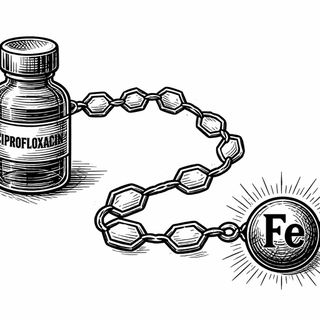
Intracellular bacterial infections are a good example of why delivery matters. Some bacteria do not politely remain out in the open where drugs can find them. They tuck themselves inside host cells, which complicates treatment in at least two ways. First, the antibiotic has to get into the right cells in meaningful amounts. Second, it still has to stay active once it gets there. That turns a straightforward chemistry problem into a supply-chain problem with membranes, trafficking, and biological toll booths.
From an engineering standpoint, this is familiar territory. Plenty of technologies fail not because the payload is useless, but because the payload never arrives in working order at the right address.
What This Study Appears to Change
Based on the paper title and summary, the researchers developed ciprofloxacin-polymer conjugates targeted with iron(III) to improve treatment of intracellular bacterial infections.
There are three moving parts in that phrase.
First, ciprofloxacin is the antibiotic. It is well known, clinically established, and hardly a shiny new toy. That is not a weakness. In development terms, reworking a known active compound can be a smarter bet than starting from scratch with a molecule that still needs its entire biography written.
Second, polymer conjugates suggest the drug was chemically linked to a larger carrier system. Polymer-drug conjugates are often explored to change how a drug distributes, how long it circulates, or how efficiently it enters cells. In plain English, this is less about inventing a new bullet and more about redesigning the casing, guidance system, and shipping route.
Third, iron(III) targeting is the intriguing garnish on the plate. Iron is biologically valuable, and bacteria are famously motivated to acquire it. Targeting strategies involving iron can, in principle, exploit that appetite or influence how the construct interacts with infected environments and cellular uptake pathways. Without the full paper, I would be careful not to over-specify the exact mechanism. But the broad idea is clear enough: make the antibiotic construct more attractive, more deliverable, or more locally effective where intracellular pathogens are causing trouble.
Why This Is Interesting Beyond the Chemistry
The medical device industry has a habit of teaching one very reusable lesson: performance in a controlled system is not the same as performance in the mess of real biology. An elegant sensor that cannot survive workflow is just expensive décor. Antibiotics have a similar problem. Potency in a dish is nice. Potency where infected human cells, immune responses, and bacterial survival tactics are all in play is the real exam.
That is why this paper is interesting.
It shifts attention from the usual headline question, "Do we have a stronger antibiotic?" to a more operational one, "Can we get a useful antibiotic to the right compartment in a better format?" In business terms, this is optimization of an existing asset rather than greenfield discovery. Investors, translational teams, and hospital buyers all understand that logic. If you can improve effectiveness, reduce dosing burden, or revive value in a known agent, that is often a more realistic development path than trying to discover the next miracle compound in a scientific haystack.
It is not glamorous, but neither is sterile processing, and yet everyone gets very interested when that goes wrong.
Why Intracellular Infections Are Such a Nasty Target
Bacteria living inside cells are difficult customers. They are insulated by the host cell membrane, may occupy specialized intracellular compartments, and can persist in ways that frustrate standard treatment. That matters because even a respectable antibiotic may underperform if its intracellular penetration is limited or inconsistent.
So the practical challenge is not just bacterial resistance in the classic sense. It is also biological access.
That makes targeted conjugates appealing. A well-designed conjugate can potentially alter uptake, distribution, and local concentration in ways free drug cannot. If the iron(III)-targeted polymer system truly improves intracellular delivery of ciprofloxacin, the payoff could be significant. Better intracellular exposure could mean better bacterial killing, possibly with more efficient use of an existing antibiotic platform.
That is the sort of quiet engineering gain that ends up mattering a great deal. Nobody throws a parade for improved pharmacologic logistics, but hospitals tend to appreciate results more than fireworks.
The Real-World Upside, If Follow-Up Work Holds Up
If this line of work continues to perform well, it could open a useful playbook for anti-infective development.
One possibility is a platform approach. If polymer conjugation and metal-based targeting can be tuned successfully, the same design logic might be adapted for other antibiotics or other hard-to-reach infection settings. That is the kind of translational leverage teams like to see. A single clever formulation is interesting. A repeatable delivery strategy is where people start sharpening pencils and discussing manufacturing.
Another upside is life-cycle extension for known drugs. Ciprofloxacin is familiar territory. Reformulating or retargeting established agents can sometimes shorten part of the development burden compared with completely novel therapeutics, though no one should pretend it becomes easy. New formulations still have to prove safety, stability, manufacturability, and actual clinical value. Biology always sends an invoice.
Still, from a portfolio perspective, this is attractive. It treats antibiotic innovation as a systems problem, not just a molecule problem.
The Skeptical Part, Which Every Good Program Needs
Promising concept does not equal finished product.
For a strategy like this to move beyond an elegant paper, several questions matter. Can the conjugate be manufactured reproducibly at scale? Does the targeting behave consistently in complex biological settings? What does the safety profile look like once you attach ciprofloxacin to a polymer and add iron(III)-based targeting? Does improved intracellular activity translate into meaningful benefit in animal models and, eventually, patients?
And then there is the usual translational obstacle course: formulation stability, regulatory strategy, cost of goods, and whether the final product is better enough to justify adoption. Science can make a lovely sauce, but reimbursement still wants to know what is on the plate.
The Bottom Line
This study is compelling because it treats antibiotic failure like an engineering problem that can be redesigned. Rather than betting everything on discovering a brand-new antibacterial compound, the researchers appear to have reworked ciprofloxacin into a polymer-linked, iron(III)-targeted construct aimed at intracellular infections, where standard drug delivery can fall short.
That is a smart direction. Multidrug resistance is forcing the field to be less romantic and more practical. Better delivery, better targeting, and better intracellular reach may not sound as cinematic as a miracle new drug, but they may prove more useful. And in healthcare, useful tends to age better than flashy.
This blog post discusses research findings and should not be taken as medical advice. If you have concerns about bacterial infections or antibiotic treatment, please consult a healthcare provider. Research discussed here represents ongoing scientific investigation and clinical validation is still in progress.
All images used in this post are decorative illustrations only and do not represent or reflect the accuracy, reality, or correctness of the referenced research.
Primary Source: PubMed Record 41841526. Ciprofloxacin-polymer conjugates targeted with iron(III) for effective treatment of intracellular bacterial infections. PubMed