
Forecast for biomedical engineering: breakthrough with a chance of controversy. The headline act is ethanol, but not in its usual role as a bad conference decision. In this paper, ethanol gets frozen, cross-linked, and turned into intricate 3D microstructures for biomedical use. That sounds a little like molecular gastronomy wandered into a cleanroom and refused to leave, but the technical point is serious: a renewable, relatively low-toxicity starting material may be able to support both cell growth and implantable neurostimulation applications.
That combination is what makes this study interesting. Plenty of materials look promising in one lane. Some are easy to fabricate but biologically fussy. Some behave nicely around cells but are miserable from a manufacturing standpoint. Some work in vitro and then fall apart when asked to survive contact with real tissue, water, sterilization logic, and the rest of the medical device gauntlet. This work tries to plate all three courses at once: fabrication, mechanics, and biocompatibility.
What the researchers actually built
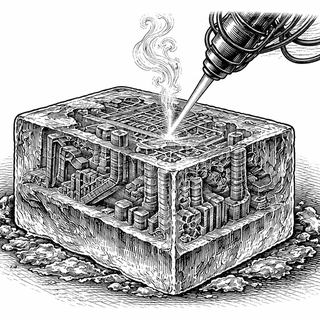
The platform here is 3D ice lithography, or 3DIL, an electron-beam direct-write process that uses frozen precursor materials to create fine 3D structures. In plain English, you start with something frozen, write into it with an electron beam, and end up with a patterned carbon-based material after processing. The novelty in this paper is using ethanol as that precursor for biomedical microdevices.
That matters because precursor choice is not an academic footnote. In device development, feedstock chemistry has a way of showing up later in all the expensive places: toxicology, process reproducibility, supply chain, regulatory messaging, and manufacturing scale-up. If your raw material story sounds like a hazmat training module, your downstream life gets harder. Ethanol, by contrast, gives you a cleaner narrative out of the gate. Renewable. Lower toxicity. Familiar industrial handling. Not magical, but practical.
The structures produced here were porous microarchitectures made from cross-linked ethanol-derived amorphous carbon. The authors also report that the material can be graphitized in a controlled way with annealing at 1300 degrees C. That does not mean every future product will want a 1300 degree C bake, of course. It does mean the platform has tunability, and tunability is often where a lab curiosity starts looking like a toolbox.
Why engineers should care about the material properties
One of the more useful data points in the paper is the nanoindentation result. The material showed a Young's modulus in the range of 2 to 4 GPa, which the authors note is comparable to biocompatible polymers. For anyone building implantable or cell-facing structures, this is the part where the room stops nodding politely and starts paying attention.
Mechanical mismatch is one of those unglamorous failure modes that keeps showing up like undercooked chicken at a summer cookout. A material can be chemically acceptable and still behave badly because it is too stiff, too brittle, or too unstable in a wet biological environment. Here, the ethanol-derived scaffolds appear mechanically credible and stable in water, which is exactly the sort of sentence investors and development teams both like to hear, for different reasons.
The paper also reports endothelial cell adhesion and proliferation with high confluency on these scaffolds in vitro. That is a meaningful early indicator for tissue-engineering relevance. Not proof of commercial readiness, obviously. Cells behaving well on a scaffold is a first date, not a 20-year marriage. Still, it clears an important early screen.
The brain implant angle is where things get spicy
The in vivo portion is where this study moves from "interesting materials paper" to "keep this on the watchlist." The researchers patterned neurostimulation electrodes using 3DIL and implanted them in mouse brains. They found no significant increase in astrocytic or microglial activation, which suggests a favorable biocompatibility profile in the brain.
In the implant business, that is not a trivial checkbox. Neural interfaces live under unusually harsh scrutiny because the target tissue is unforgiving, the performance requirements are high, and the tolerance for inflammatory trouble is low. A material that can be directly written into fine electrode structures and then avoid obvious immune escalation in vivo has real strategic appeal.
There is also a manufacturing subtext here that should not be missed. Direct-write fabrication can be slow, yes, and nobody should pretend otherwise. It is not the industrial equivalent of pouring pancake batter onto a griddle and feeding millions. But for rapid prototyping, custom geometries, low-volume specialized devices, and research tools, direct-write methods can make economic sense long before they make mass-market sense. Medical devices are full of markets where "small but valuable" beats "large but commodity" every day of the week.
Transparent substrates and other quietly important details
Another notable feature is the reported use of optically transparent substrates along with patterned neurostimulation electrodes. That may sound like a side dish, but it has obvious implications for combined optical and electrical research systems, especially in neuroscience. If you can stimulate and observe in a compatible platform, you reduce the number of awkward workarounds researchers usually have to stack together like a Jenga tower in a vibration lab.
This is where I get a little skeptical in the useful way. A promising fabrication method is not yet a product strategy. The field still needs answers on repeatability, long-term implantation behavior, sterility workflows, packaging integration, electrical performance over time, and whether this process can be translated without turning every device into an artisanal one-off. Charming in a bakery, less charming in quality systems.
What this could mean in the real world
If follow-up development goes well, ethanol-based 3DIL could find a place in microstructured scaffolds, neural interfaces, lab-on-chip systems, and other biomedical devices that benefit from precise 3D geometry and water-stable, biocompatible carbon materials. The renewable precursor angle also fits the growing appetite for cleaner materials stories in medtech, even if nobody gets regulatory clearance merely for having a nice sustainability slide.
The deeper value proposition is flexibility. A direct-write approach using a relatively accessible precursor could shorten iteration cycles for advanced biomedical microdevices. That matters because early-stage device development is often less like elegant engineering and more like reducing a sauce without letting it burn. Faster iteration means faster learning, and faster learning is usually what separates a platform from a press release.
So yes, this paper has some real sizzle. Not because ethanol is trendy, and not because every carbon scaffold deserves a parade. It has sizzle because it connects material choice, manufacturability, and biological performance in a way that could be useful if the next rounds of work hold up. In this industry, that is about as close as we get to romance.
This blog post discusses research findings and should not be taken as medical advice. If you have concerns about neurological disorders, implantable devices, or tissue-engineering treatments, please consult a healthcare provider. Research discussed here represents ongoing scientific investigation and clinical validation is still in progress.
All images used in this post are decorative illustrations only and do not represent or reflect the accuracy, reality, or correctness of the referenced research.
Primary Source: Solid Ethanol as a Renewable, Low-Toxicity, Electron-Beam Direct Write, and Biomedical Material. PubMed record 42037366. PubMed link