
"Titanium," said the first engineer, slapping the table. "You want a bone implant that lasts? You want it strong? Titanium. It's been holding people together since before you were born."
"That's the problem," said the second engineer. "It never leaves. It's the houseguest who said they'd stay a weekend and is now arguing with you about the thermostat. The bone heals around it and then has to live with it forever."
This argument, more or less, is the whole drama of orthopedic biomaterials, and a recent study published in 2026 has thrown a genuinely interesting plot twist into the third act. The hero of this story is a magnesium alloy with the very Star Wars droid-sounding name WZM211, shaped into fluorine-coated fibres, and its superpower is that it does its job and then biodegrades. It builds the bone back up and then, like a good mentor character, fades away once the protagonist can stand on their own.
The Goldilocks Problem of Holding Bones Together
Here is the engineering headache that makes bone implants so tricky. Your bone is alive. It constantly remodels itself based on the loads it feels, a principle called Wolff's law. When you bolt a chunk of permanent metal next to it, that metal is far stiffer than bone and hogs all the mechanical stress. The neighboring bone, sensing it has nothing to do, gets lazy and starts thinning out. Engineers call this "stress shielding." I call it the bone equivalent of a coworker who does all your work for you until you forget how to do it yourself.
Magnesium sidesteps this because its elastic modulus, which is basically a measure of stiffness, sits much closer to actual bone than titanium or steel do. So the load gets shared more fairly. The bone keeps working, keeps remodeling, keeps being bone. And because magnesium dissolves harmlessly in the body over time, there is no permanent freeloader left behind, and no second surgery to remove hardware.
The catch, historically, is that pure magnesium can corrode too enthusiastically, fizzing away and releasing hydrogen gas before the bone is ready to take over. It is a bit like the self-destruct sequence starting before the crew has reached the escape pods. The trick is tuning the alloy and its coating so the degradation happens at exactly the right tempo. That fluorine coating on the WZM211 fibres is the dimmer switch on that timing.
A Critical-Sized Defect, Which Is As Serious As It Sounds
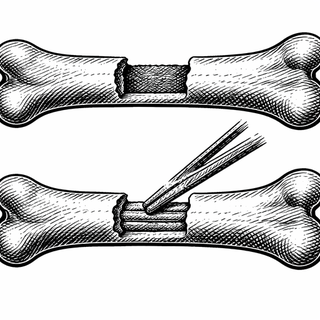
To test this, the researchers used what is called a critical-sized defect in a dog model. A critical-sized defect is a hole in the bone so large it will not heal on its own, no matter how patient you are. Left alone, it just stays a gap. This is the bone-healing equivalent of the impossible mission, the one where everyone says it cannot be done in the briefing scene.
They implanted the magnesium fibres into these defects and then watched what happened at 4, 8, and 16 weeks using high-resolution X-ray computed tomography, which is essentially a very fancy CT scanner that can image bone microstructure in stunning detail. They ran a proper three-way contest: the magnesium fibres versus a commercially available bovine bone graft (think of it as the established veteran in the field) versus empty defects that got no help at all (the control group, valiantly representing what happens when you do nothing).
The Magnesium Won, and Not By a Little
This is where the numbers get fun. By 16 weeks, the researchers measured how much of the defect volume had filled in with new bone, a metric called bone volume fraction. The magnesium fibres hit 0.77, meaning roughly three-quarters of the space had become bone. The empty controls reached 0.53, and the bovine bone graft, the supposed veteran, came in at 0.45.
Read that again, because it is the surprising part. The magnesium not only beat doing nothing, it comfortably outperformed the commercial graft that is actually used in clinics. The new bone grew in so well, and the magnesium fibres integrated so tightly and evenly with the surrounding tissue, that the defect was completely restored. The bone and the implant fused into one continuous structure rather than the implant sitting there like an awkward insert.
The newly formed bone was also genuinely maturing, not just filler. It showed increasing mineralization, around 541 mg of hydroxyapatite per cubic centimeter, hydroxyapatite being the calcium-phosphate mineral that gives bone its hardness. Higher mineralization means the new bone was hardening into the real, load-bearing thing, not staying soft and provisional.
Proving It Could Actually Take a Beating
Growing bone is one thing. Growing bone that can survive being walked on is another. So the team brought out a technique called digital volume correlation, which is one of those tools that sounds like background dialogue in a heist movie but is wildly clever. You take CT scans of the bone before and during a controlled load, then track how every tiny internal speck shifts. From those shifts you can map the strain and stress throughout the structure without ever cutting it open. It is full-field mechanical testing of the bone's actual interior, which is about as close to having X-ray vision as a lab gets.
This mattered because it confirmed the regenerated bone was not just present but mechanically sound. The whole point of an implant is to provide support while the body rebuilds, and these results suggest the magnesium fibres pulled off both jobs at once: scaffolding the repair and degrading on a schedule that let real bone inherit the load.
Why You Might Care Even If Your Bones Are Fine
Big bone defects from trauma, tumor removal, or infection are some of the hardest problems in orthopedics, and current fixes often mean grafts harvested from the patient's own body (painful, limited supply) or donor and animal grafts (which, per this study, the magnesium just outperformed). A degradable implant that beats the existing graft, restores the defect completely, and never needs a removal surgery would be a meaningful upgrade for a lot of people facing a long road of reconstruction.
This is animal-model research, so the usual sequel disclaimer applies: large-animal success is a strong signal but not a guarantee that human trials will follow the same script. Still, as far as proof-of-concept goes, watching a dissolving magnesium fibre out-build a commercial bone graft is the kind of result that makes the next chapter genuinely worth waiting for.
This blog post discusses research findings and should not be taken as medical advice. If you have concerns about bone injuries, fractures, or orthopedic conditions, please consult a healthcare provider. Research discussed here represents ongoing scientific investigation and clinical validation is still in progress.
All images used in this post are decorative illustrations only and do not represent or reflect the accuracy, reality, or correctness of the referenced research.
Primary Source: Improved in vivo bone regeneration and mechanical stability in critical-sized defects using WZM211 fluorine coated fibres. PubMed. 2026. PMID: 42061484