
The crowd is on its feet, the clock is winding down, and mesenchymal stem cells have once again fumbled the ball somewhere between the bloodstream and the injured liver. Enter a new contender: a modular protein-nucleic acid nanodevice designed to coach these cells all the way to fibrotic tissue and get them to stick the landing. If regenerative medicine has sometimes looked like a team full of gifted athletes who cannot find the stadium, this paper is an attempt to hand them a map, a jersey, and perhaps a very aggressive GPS.
The basic problem: good cells, bad navigation
Mesenchymal stem cells, often shortened to MSCs, have long been one of regenerative medicine’s favorite prospects. They can influence inflammation, support tissue repair, and generally behave like the competent consultants every damaged organ wishes it had hired sooner. The trouble is less what they can do and more whether they ever arrive where they are needed.
That has been a recurring frustration in cell therapy. You can infuse helpful cells into the body, but many of them do not home efficiently to the site of injury. They circulate, drift, get trapped elsewhere, or simply fail to accumulate in meaningful numbers where the pathology is worst. It is a bit ironic: modern biomedicine can prepare exquisitely sophisticated therapeutic cells, then watch them struggle with the biological equivalent of finding parking downtown.
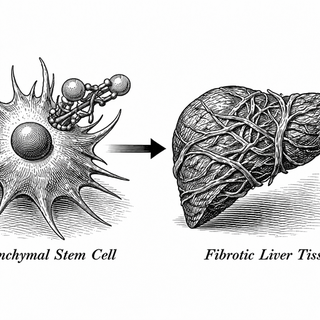
This study focuses on liver fibrosis, a condition in which repeated liver injury leads to excess scar-like material building up in the organ. A major component of that scarred environment is collagen, especially collagen-rich extracellular matrix that piles up where normal liver architecture is being replaced by fibrosis. If you wanted a targeting beacon, pathological collagen is a pretty sensible one.
What the researchers built
The authors describe a modular protein-nucleic acid nanodevice used for non-genetic engineering of MSCs. That phrase matters.
Non-genetic engineering means the researchers are trying to modify the behavior of the cells without altering their DNA. In a field where “let’s reprogram the cells” can quickly become “let’s create an entire regulatory headache,” avoiding permanent genetic modification has obvious appeal. The goal here is to give MSCs better targeting ability while preserving their fundamental properties, including what stem cell researchers call “stemness,” meaning the traits that make these cells useful in the first place.
The device has two main parts:
- A multifunctional fusion protein that can bind collagen and can also be covalently linked to DNA using click chemistry.
- A DNA nanostructure that binds specifically to MSCs.
Put together, this system effectively decorates the surface of MSCs with a collagen-seeking module. The cells are not rewritten from the inside. They are outfitted from the outside. Think less “genetic overhaul” and more “molecular Velcro, but make it elegant.”
Why collagen is the target
In liver fibrosis, collagen is not just present. It is part of the problem. Fibrotic tissue becomes packed with abnormal extracellular matrix, including collagen I. That makes collagen a practical marker of diseased tissue and, in this paper, a docking site.
The researchers appear to have optimized the collagen-binding domain to improve affinity for collagen I. That detail may sound technical, but it is actually the whole game. If MSCs can be directed toward the very scaffold that marks fibrotic injury, they may accumulate more effectively in the places where repair signals are needed.
This is the kind of strategy I find genuinely appealing because it is not pretending biology is neat. It is using the scar itself as the address label.
Why this is interesting beyond liver disease
The real intrigue here is not only the liver application. It is the platform logic.
A modular nanodevice suggests flexibility. One part grabs the target. Another part associates with the therapeutic cell. If that architecture is robust, researchers could, in principle, swap modules in and out depending on the tissue, disease, or cell type. Today it is fibrotic liver and collagen-rich tissue. Tomorrow, perhaps a different matrix protein, a different diseased organ, or a different cell-based therapy.
That modularity is catnip for translational researchers, because it hints at a repeatable strategy rather than a one-off trick. Medicine loves the phrase “platform technology” almost as much as hospital administrators love the phrase “operational efficiency,” but every now and then the label is deserved.
What challenge this paper is really tackling
At heart, this paper addresses one of the least glamorous and most stubborn barriers in regenerative medicine: delivery.
A therapy does not fail only because the biology is weak. It can fail because it never reaches the right place in adequate amounts. In that sense, this study belongs to a very practical branch of biomedical science. It is asking not, “Can MSCs help?” but, “Can we stop wasting their potential by sending them into the body with no decent targeting plan?”
That is a more serious problem than it sounds. Poor homing can reduce efficacy, increase variability, and muddy interpretation of results. If a cell therapy underperforms, is the concept bad, or did the cells simply not get where they needed to go? Those are very different disappointments.
By building a non-genetic targeting system, the authors are trying to solve that problem without compromising the cells themselves. That balancing act matters. You want better adhesion to diseased tissue, but not at the cost of damaging viability or altering the properties that made MSCs attractive in the first place.
What this could mean in the real world
If follow-up work holds up, a strategy like this could make cell therapies more efficient and more predictable. Better homing to fibrotic tissue could mean lower required doses, stronger local effects, and a clearer path toward therapeutic benefit. For patients with liver fibrosis, where treatment options can be limited and progression can be devastating, that possibility is not trivial.
More broadly, targeted cell-surface engineering could help bridge the gap between exciting cell therapy concepts and their very messy in vivo performance. The lab bench has never had trouble producing beautiful ideas. The bloodstream, by contrast, is where beautiful ideas go to be mugged by reality.
That said, this is still research, not a ready-made therapy. Promising targeting is not the same as proven clinical benefit. The important next questions are the unglamorous ones: How durable is the modification? How safe is it? Does it behave consistently across different MSC preparations? Does better homing translate into better liver function and better outcomes, not just prettier images and more satisfying biodistribution graphs?
The bigger picture
What I like most about this paper is that it shows a mature instinct about translational medicine. Rather than treating stem cells as magical free agents who will naturally sprint to the correct organ and heal what they find there, the researchers assume the obvious: biology needs help with logistics.
That may not sound romantic, but it is how useful therapies are built. Not by admiring the potential of a cell in isolation, but by solving the annoying practical problems that keep the potential from becoming treatment.
And yes, there is something deliciously ironic about using a tiny engineered protein-DNA device to make a sophisticated stem cell do something as basic as show up at the correct address. But medicine is often like that. The future arrives wrapped in nanotechnology, only to spend most of its time fixing traffic flow.
This blog post discusses research findings and should not be taken as medical advice. If you have concerns about liver fibrosis or chronic liver disease, please consult a healthcare provider. Research discussed here represents ongoing scientific investigation and clinical validation is still in progress.
All images used in this post are decorative illustrations only and do not represent or reflect the accuracy, reality, or correctness of the referenced research.
Primary Source: PubMed Record 42010596. A modular protein-nucleic acid nanodevice for non-genetic engineering of mesenchymal stem cells to target pathological collagen in liver fibrosis. Available at: https://pubmed.ncbi.nlm.nih.gov/42010596/