
Your nose has a secret, and scientists just figured it out. Well, sort of. Your nose can detect a single molecule of certain scents among billions of others. For decades, engineers have been trying to build diagnostic tools that come even close to that kind of molecular selectivity. And now, a team of researchers may have cracked the code using something deceptively simple: aluminum with billions of incredibly tiny holes in it, dressed up with molecular "gates" that only open for the right guest.
Welcome to the world of gated nanoporous anodic alumina test strips, a technology that sounds like it belongs in a sci-fi lab but could soon end up in your medicine cabinet.
What on Earth Is Nanoporous Anodic Alumina?
Imagine taking a sheet of aluminum and running a carefully controlled electrical current through it in an acid bath. What you get is a material riddled with perfectly ordered nanoscale pores - channels so small that roughly 700 of them could fit across the width of a single human hair. This material is called nanoporous anodic alumina (NAA), and researchers have been fascinated by it for years because of its massive surface area and tunable pore sizes.
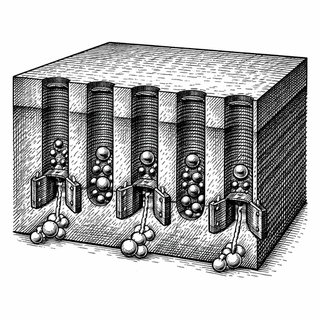
But here is where things get really clever. On their own, these nanopores are just empty tunnels. The magic happens when you install molecular "gates" at the entrance of each pore. Think of it like a bouncer at a very exclusive, very microscopic nightclub. These gates are designed to recognize one specific molecule and only that molecule. When the target shows up, the gates swing open, triggering a detectable signal. Everything else gets turned away at the door.
Why Do We Need Better Test Strips?
Here is a question worth asking: if we already have lateral flow assays (the technology behind home pregnancy tests and COVID rapid tests), why bother reinventing the test strip?
The honest answer is that current rapid tests, while convenient, have some well-known blind spots. They can struggle with sensitivity at low concentrations, meaning they sometimes miss what they are looking for when it matters most. They also tend to give binary yes-or-no answers rather than telling you how much of something is present. For conditions where the concentration of a biomarker matters - think early-stage infections, hormone fluctuations, or environmental toxin exposure - that quantitative information can be the difference between catching a problem early and missing it entirely.
The gated NAA approach tackles both problems head-on. The enormous surface area of the nanopores means more binding sites for target molecules, boosting sensitivity. And because the gating mechanism produces a signal proportional to how many molecular "doors" have been opened, you get quantitative readouts, not just a thumbs-up or thumbs-down.
How the Gated System Actually Works
Let's walk through this step by step, because it is genuinely elegant.
First, the nanopores are loaded with a signaling molecule - essentially a dye or fluorescent reporter trapped inside the tunnels. Then the pore entrances are capped with the molecular gates. These caps are typically made from polymers, nanoparticles, or biological molecules (like antibodies or aptamers) that are specifically chosen to recognize the target analyte.
When a sample is applied to the test strip and the target molecule is present, it interacts with the gate, causing it to open or degrade. The signaling molecules rush out of the pores like fans pouring out of a stadium after the final whistle. The amount of signal detected corresponds directly to the amount of target in the sample.
No target? The gates stay shut. The dye stays locked inside. Silence.
It is molecular hide-and-seek, and these gates are excellent seekers.
What Makes This Research Stand Out
The study published by this research team represents a meaningful step forward in translating gated NAA from a laboratory curiosity into a practical diagnostic tool. Moving from benchtop experiments to an actual test strip format is not trivial. It requires solving real-world engineering problems: How do you maintain gate stability during storage? How do you ensure the sample wicks through the material evenly? How do you make the readout simple enough for a non-specialist?
By demonstrating rapid and accurate detection in a strip format, the researchers show that this technology is inching closer to the point-of-care space where it could do the most good. Imagine a test strip that a rural clinic could use to detect low-level biomarkers without needing expensive lab equipment. Or a home test that could quantify hormone levels with precision previously reserved for hospital labs.
The Bigger Picture for Point-of-Care Diagnostics
We are living in something of a golden age for rapid diagnostics. The COVID-19 pandemic taught the world just how valuable at-home testing can be, and it exposed just how much room there is for improvement. Researchers worldwide are now racing to develop next-generation platforms that are faster, cheaper, more sensitive, and more informative.
Nanoporous materials like NAA occupy a sweet spot in this landscape. The raw material - aluminum - is abundant and inexpensive. The fabrication process, anodization, is well-established and scalable. And the gating chemistry can be adapted for virtually any target, from viral antigens to cardiac biomarkers to environmental pollutants.
Could we eventually see a single test strip platform that swaps out different molecular gates depending on what you need to detect? That is the kind of modular diagnostic dream that keeps bioengineers up at night - in a good way.
What Comes Next
As with all promising diagnostic technologies, there are hurdles remaining. Long-term stability of the molecular gates under real-world storage conditions (your bathroom shelf is not a climate-controlled lab, after all) needs further validation. Large-scale manufacturing will require optimization. And regulatory approval for any new diagnostic platform is a marathon, not a sprint.
But the foundation is solid. Nanoporous anodic alumina has been studied for over two decades, and the gating concept has been validated across multiple analyte classes. What this research adds is the practical proof that you can put this technology into a format people can actually use outside of a research lab.
And honestly? Any technology that brings lab-quality diagnostics closer to the people who need them most is worth paying attention to.
This blog post discusses research findings and should not be taken as medical advice. If you have concerns about diagnostic testing or any health condition, please consult a healthcare provider. Research discussed here represents ongoing scientific investigation and clinical validation is still in progress.
All images used in this post are decorative illustrations only and do not represent or reflect the accuracy, reality, or correctness of the referenced research.
Primary Source: Test Strips Based on Gated Nanoporous Anodic Alumina for the Rapid and Accurate Detection. PubMed. 2026. PMID: 41962006