
So this week I learned that materials scientists have been inventing ultra-thin nanomaterials faster than toxicologists can figure out whether those materials will wreck your lungs. Which, when you think about it, is a very on-brand problem for modern science: build the rocket first, then maybe check if the fuel is flammable. A team of researchers just published a paper that essentially says "hold on, let's build a better fake lung before we start inhaling the future," and honestly, it might be one of the most responsible things I've read in nanomedicine all year.
MXenes: The Wonder Material You Haven't Heard Of (Yet)
MXenes (pronounced "maxenes," because materials scientists love naming things like indie bands) are a family of two-dimensional materials - we're talking sheets of atoms just a few layers thick - made from transition metal carbides and nitrides. They've been generating enormous excitement since their discovery in 2011 because they conduct electricity, are biocompatible (allegedly), and can be tuned for all sorts of biomedical applications: drug delivery, biosensing, photothermal cancer therapy, you name it.
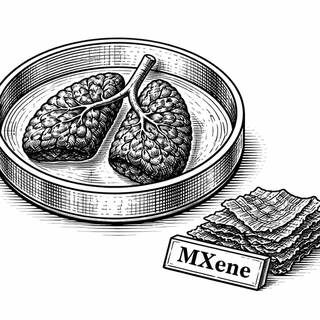
Tantalum-based MXenes, specifically Ta4C3, are particularly interesting because tantalum already has a long track record in medical implants. Your orthopedic surgeon probably has opinions about tantalum. The problem? The field has been sprinting toward clinical applications while our safety data comes almost entirely from flat, two-dimensional cell cultures - basically cells growing on a plastic dish like pancakes on a griddle. Lungs, as you may have noticed from having them, are not flat.
The Problem With Flat Cells
Here's where the regulatory nerd in me gets excited. Traditional toxicity testing grows one type of cell in a single layer on a plate, dunks it in whatever substance you're testing, and checks if the cells die. It's simple, it's cheap, and it has all the physiological relevance of testing a car's crash safety by dropping it off a table.
Real lung tissue is a three-dimensional, multi-layered ecosystem. You've got epithelial cells forming a barrier on top, fibroblasts providing structural support underneath, and immune cells (macrophages) patrolling everything like tiny, angry security guards. These cells talk to each other. They produce surfactant - that slippery stuff that keeps your alveoli from collapsing every time you exhale. They mount coordinated immune responses. None of this happens in a flat dish.
The result has been wildly inconsistent safety data for MXenes. One study says they're fine. Another says they're toxic. Nobody can agree because everyone is testing in systems that don't actually represent a human lung. From a regulatory standpoint, this is a nightmare. How do you approve something for clinical use when you can't even agree on whether it's safe?
Enter the 3D Alveolar Model
The researchers behind this study decided to fix the testing platform rather than argue about the results. They built what amounts to a miniature lung-in-a-dish using three different human cell types: A549 epithelial cells (the lung lining), MRC-5 fibroblasts (the structural scaffold), and THP-1-derived macrophages (the immune sentinels). These cells were grown together at an air-liquid interface - meaning the top of the model breathes air while the bottom sits in culture medium, just like your actual alveoli.
What happened next is genuinely cool. The three cell types self-organized into a stratified structure that the researchers call an "epithelial-mesenchymal trophic unit." In less academic terms: the cells figured out where to go and what to do on their own. The epithelial cells formed a barrier on top, the fibroblasts settled underneath, and the macrophages embedded themselves throughout - all producing functional surfactant and engaging in the kind of cell-to-cell crosstalk that makes real lung tissue actually work.
This is the biological equivalent of throwing three groups of strangers into an empty building and having them spontaneously form a functioning hospital.
Testing Tantalum MXenes the Right Way
With their miniature lung assembled, the team used it to screen tantalum-based MXenes (Ta4C3) for both therapeutic potential and pulmonary safety. The air-liquid interface setup means the nanomaterials are delivered the way they'd actually reach your lungs - through the air side - rather than being dumped into a liquid bath and hoping the physics works out.
This matters enormously for translational relevance. Nanoparticle behavior changes dramatically depending on whether particles are suspended in liquid or deposited on a wet surface from the air. Dose, distribution, cellular uptake, immune activation - all of it shifts. Testing at the air-liquid interface doesn't just look more like a real lung; it behaves more like one.
The triculture model also allows researchers to observe something flat cultures never could: how different cell types respond to the same material simultaneously. Do the epithelial cells take up the MXenes? Do the macrophages mount an inflammatory response? Do the fibroblasts start remodeling? In a single-cell-type experiment, you'd need to run three separate tests and then guess how the results interact. Here, the interaction IS the experiment.
Why This Matters for the Future of Nanomedicine Regulation
If you're wondering why anyone outside a materials science lab should care about this, consider the regulatory bottleneck. The FDA and its global counterparts need reliable safety data before nanomedicines can enter clinical trials. When the available data is contradictory because the testing methods are inadequate, everything slows down. Promising therapies sit in limbo. Potentially dangerous ones might slip through.
Better in vitro models - models that actually predict what will happen in a living human - could dramatically accelerate the regulatory pipeline. They could also reduce reliance on animal testing, which is both an ethical win and a practical one (animal lungs and human lungs don't always agree on what's toxic, as it turns out).
The 3D alveolar model described here isn't just a neat piece of tissue engineering. It's a potential standardization tool. If multiple labs adopt the same validated platform, we might finally get consistent, comparable safety data across studies. The regulatory implications of that are enormous. Consistent data means clearer safety profiles, which means faster decisions, which means therapies reaching patients sooner - or dangerous ones being flagged before they reach anyone at all.
The Bottom Line
We're in this weird transitional period where nanomedicine is exploding with possibility but our ability to evaluate safety hasn't kept pace. This study represents exactly the kind of boring-but-essential infrastructure work that makes clinical translation actually possible. Nobody's going to make a documentary about a better cell culture model. But without it, the MXene-based cancer therapy that might save your life in 2035 stays stuck in regulatory purgatory.
Sometimes the most impactful science isn't the flashy breakthrough. It's the part where someone builds a better testing platform so the flashy breakthroughs can actually be trusted.
This blog post discusses research findings and should not be taken as medical advice. If you have concerns about pulmonary health or nanomaterial exposure, please consult a healthcare provider. Research discussed here represents ongoing scientific investigation and clinical validation is still in progress.
All images used in this post are decorative illustrations only and do not represent or reflect the accuracy, reality, or correctness of the referenced research.
Primary Source: Predictive Screening of Tantalum MXenes Using an Immunocompetent 3D Alveolar Model. PubMed. 2026. PMID: 41925143