
Roughly 1 to 2 percent of joint replacements end in an infection, which sounds reassuringly small until you remember that the worldwide total runs into the millions, and that treating a single periprosthetic joint infection can cost north of $100,000 and sometimes a second surgery to dig the original hardware back out. That is a lot of money and misery riding on a number that polite presentations describe as "low." A new study on a polymer with the unpronounceable name polyether ether ketone proposes a fix that skips antibiotics entirely, which, in our current era of resistance, is the regulatory equivalent of arriving at a potluck without the dish everyone is quietly worried about.
The Problem With a Material That Is Almost Perfect
PEEK is the overachiever of orthopedic materials. It is strong, it flexes a bit like bone instead of stubbornly resisting it the way titanium does, and it is radiolucent, meaning it does not blot out X-rays and let surgeons actually see what is happening around the implant. On paper it is the ideal tenant.
The catch is that PEEK is what scientists diplomatically call "bioinert." Translated out of grant-speak, that means it does not interact with the body much at all, including the parts of the body you would actually want it to befriend. Bone cells are indifferent to it, and bacteria treat its smooth, unbothered surface like a freshly cleaned countertop at a buffet. They land, they settle, they build a biofilm, and once a biofilm forms it becomes a fortified bacterial city that shrugs off antibiotics and immune cells alike. The implant that was supposed to fix you becomes the thing harboring the problem.
The conventional answer has been to load surfaces with antibiotics or silver and hope for the best. This works, briefly. Then the drug leaches out, the reservoir empties, and the resistant bacteria send a thank-you note. It is a strategy with a built-in expiration date, and bacteria are nothing if not patient.
N-Halamines: Tiny Chemical Bouncers
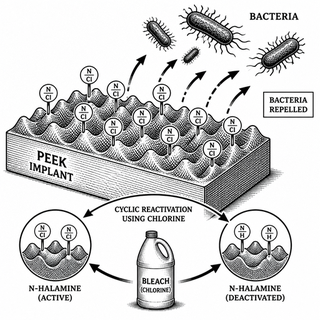
This is where the new approach gets clever. Instead of stocking the implant with a drug that gets used up, the researchers grafted molecules called N-halamines onto the PEEK surface. The short version: N-halamines hold onto chlorine in a stable chemical bond, and that bonded chlorine is murder on microbes. When a bacterium makes contact, the chlorine does its oxidative damage on the spot, no diffusion required.
The genuinely useful part is what happens next. A spent N-halamine is not a dead end. Expose the surface to a fresh source of chlorine, the kind found in ordinary household bleach, and the chemical bouncers reload. It is the difference between hiring a security guard for one shift and installing a turnstile that resets itself. The antimicrobial mechanism is structural rather than consumable, which sidesteps the entire "we ran out of drug" failure mode.
And because the killing is contact-based oxidation rather than a specific molecular target, bacteria have a much harder time evolving around it. You can mutate your way past an antibiotic that jams one enzyme. Mutating your way past "got chemically oxidized on touch" is a taller order.
Welding It On, With Light
The other half of the story is how the N-halamine actually stays put, and this is where the method earns its keep. The team used UV-induced self-initiation to covalently graft the antimicrobial polymer directly onto the PEEK. "Covalent" is the operative word here. It means the coating is chemically bonded to the surface rather than just resting on top of it like a sticker waiting to peel.
This matters enormously for a load-bearing implant, which spends its career being rubbed, flexed, and generally abused inside a moving body. A coating that wipes off during insertion or sloughs away after a few months is a coating that was never really there. By using ultraviolet light to start the reaction and stitch the polymer on, the researchers aimed for durability that survives the rough-and-tumble of real anatomy. Light-activated chemistry also has a quiet practical charm: it is reasonably clean, controllable, and does not require dunking the implant in an exotic chemical bath that a manufacturing line would dread.
The Part Where the Body Has to Agree
A surface that kills bacteria is only half a victory if it also kills the cells you are trying to keep. Plenty of antimicrobial coatings flunk this exam, being roughly as friendly to your own tissue as they are to the microbes. The study reports that the modified PEEK held onto its biocompatibility and, encouragingly, still supported bone-related biological responses. In other words, the surface discourages the wrong guests while remaining hospitable to the bone cells that need to integrate with the implant for it to do its job.
That dual result is the whole ballgame. An implant has to be antisocial toward bacteria and welcoming toward bone in the same breath, which is a personality most of us struggle to pull off in any context.
Why a Policy-Minded Reader Should Care
Step back from the chemistry and the appeal sharpens. Antibiotic resistance is one of the slowest-moving public health emergencies on the books, the kind that does not generate headlines until it generates a very bad one. Every strategy that achieves infection control without spending down our shared antibiotic budget is, in a real sense, a piece of stewardship policy disguised as a material science paper. A rechargeable, drug-free antimicrobial surface does not just protect one patient. It declines to contribute to the resistance problem that threatens all of them.
There is also the unglamorous matter of translation, the long bureaucratic march from "works in the lab" to "approved for your grandmother's hip." The authors are appropriately measured, framing this as a feasible approach that needs further optimization before it reaches clinically relevant load-bearing implants. That is the honest version, and it should be read as a promising beginning rather than a finished product. The path from a covalently grafted coating to a regulated medical device runs through years of testing, and the graveyard of clever surface modifications is well populated. Still, a method that is durable, rechargeable, and gentle on the host is exactly the sort of candidate worth shepherding through that gauntlet.
For now, file this one under "quietly important." It will not trend. It might, eventually, keep a great many people out of a second operating room, which is the kind of unglamorous win that good policy and good chemistry occasionally share.
This blog post discusses research findings and should not be taken as medical advice. If you have concerns about orthopedic implants or implant-associated infection, please consult a healthcare provider. Research discussed here represents ongoing scientific investigation and clinical validation is still in progress.
All images used in this post are decorative illustrations only and do not represent or reflect the accuracy, reality, or correctness of the referenced research.
Primary Source: Antibiotic-free antimicrobial functionalization of PEEK via UV-induced self-initiation and N-halamine grafting. PubMed. 2026. PMID: 41909162