
Good news: researchers keep building smarter tools to detect tiny biological signals before problems get loud. Bad news: biology loves being sneaky, and some of those signals are so slippery they make a toddler hiding peas under the table look subtle. This paper, focused on a dual-mode FL-SERS biosensor for hydrogen sulfide, lands right in that messy middle. It is basically an attempt to make detection more trustworthy by giving the sensor two ways to check its own homework.
Why hydrogen sulfide matters more than its smell would suggest
Hydrogen sulfide, or H2S, has a public relations problem. Most of us know it as the rotten-egg gas and would prefer it stay far away from anything involving our children, kitchens, or nostrils. But inside the body, H2S is also a signaling molecule. In plain English, that means cells can use it as a tiny chemical message.
Researchers care about H2S because abnormal levels may be linked to disease processes such as inflammation, oxidative stress, and tissue injury. When a molecule shows up around important pathways like that, scientists start asking the obvious questions: can we measure it accurately, can we track it early, and can that information eventually help guide diagnosis or treatment?
That is where this study gets interesting. Not because it promises an instant cure or a shiny miracle gadget, but because better measurement tools are often the unglamorous first step that makes later medical progress possible. Nobody throws a parade for improved biosensing, yet half of modern medicine quietly depends on it.
What this sensor is trying to do
The paper describes a dual-mode biosensor that combines fluorescence, often shortened to FL, with surface-enhanced Raman scattering, or SERS. Those are two different signal-reading methods.
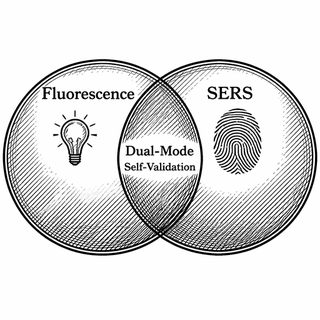
Fluorescence is the friendlier one for non-specialists. A target chemical triggers a light-based response, and the system reads that change. Think of it like a glow signal saying, "Yep, something happened."
SERS is more like a molecular fingerprint scanner. Raman signals can provide very specific chemical information, and the "surface-enhanced" part means the signal is boosted using specialized materials so very small amounts become easier to detect.
Now put those together and you get the key idea of this paper: instead of relying on one signal alone, the biosensor uses two. If both modes point in the same direction, confidence goes up. That "self-validating" feature is the real star here.
As a parent, I love anything that reduces the odds of false alarms and missed alarms. If my kid tells me the dog ate the homework, I want at least two independent witnesses. A dual-mode biosensor follows the same common-sense logic.
Why "self-validating" is a big deal
A lot of biosensing challenges boil down to one frustrating question: is the result real, or is the sensor being fooled?
Biological samples are messy. Blood, tissue fluid, and cell environments are full of molecules that can interfere with testing. Signals can drift. Background noise can creep in. A sensor can look clever in a neat lab setup and then get wobbly when real-life complexity barges in wearing muddy shoes.
A self-validating design helps tackle that problem. If fluorescence says H2S is present and SERS says the same thing, researchers have a stronger case that the reading is not random noise or a misleading artifact. That does not make the system perfect, but it does make it more believable.
And believable matters. In medicine, a test is only useful if clinicians can trust it enough to act on it. Fancy technology that cannot survive contact with reality belongs in the science-fair cabinet, not the clinic.
What could this mean in the real world?
If follow-up development goes well, a tool like this could support earlier and more reliable monitoring of H2S-related biology. That may eventually matter in research settings studying disease progression, treatment response, or cellular stress.
The immediate value is not "your pediatrician will use this next Tuesday." The immediate value is that researchers may get a sharper window into what is happening in cells and tissues. Better readouts can improve experiments, help compare patient samples more accurately, and reveal patterns that weaker tools might miss.
That can matter downstream for families, even if the first step happens far away from the exam room. A more dependable biosensor could eventually contribute to:
- Earlier detection of biologically meaningful changes
- Better tracking of disease-related signaling
- More precise research on therapies that affect H2S pathways
- Fewer misleading results caused by single-mode sensor errors
That is the boring-but-vital pipeline of medical progress. First somebody builds a better ruler. Then the field finally notices what it has been measuring badly.
The catch, because there is always a catch
This is still research. A sophisticated biosensor is not automatically a practical medical test.
To move from promising concept to real-world use, researchers still have to answer the questions that make engineers sweat and clinicians squint:
- How sensitive is it in realistic biological samples?
- How selective is it when other sulfur-containing molecules are around?
- How stable is the sensor over time?
- Can it be manufactured consistently?
- Can it work quickly enough, cheaply enough, and simply enough for broader use?
Those questions are not party decorations, but they are the difference between "interesting paper" and "useful tool."
There is also the broader issue that detecting a biomarker is not the same as knowing exactly what to do with the result. Even if H2S can be measured beautifully, medicine still needs strong evidence linking that measurement to decisions that improve outcomes.
Why this paper still deserves attention
What I like here is the mindset. Instead of pretending one signal is enough, the researchers built in a second layer of confirmation. That is a very grown-up response to a difficult measurement problem.
In pediatric medicine especially, reliability matters. Families do not need more maybes dressed up as certainty. We need tools that reduce confusion, not tools that generate prettier versions of it. A dual-mode, self-validating sensor is appealing because it aims for sturdier evidence at the point of detection.
So no, this is not the kind of paper that changes your life before lunch. But it is the kind that might make later breakthroughs more solid, more reproducible, and less likely to fall apart the moment real biology starts acting like real biology.
And honestly, that is worth respecting. Medicine has enough drama already. A sensor that double-checks itself feels less like hype and more like competence.
This blog post discusses research findings and should not be taken as medical advice. If you have concerns about health conditions linked to abnormal hydrogen sulfide signaling, please consult a healthcare provider. Research discussed here represents ongoing scientific investigation and clinical validation is still in progress.
All images used in this post are decorative illustrations only and do not represent or reflect the accuracy, reality, or correctness of the referenced research.
Primary Source: PubMed Record 41944294: Dual-Mode FL-SERS Biosensor for Self-Validating H