
Breaking news from the world of nanomedicine: researchers have built cage-shaped silicon nanostructures so small and so convincing at mimicking real enzymes that they can waltz into cancer cells, flip a molecular switch on an inactive drug, and turn it into a tumor-killing machine. No metals required. No surfactants. No committee approval for the use of fancy additives. Just silicon, amino groups, and a dash of sol-gel chemistry.
If that sounds like the nanotechnology equivalent of MacGyver building a reactor out of a paperclip and some chewing gum, well, you're not entirely wrong.
The Problem with Nature's Enzymes (and Why We Keep Trying to Replace Them)
Natural enzymes are spectacular molecular machines. They fold into intricate 3D shapes, grab specific substrates, and catalyze reactions with jaw-dropping efficiency. They are also, frankly, divas. They denature at the wrong temperature. They throw fits in non-physiological pH. They cost a fortune to produce at scale, and they have the shelf life of an avocado you bought on Monday.
Enter nanozymes: synthetic nanoparticles designed to mimic enzyme activity without all the biological drama. The nanozyme field has exploded over the past decade, with researchers engineering metal-based nanoparticles (iron oxide, cerium oxide, gold, platinum) that can replicate oxidase, peroxidase, and catalase activities. The catch? Most of these systems depend on metals, struggle with water compatibility, and have a catalytic repertoire about as diverse as a one-trick pony at a talent show.
What's been largely missing is a metal-free nanozyme that works in water, plays nicely with living cells, and can do something more exotic than basic redox chemistry. Something like, say, aldol chemistry - the kind of carbon-carbon bond-forming reaction that organic chemists normally run in flasks full of organic solvents.
Silicon Cages to the Rescue
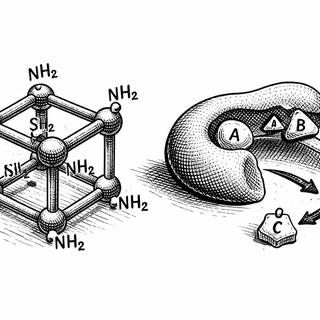
A new study published on PubMed describes a refreshingly minimalist solution. The researchers synthesized octa-amino silsesquioxanes - essentially tiny cage-like structures made of silicon, oxygen, and eight dangling amino groups - using a one-step sol-gel process. That's the kind of synthesis that doesn't require a government grant just to afford the reagents.
These ultrasmall nanostructures turned out to be remarkably water-stable and capable of catalyzing aldol reactions in water without any surfactants, phase-transfer agents, or the usual entourage of additives that organic reactions in aqueous media typically demand. For context, running aldol reactions in water is a bit like trying to mix oil and vinegar without a whisk. Enzymes called aldolases do this effortlessly in biology. Getting a synthetic, metal-free nanoparticle to pull it off? That's a neat trick.
The On-Off Switch Nobody Expected
Here's where things get genuinely clever. These nanozymes don't just catalyze reactions - they can be turned on and off.
The researchers demonstrated that specific chemical inputs trigger reversible supramolecular aggregation and disaggregation. In plain English: you can add a chemical signal that makes the nanozymes clump together (turning catalysis off) and then add another signal to break them apart (turning catalysis back on). It's stimuli-responsive, tunable, and - dare I say - almost regulation-friendly, if regulatory agencies ever figure out how to categorize "reversibly self-assembling silicon cages that pretend to be enzymes."
This kind of dynamic control is something natural enzymes achieve through allosteric regulation, and seeing it replicated in a synthetic system with this level of structural simplicity is the sort of thing that makes materials scientists quietly fist-pump at their desks.
From Flask to Cancer Cell
The real headline-grabber, though, is what happened when the researchers introduced these nanozymes into living cells. The particles showed high biocompatibility (they don't kill cells just by showing up - always a plus) and efficient cellular internalization (they actually get inside).
Once inside, the nanozymes were put to work as intracellular prodrug activators. The team designed a doxorubicin prodrug - essentially doxorubicin (a well-known chemotherapy drug) with a chemical lock on it, rendering it inactive. The nanozyme's aldolase-like activity performed a retro-aldol reaction inside the cell, snapping that lock off and releasing active doxorubicin right where it's needed.
They tested this in human glioblastoma cells (brain cancer) and metastatic melanoma cells. The result: selective cytotoxicity. The prodrug was harmless until the nanozyme activated it, meaning you could theoretically deliver an inactive drug throughout the body and only switch it on inside tumor cells that have internalized the nanozyme.
This is the holy grail of targeted drug delivery: kill the cancer, spare the bystanders. We're not there yet - this is cell culture work, not a clinical trial - but the proof of concept is genuinely exciting.
Why This Matters Beyond the Lab Bench
Let's zoom out for a second. The nanozyme field has been heavily dominated by metal-based systems. Metals bring baggage: potential toxicity, environmental concerns, supply chain issues, and regulatory headaches that would make an FDA reviewer weep. A metal-free, water-compatible, biocompatible nanozyme that can be synthesized in one step from cheap precursors? That checks boxes that health policy advocates have been drawing on whiteboards for years.
Scalability. Cost-effectiveness. Sustainability. These aren't just buzzwords - they're the bottlenecks that keep promising lab technologies from ever reaching patients. A system built on silicon-based cage compounds, synthesized through sol-gel chemistry (which has been industrial-scale for decades in other applications), sidesteps many of these obstacles.
The stimuli-responsive behavior also opens doors to programmable therapeutics - systems where drug activation can be externally controlled or triggered by the tumor microenvironment itself. If you've ever sat through a conference presentation on "smart drug delivery" and wondered when we'd actually see something that felt smart, this is a step in that direction.
What Comes Next
The obvious next steps are in vivo studies - moving from cell culture dishes to animal models to see if the nanozymes can be delivered to tumors, survive the bloodstream, and activate prodrugs with the same selectivity seen in vitro. There are also questions about biodistribution, clearance, and long-term safety that cell culture experiments simply can't answer.
But the foundation here is solid. A structurally simple, metal-free, water-stable nanozyme that does enzyme-like chemistry in living cells, with built-in on-off control, synthesized cheaply in one step. The regulatory pathway for something like this is still uncharted territory (good luck classifying it - is it a drug? A device? A catalyst? A very ambitious molecule?), but the science is the kind of building block that translates well when the translation machinery gets moving.
Sometimes the best solutions are the simplest ones. Eight amino groups on a silicon cage, and suddenly you've got a synthetic enzyme that works in water and kills cancer cells on command. Nature took billions of years to evolve aldolases. These researchers did it with a sol-gel reaction and a good idea.
This blog post discusses research findings and should not be taken as medical advice. If you have concerns about cancer treatment or nanomedicine, please consult a healthcare provider. Research discussed here represents ongoing scientific investigation and clinical validation is still in progress.
All images used in this post are decorative illustrations only and do not represent or reflect the accuracy, reality, or correctness of the referenced research.
Primary Source: Stimuli-Responsive Silsesquioxane Nanozymes for Organocatalysis in Water and Prodrug Activation in Cells. PubMed. 2026. PMID: 41937695