
Dolphins do it. Octopuses do it. Now we're learning how to do it too. Nature has long known that elegance and efficiency often arrive in curious shapes, and flowers are among its favorite tricks. So when scientists begin building tiny "nanoflowers" to tackle one of medicine's oldest annoyances - bacteria - I confess I smile a little. After a lifetime in laboratories, I have learned that when researchers borrow a good structural idea from nature, they are often onto something more interesting than mere scientific decoration.
The paper at hand, with the wonderfully vivid title Lysozyme-Modified Copper Phosphate Nanoflowers as Effective Antibacterial Agents for the Inactivation of..., points toward exactly that sort of idea. Even from the title alone, one can see the broad outline: combine a natural antibacterial protein, lysozyme, with copper phosphate in a nanoflower structure, and use the resulting material to knock out harmful bacteria. That is a tidy concept, and tidy concepts have a habit of becoming useful ones.
Why Nanoflowers?
"Nanoflower" is one of those scientific terms that sounds as though it escaped from a botany lecture and wandered into a chemistry lab. But the image is helpful. These are microscopic or nanoscale structures whose petals and layered surfaces create a large active area. In practical terms, that means more places for biological and chemical interactions to happen.
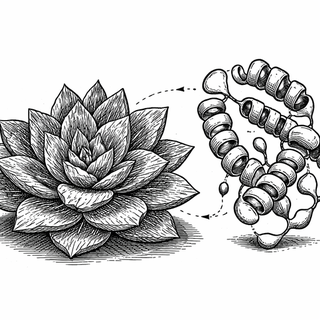
And in antibacterial work, surface area is not some fussy technical footnote. It is the whole game. The more contact a material can make with bacterial cells, the more opportunities it has to disrupt membranes, interfere with metabolism, or otherwise make microbial life rather unpleasant. If bacteria had a union, they would surely file a grievance.
A flower-like structure can also help organize several functions in one place. That matters here because this material appears to combine at least two biologically interesting pieces: copper and lysozyme.
The Old Hands in the Room: Copper and Lysozyme
Copper has been in the antimicrobial business for a very long time. Long before nanotechnology acquired its modern glamour, copper surfaces were already known to be unfriendly territory for many microbes. Copper ions can damage membranes, disturb proteins, and promote oxidative stress. In plain English, copper tends to make bacterial cells fall apart, short-circuit, or both.
Lysozyme, meanwhile, is one of nature's classic defensive tools. It is an enzyme found in places such as tears, saliva, and egg white, and it works by attacking components of bacterial cell walls. It is a beautifully economical molecule - one of those inventions of evolution that makes a chemist jealous.
So when a study modifies copper phosphate nanoflowers with lysozyme, the appeal is obvious. One can reasonably infer that the researchers hoped to create a material with both structural advantages and biological punch: a broad reactive surface, the antibacterial chemistry of copper, and the cell-wall attacking talent of lysozyme. It is a bit like hiring both a locksmith and a demolition crew.
Why This Research Is Interesting
The world does not suffer from a shortage of bacteria. It suffers from a shortage of ways to manage the troublesome ones without running into resistance, toxicity, cost, or all three before lunch.
Traditional antibiotics remain indispensable, but resistance keeps advancing with the grim persistence of weeds in a neglected garden. Materials-based antibacterial strategies offer a different approach. Instead of depending entirely on a drug that bacteria may eventually outsmart, researchers can design surfaces or particles that physically and chemically create hostile conditions for microbes.
That is why this nanoflower idea catches the eye. It suggests a strategy that is not merely "find another antibiotic," but rather "build a smart antibacterial material." Those are not the same thing. Materials can be incorporated into coatings, wound dressings, filtration systems, food safety applications, and diagnostic or medical device surfaces. If such a material proves potent, stable, and safe, its future could extend well beyond a petri dish.
What Problem Might It Help Solve?
Although the full abstract is not provided here, the title signals "effective antibacterial agents for the inactivation of" something specific, likely a bacterial target of practical importance. Whether that means a particular pathogen, a contaminated surface, or another application, the broader challenge is familiar: how do we inactivate harmful bacteria efficiently without creating new headaches?
Researchers in this space are usually trying to improve one or more of the following:
- Antibacterial strength
- Speed of bacterial killing
- Stability under real-world conditions
- Ease of manufacturing
- Compatibility with medical or industrial use
Nanostructured materials are attractive because they may achieve strong activity with relatively modest amounts of active ingredients. If the architecture does more of the work, one does not always need brute force. That is a lesson many of us learned eventually in science, and some of us in faculty meetings.
The Broader Historical Thread
This study belongs to a long and honorable tradition in science: combining old biological wisdom with newer engineering tools. Lysozyme is not new. Copper is certainly not new. Phosphate chemistry is not new. What is new is the way these ingredients can be assembled into highly organized nano-scale structures with tailored properties.
That is one of the pleasures of modern biomedical research. Breakthroughs do not always arrive as a completely novel ingredient. Sometimes they arrive because someone finally asks, "What if we arrange familiar pieces in a better geometry?" Often the answer turns out to be surprisingly powerful.
I have watched this pattern repeat for decades. First, a field discovers a useful molecule. Then another field discovers a useful material. Then a third field comes along, marries them, and everyone acts surprised that the children are talented.
Real-World Impact, If Follow-Up Work Succeeds
If these lysozyme-modified copper phosphate nanoflowers hold up under further testing, they could be relevant in several practical settings. One can imagine uses in antimicrobial coatings, infection-control materials, wound-care products, or decontamination systems. Their appeal would lie in combining biological inspiration with engineered robustness.
That said, laboratory promise is not the same as clinical or commercial success. A material can be marvelous against bacteria in controlled experiments and then become far less marvelous when asked to behave in blood, on skin, in humid environments, or on a manufacturing line run by sleep-deprived humans with deadlines.
The next questions are the usual hard ones:
- How selective is the antibacterial effect?
- Is the material safe for human tissues?
- Does it remain active over time?
- Can it be produced consistently and affordably?
- Does it work outside ideal laboratory conditions?
Those questions are not glamorous, but they separate interesting papers from useful technologies.
A Sensible Dose of Optimism
Even with limited details from the record provided, this paper stands out because it reflects a lively and promising direction in antibacterial science. The design is imaginative without being fanciful. It draws on known antimicrobial components, arranges them in a high-surface-area structure, and aims at a very real public health problem.
That is the sort of work I admire. It does not wave its arms and promise to reinvent all of medicine by Tuesday. It takes a grounded idea, gives it a clever form, and asks whether function can be improved through design. Good science often grows that way - patiently, petal by petal.
This blog post discusses research findings and should not be taken as medical advice. If you have concerns about bacterial infections or infection prevention, please consult a healthcare provider. Research discussed here represents ongoing scientific investigation and clinical validation is still in progress.
All images used in this post are decorative illustrations only and do not represent or reflect the accuracy, reality, or correctness of the referenced research.
Primary Source: PubMed Record 42024799. Lysozyme-Modified Copper Phosphate Nanoflowers as Effective Antibacterial Agents for the Inactivation of. PUBMED. Available at: https://pubmed.ncbi.nlm.nih.gov/42024799/