
A wound that refuses to heal is the medical version of a group chat that will not stop buzzing. It demands attention, drains energy, and somehow gets worse right when everyone thought it was under control. For families dealing with diabetes, infected wounds can become scary fast, especially when bacteria are shrugging off antibiotics like tiny villains in lab coats.
That is the problem behind a new PubMed-indexed study on coordination-driven self-assembled nanozyme-loaded GelMA microneedles for infected diabetic wounds. Yes, the name sounds like someone dropped a chemistry textbook into a blender. But the basic idea is much more parent-friendly: build a tiny patch that can deliver infection-fighting materials into a wound, improve the wound environment, and help light-based therapy work better.
Why Diabetic Wounds Are So Hard to Treat
Diabetes can make wound healing painfully slow. High blood sugar, poor circulation, inflammation, nerve damage, and immune dysfunction can all team up to turn a small sore into a long-running medical project nobody asked for.
When infection enters the picture, things get even more complicated. Some wounds develop multidrug-resistant bacteria, meaning the usual antibiotics may not work well. Standard care can include cleaning the wound, removing dead tissue, dressings, pressure relief, blood sugar control, and antibiotics when needed. But in stubborn infected wounds, those tools may not be enough.
As a parent, this is the part where my brain skips straight to: "Okay, but does this help someone avoid months of pain, clinic visits, and increasingly complicated bandages?" That is the practical lens. A treatment does not need to sound futuristic to matter. It needs to help the wound heal, reduce infection, and not make life harder.
The Light Therapy Problem
This study focuses partly on photodynamic therapy, often shortened to PDT. PDT uses a photosensitizing material plus light to generate reactive oxygen species. These reactive molecules can damage bacteria and help control infection.
Think of it as switching on a microscopic porch light that is deeply unpleasant for bacteria. Not exactly a fairy tale ending for the microbes.
But PDT has a big limitation in diabetic wounds: low oxygen. These wounds are often hypoxic, meaning oxygen levels are poor. Since PDT depends on oxygen to generate its bacteria-fighting effects, a low-oxygen wound can make the therapy underperform.
So the researchers were not just trying to add light therapy. They were trying to fix the wound environment so light therapy could actually do its job.
What This Microneedle System Is Trying to Do
The team developed a multifunctional microneedle system called GM@MnFC. The “GM” refers to a GelMA microneedle platform. GelMA, or gelatin methacryloyl, is a hydrogel material often studied for biomedical uses because it can hold water, support tissue-friendly designs, and be shaped into useful delivery structures.
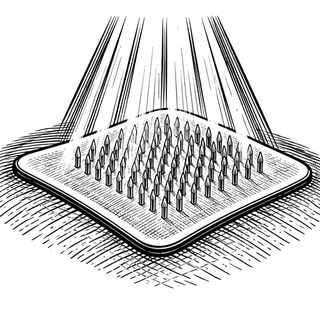
Microneedles are exactly what they sound like: very tiny needle-like structures arranged on a patch. They are designed to reach into superficial tissue without the drama of a traditional needle. In wound care, that matters because delivery is a huge challenge. It is one thing to put medicine on top of a wound. It is another to get active materials where they need to go.
Inside this microneedle system, the researchers loaded MnFC nanoparticles, built through a coordination-driven self-assembly process involving Fmoc-L-leucine and manganese-related components. In simpler terms, the study uses chemistry to assemble tiny functional particles that can behave like enzymes, sometimes called nanozymes.
Nanozymes are engineered nanomaterials that mimic enzyme-like activity. In this case, the goal is to change the wound microenvironment, especially by helping address hypoxia, so PDT can become more effective against infection.
Why the “Nanozyme” Part Matters
The wound environment is not just a passive background. It is more like the room where the whole healing drama takes place. If that room is smoky, dark, and full of bacteria throwing chairs, even a good treatment may struggle.
Nanozymes are interesting because they can be designed to interact with chemicals already present in diseased tissue. For diabetic wounds, researchers often look at ways to reduce harmful oxidative stress, generate oxygen, disrupt bacterial survival, or support tissue repair.
This study’s concept is appealing because it combines several pieces into one system:
- A microneedle patch for local delivery
- A hydrogel material that can carry therapeutic components
- Nanozyme particles designed to modulate the wound environment
- Photodynamic therapy to attack infection
That combination approach is what makes the work intriguing. It is not just "shine light on wound, hope for best." It is more like setting the stage, cueing the lights, and making sure the bacteria are not hiding behind the curtains with snacks.
The Parent Question: Is This Ready for Real Patients?
Not yet.
This is research, not a product sitting in a pharmacy aisle next to cartoon bandages and overpriced adhesive strips. The abstract describes a therapeutic framework and experimental development, but it does not mean this treatment has been proven in broad clinical use.
Before something like GM@MnFC microneedles could become part of routine wound care, researchers would need more evidence on safety, dosing, durability, manufacturing, infection control, healing outcomes, and how it compares with existing treatments. Human studies would be especially important.
That said, the direction makes sense. Infected diabetic wounds are a major medical problem, and multidrug-resistant bacteria make them harder to manage. A local treatment that can deliver therapy precisely, improve oxygen-related limitations, and reduce bacterial burden would be a meaningful advance if it holds up in future testing.
What Could the Real-World Impact Be?
If follow-up research succeeds, a system like this could potentially help clinicians treat infected diabetic wounds more effectively without relying only on antibiotics. That matters because antibiotic resistance is not some distant science-fiction concern. It is already sitting in hospitals, clinics, and wound care centers, acting smug.
A microneedle-based PDT approach could also offer targeted treatment. Local delivery may reduce some issues associated with systemic therapies, though that would need careful study. The best-case future version would be easy to apply, reliable, safe for fragile tissue, and compatible with the messy reality of wound care.
And yes, “messy reality” includes drainage, dressings, mobility issues, blood sugar swings, missed appointments, worried parents, exhausted caregivers, and the fact that nobody has ever calmly said, “Great news, we need to manage this open wound for several more months.”
What I Like About This Research
The best part of this study is that it treats the wound as an ecosystem, not just a hole in the skin. That is the right mindset. Diabetic infected wounds are complicated because oxygen, bacteria, inflammation, tissue damage, and immune response all interact.
Trying to solve only one piece can be like mopping the kitchen while the sink is still overflowing. This research tries to address both infection control and the local wound conditions that weaken therapy.
The microneedle format is also appealing because delivery matters. A clever treatment that cannot reach the right tissue is basically a very expensive motivational poster.
What Still Needs Answering
The big questions are practical ones:
How well does this work in living systems that resemble real diabetic wounds?
How durable is the treatment effect?
Could it damage healthy tissue?
How often would it need to be applied?
Would it work against different resistant bacteria?
Could it be manufactured consistently and affordably?
Those questions do not make the research less exciting. They are the normal bridge between a promising lab idea and something that can actually help patients.
For now, GM@MnFC microneedles are a smart experimental approach to a hard clinical problem. They combine material science, nanotechnology, and antimicrobial photodynamic therapy in a way that directly targets one of PDT’s biggest weaknesses: low oxygen in diabetic wounds.
As a parent reading this, I am not thinking, “Wonderful, more nanoparticles.” I am thinking, “If this eventually helps someone’s wound heal faster and keeps infection from spiraling, please keep going.”
This blog post discusses research findings and should not be taken as medical advice. If you have concerns about diabetic wounds, wound infection, or diabetes-related complications, please consult a healthcare provider. Research discussed here represents ongoing scientific investigation and clinical validation is still in progress.
All images used in this post are decorative illustrations only and do not represent or reflect the accuracy, reality, or correctness of the referenced research.
Primary Source: Coordination-driven self-assembled nanozyme-loaded GelMA microneedles for enhanced photodynamic therapy of diabetic infected wounds. PubMed Record 42065571. https://pubmed.ncbi.nlm.nih.gov/42065571/