
For decades, materials engineers wrestled with a frustrating trade-off that felt less like physics and more like a cruel cosmic joke: make a material strong, and it turns brittle. Make it tough, and it goes soft. Strength and toughness sat at opposite ends of a seesaw, and the conventional wisdom said you could not have both. Then someone went fishing, looked at a fish scale under a microscope, and discovered that nature had been quietly ignoring that rule the entire time.
This new study tackles exactly that paradox by reverse-engineering the scales of the jiangjunjia fish, turning them into mineralized collagen matrices that hit both ends of the seesaw at once. If that sounds like cheating, well, biology has been cheating for about 500 million years.
The Numbers Nature Refuses to Compromise On
Here is what the data actually says about biological materials, and it is genuinely strange. Most engineered composites force you to pick a lane. A ceramic might be stiff and strong but shatter the moment you look at it sideways. A polymer might bend forever without breaking but crumple under any real load. The classic strength-versus-toughness chart looks like a wall that nothing crosses.
Biological materials laugh at that wall. Bone, nacre (the iridescent stuff inside seashells), tooth enamel, and fish scales all plot themselves in the forbidden upper-right corner where high strength and high toughness coexist. The secret is not some exotic ingredient. The raw materials are almost embarrassingly ordinary: collagen, calcium minerals, and water. The magic is entirely in the architecture, the way those plain ingredients are stacked across multiple scales of organization.
Think of it like a recipe where the ingredients cost a dollar but the technique is worth a fortune.
What on Earth Is a Bouligand Structure?
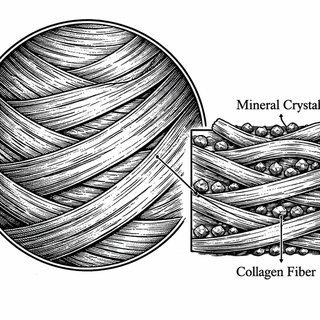
This is my favorite part, so bear with the geometry. A Bouligand structure is a stack of fiber layers where each layer is rotated by a small angle relative to the one beneath it. Picture a ream of paper where every sheet is twisted a few degrees, so the fibers spiral through the thickness like a slow-motion helical staircase.
That twist is doing real mechanical work. When a crack tries to travel through a normal layered material, it takes the straight path, because cracks are lazy and always pick the route of least resistance. But in a Bouligand arrangement, every rotated layer redirects the crack into a corkscrewing detour. Instead of slicing cleanly through, the crack has to wind around and around, burning enormous amounts of energy with every twist. A crack that should have sprinted through the material instead gets sent on the geometric equivalent of a very long, very confusing hike. By the time it gives up, the material has absorbed far more punishment than its ingredients should allow.
Fish scales use this trick to survive predator bites. The researchers borrowed it for the lab.
The Mineralization Step, or How to Add Bones to Jelly
Collagen on its own is the jelly half of the equation. It is flexible and tough but not particularly strong, which is great if you want something that bends and bad if you want something that holds up under load. To get strength, you need mineral, specifically calcium phosphate crystals threaded through the collagen scaffold at the nanoscale. This is the same process your own body uses to build bone, and it is called biomineralization.
The challenge the team set out to solve is that controlling this process artificially is fiendishly difficult. Dump minerals onto collagen and you usually get a clumpy, disorganized mess that adds weight without adding much performance. Real bone grows its mineral crystals in a precise, aligned, intimately integrated way. Replicating that level of control outside a living organism has tripped up researchers for years.
By starting with the fish scale's pre-built Bouligand collagen template and then mineralizing it in a guided fashion, the study reports composites with meaningfully enhanced mechanical properties. The scaffold provides the blueprint; the mineral provides the muscle. Combine the two correctly and you climb into that forbidden upper-right corner of the chart where strength and toughness finally stop arguing.
The Quiet Bonus: Biocompatibility
There is a second result that deserves a spotlight, and it is the kind of thing that turns a neat physics demo into something a hospital might actually care about. The mineralized matrices showed enhanced biocompatibility, meaning living cells get along with the material rather than treating it as a hostile intruder.
That matters enormously for medicine. A material can have spectacular mechanical numbers and still be useless as an implant if your immune system declares war on it. Because this scaffold is built from collagen and calcium phosphate, the same fundamental components as natural bone, it speaks a biological language the body already understands. The data points toward potential applications in bone repair and tissue engineering, where you want a scaffold that is strong enough to bear load, tough enough to resist cracking, and friendly enough for your own cells to colonize and eventually replace.
A fish scale that helps mend a fractured bone. Somewhere, a tarpon is feeling underappreciated.
Why This Is More Than a Cool Trick
The broader pattern here is the genuinely exciting part. This is biomimicry doing what it does best, which is treating evolution as the world's longest-running research grant. Nature ran a 500-million-year experiment with a brutal selection criterion (survive or become lunch) and arrived at design solutions our best labs are still struggling to copy.
If follow-up work succeeds, the implications stretch well past fish. The same Bouligand-plus-mineralization playbook could inform impact-resistant armor, lightweight structural panels, dental materials, and orthopedic implants. Every one of those applications wants the same impossible thing: strong and tough, please, and hold the trade-off.
The honest caveat is that this is early-stage research. Lab-scale mechanical tests and cell studies are a long, expensive road away from a product surgeons trust. Scaling up production, ensuring consistency, and clearing clinical validation are all real hurdles still ahead.
But the proof of concept is sitting right there in the numbers. A humble fish scale, properly understood, did something the textbooks said was off-limits. The seesaw, it turns out, was never the rule. It was just a problem nobody had asked a fish about.
This blog post discusses research findings and should not be taken as medical advice. If you have concerns about bone health or orthopedic conditions, please consult a healthcare provider. Research discussed here represents ongoing scientific investigation and clinical validation is still in progress.
All images used in this post are decorative illustrations only and do not represent or reflect the accuracy, reality, or correctness of the referenced research.
Primary Source: Mineralization of Bouligand-structured collagen matrices derived from fish scales with enhanced mechanical properties and biocompatibility. PubMed. 2026. PMID: 41979275