
The blog post is below.
A pharmacist counts out the day's twentieth prescription for a GLP-1 drug, and the shelf is bare again. A patient stares at a pen injector wondering why a single hormone-mimicking molecule costs more than a week of groceries. A chemist in a quiet lab squints at a peptide and asks the question nobody upstream wants to hear: surely there is more than one way to make this lock turn?
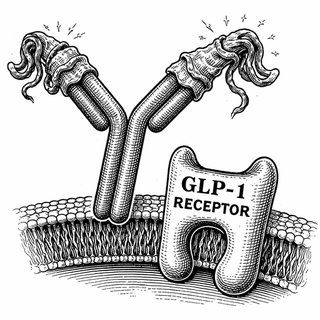
That last question is the one I want to talk about, because a group of researchers went and answered it in a way that would have made my old graduate advisor spill his coffee. In a paper with the unassuming title "Glucagon-like peptide-1 mimotopes screened from an Fv-antibody library," they set out to build brand-new molecules that fool the GLP-1 receptor, and they did it by raiding the toolbox of the immune system. I have spent enough decades watching drug discovery lumber along its usual paths that when somebody takes a genuinely sideways route, I sit up and pay attention.
The Hormone Everyone Suddenly Wants
Let me back up for the folks who have been blissfully ignoring the news. Glucagon-like peptide-1, GLP-1 to its friends, is a hormone your gut releases after a meal. It nudges your pancreas to release insulin, tells it to hold off on glucagon, and generally helps keep blood sugar from doing acrobatics. Drugs that mimic it have become the celebrities of modern medicine for type 2 diabetes and obesity, and demand has been so ferocious that supply chains have buckled under the weight.
The catch is that these molecules are not trivial to design. GLP-1 itself is a fussy little peptide, and crafting agonists that bind its receptor and switch it on is delicate work. So the field has a real appetite for new ways to generate fresh candidates, ideally ones that do not all look like minor variations on the same theme. Molecular diversity, as we say when we want to sound respectable at conferences.
Raiding the Antibody's Wardrobe
Here is where the cleverness comes in. Antibodies, those Y-shaped proteins your immune system uses to recognize invaders, have a region at their tips that is staggeringly variable. The business end of an antibody heavy chain contains stretches called complementarity-determining regions, the CDRs, and one of them, CDR3, is the immune system's improvisational jazz solo. It varies wildly, and that variation is exactly how your body recognizes essentially anything it has never seen before.
The researchers took the hypervariable region of a heavy-chain IgG antibody, the Fv portion containing three CDRs and four framework regions, and turned CDR3 into a slot machine. Using site-directed mutagenesis, they randomized eleven amino acids in that loop, spinning up an enormous library of possible sequences. Think of it as a costume shop with a near-infinite rack of outfits, and somewhere on that rack hangs something that looks, to a receptor, exactly like GLP-1.
To find the right costume, they used monoclonal anti-GLP-1 antibodies as the casting directors. If an antibody recognizes GLP-1, then a peptide that fools that same antibody is wearing a convincing disguise. These winning sequences are called mimotopes, a lovely word meaning roughly "shapes that mimic an epitope," and they are the heart of this whole enterprise.
Putting the Imposters to the Test
Finding a molecule that looks like GLP-1 is one thing. Proving it actually works is where most clever ideas go to quietly die. To their credit, this team did not stop at the costume fitting.
They produced the mimotopes two ways: synthesized as standalone peptides, and expressed as Fv-antibodies cleverly tagged with green fluorescent protein so they could literally watch where the molecules went. Then came the gauntlet. They measured binding affinity with a surface plasmon resonance biosensor, an instrument that detects molecules sticking together with the patience of a very expensive bouncer checking IDs. They measured cyclic AMP production, the receptor's internal "message received" signal, in actual pancreatic alpha and beta cells, the very cells that handle glucagon and insulin.
The receptor responded. The imposters got in.
They went further still, running molecular docking simulations that showed the mimotopes nestling against the same key residues on the receptor that real GLP-1 grabs onto. It is one thing to knock on the door; it is another to show you are using the right key in the right lock. They also poked at liver cells, HepG2 and Huh7 lines, to see whether the molecules affected fatty acid accumulation, ran RNA sequencing to catch the broader ripple of gene expression changes, and checked downstream signaling in beta cells by looking at AKT and ERK1/2 phosphorylation. That last bit is the molecular equivalent of confirming that pressing the doorbell actually rang a bell somewhere inside the house, rather than just making a satisfying click.
Why This Is More Than a Neat Trick
I have seen a great many "novel approaches" in my time, and a fair number of them amounted to a press release and a shrug. This one strikes me as different, and the reason is the library.
Most drug discovery for GLP-1 mimics has been a process of careful tinkering with the peptide we already have, nudging an amino acid here, stabilizing a fold there. That works, but it tends to circle the same chemical neighborhood. By starting from the antibody's hypervariable repertoire, this approach throws open a window onto an entirely different region of molecular space. The shapes that emerge were never designed by a chemist staring at the GLP-1 structure; they were fished out of a sea of randomized possibilities, judged only by whether they could fool an antibody and flip the receptor's switch. That is a fundamentally different way to find a drug, and different is precisely what a field running low on diversity needs.
If this strategy holds up through the long, unglamorous slog of further development, and I must stress that the journey from a promising cell-culture result to anything resembling a treatment is measured in years and littered with disappointments, it could become a general engine for generating receptor agonists. Not just for GLP-1, but as a template for coaxing antibody libraries into mimicking all sorts of signaling molecules. The immune system spent a few hundred million years perfecting the art of generating diverse molecular shapes. Borrowing that machinery for drug design is the kind of idea that feels obvious only in retrospect, which is usually the sign of a good one.
For now, it is a proof of concept, and a thoroughly tested one. The receptor was fooled, the cells responded, the signals fired. Somewhere a hormone is being convincingly impersonated by a molecule that started life as a randomized loop in an antibody, and I find that quietly delightful.
This blog post discusses research findings and should not be taken as medical advice. If you have concerns about diabetes, obesity, or blood sugar management, please consult a healthcare provider. Research discussed here represents ongoing scientific investigation and clinical validation is still in progress.
All images used in this post are decorative illustrations only and do not represent or reflect the accuracy, reality, or correctness of the referenced research.
Primary Source: Glucagon-like peptide-1 mimotopes screened from an Fv-antibody library. PubMed. 2026. PMID: 41978477