
Meanwhile, in a laboratory that smells faintly of coffee and ambition, a team of researchers has done something that would have seemed like pure science fiction when I was a young postdoc puzzling over my first Western blot. They have built microscopic robots - actual robots, mind you - that contain CRISPR gene-editing machinery, magnets, and a chemotherapy drug, all crammed together inside cells that have been turned into tiny biochemical factories. And they are using this marvel not to edit genes, not to deliver drugs (though that door is clearly ajar), but to sniff out cancer from a blood sample with astonishing precision. I have seen a great many things in my years at the bench, and I confess this one made me sit down with my tea and simply stare at the ceiling for a while.
The Problem With Finding a Tumor That Does Not Want to Be Found
Before we get to the robots - and we will absolutely get to the robots - let us appreciate the problem they are solving. Tumors are, to put it charitably, sneaky. They shed tiny membrane-wrapped packages called extracellular vesicles into the bloodstream. These little parcels, about the size of a very small virus, carry molecular fingerprints of their parent cancer cells on their surfaces. In theory, you could identify what kind of cancer someone has, and track how it is progressing, just by analyzing these vesicles in a blood draw. No biopsy. No surgery. Just a tube of blood and some clever chemistry.
The catch - and there is always a catch - is that these tumor-derived extracellular vesicles (tEVs, in the trade) are vanishingly rare in blood, wildly variable from patient to patient and tumor to tumor, and notoriously difficult to separate from the ocean of non-cancerous vesicles that every cell in your body is cheerfully producing at all times. Previous methods required lengthy isolation and purification steps that made the whole enterprise feel a bit like trying to pick out a specific grain of sand from a beach while wearing oven mitts.
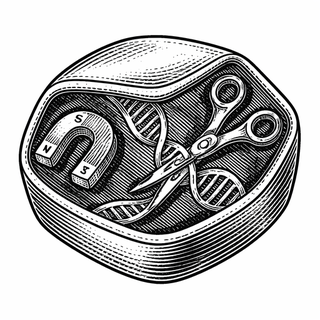
Enter the CRISPR-Magnetic Microbots
The researchers solved this problem by, essentially, building a very small Swiss Army knife. They started with living cells and gelled their interiors - think turning the inside of a cell into a firm jelly - and then loaded these "intracellularly gelated magnetic cells" (IGMCs, which sounds like a government agency but is significantly more interesting) with two payloads. First, they installed CRISPR/Cas12a, the molecular scissors that can be programmed to recognize specific DNA sequences and then go absolutely haywire cutting everything in sight once triggered. Second, they attached DNA structures shaped like icosahedra - twenty-sided geometric forms that would look right at home on a gaming table - loaded with doxorubicin, a well-known chemotherapy agent.
Now, here is where the spatial confinement business gets genuinely clever. It has been known for some time that CRISPR enzymes work better when everything is crowded together, because the molecules find each other faster when they cannot wander off. By gelating the cell interior and maintaining fluid membranes, the researchers found that their Cas12a was dramatically more active than it would be floating loose in solution. It is rather like the difference between searching for your car keys in a studio apartment versus a football stadium.
Logic Gates, Aptamers, and Sorting the Mail
The next trick involves figuring out which vesicles in a blood sample actually came from a tumor, and moreover, which subtype of tumor. For this, the team deployed a logic-gated aptamer system. Aptamers are short DNA or RNA molecules that fold into shapes that bind specific targets - in this case, protein markers on the surface of tEVs. The logic gate approach means that a vesicle only gets flagged if it presents a specific combination of surface proteins, not just one. This is the molecular equivalent of requiring both a badge AND a PIN to open a door, which cuts down considerably on false alarms.
When a genuine tumor vesicle binds to the aptamer system, it triggers the CRISPR/Cas12a machinery, which springs into action and starts cutting. What does it cut? The DNA icosahedra. This releases a flood of doxorubicin molecules into the solution, producing a strong, measurable electrochemical signal. The magnetic component then lets you sweep all the microbots out of the solution with a magnet, leaving behind only the chemical signal from the released drug - clean, amplified, and beautifully unambiguous.
What This Means for Monday Morning Oncology
The clinical implications deserve a moment of appreciation. The researchers tested this system on actual patient samples and demonstrated that it could accurately subtype cancers - distinguishing one type from another based on the specific combination of protein markers on their vesicles. This is not a trivial achievement. Cancer subtyping currently requires tissue biopsies, pathology labs, and days of waiting. The idea that you might eventually distinguish cancer subtypes from a blood draw in a clinical setting, with the accuracy demonstrated here, is the kind of thing that makes old scientists like me want to revise their lecture notes.
The signal-to-noise ratio improvements are also worth noting. One persistent headache with ultrasensitive biosensors is that background noise competes with the genuine signal, giving you results that look like radio static. The CRISPR-magnetic microbots approach substantially suppresses that background, because the magnetic cleanup step physically removes the machinery after it has done its work, leaving only the signal behind. Elegant solutions to messy problems are, in my experience, the hallmark of genuinely good science.
A Few Caveats From the Back of the Room
I would be remiss, after four decades of reading papers, if I did not mention that "demonstrated in clinical samples" and "ready for your doctor's office" are separated by a considerable distance measured in validation studies, regulatory filings, and manufacturing scale-up challenges. Doxorubicin is a chemotherapy drug with its own toxicological profile, which raises questions worth thinking through for any diagnostic application. The fabrication of CRISPR-magnetic microbots is not yet something you can order from a catalog.
But the underlying concept - using biological machinery, geometric DNA structures, and magnetic manipulation to build a self-cleaning, logic-gated, electrochemical cancer detector - represents a genuine conceptual advance. In the long story of cancer diagnostics, which I have watched unfold from the era of simple immunoassays to the age of genomics, this feels like a meaningful new chapter beginning.
And it all fits in a test tube. I find that rather wonderful.
This blog post discusses research findings and should not be taken as medical advice. If you have concerns about cancer screening or diagnosis, please consult a qualified healthcare provider. Research discussed here represents ongoing scientific investigation and clinical validation is still in progress.
All images used in this post are decorative illustrations only and do not represent or reflect the accuracy, reality, or correctness of the referenced research.
Primary Source: Fluidly Confined CRISPR-Magnetic Microbots Empowered Homogeneous Electrochemical Biosensor for Amplified Detection and Discrimination of Cancer-Derived Extracellular Vesicle Subtypes. PubMed. 2026. PMID: 41869962