
A common misconception is that an artificial blood vessel just needs to be a tiny tube that blood can pass through. But here's what actually happens: real arteries are fussy, dynamic little structures that stretch, rebound, and handle pressure all day long without throwing a tantrum. If a replacement vessel is too stiff, too weak, or just mechanically "off," the body may respond with clotting and failure. So no, this is not a plumbing problem in the hardware store sense. It is more like replacing a trampoline spring with uncooked spaghetti and hoping for the best.
That is why this PubMed paper on bio-inspired metamaterial structured small-diameter vascular grafts caught my eye. As a parent reading medical research, my first question is always the same: will this someday help somebody's kid, or is this another very clever thing that lives forever in a lab slide deck? This study does not offer a treatment ready for tomorrow morning's clinic visit. What it does offer is a smarter design idea for one of the hardest problems in tissue engineering: making a small artificial blood vessel that behaves enough like a real artery to actually last.
Why small artificial vessels are such a headache
Large artificial blood vessels already exist and can work reasonably well in some settings. Small-diameter ones are a different beast. When the vessel is narrow, blood flow conditions become less forgiving, and mechanical mismatch becomes a bigger problem. If the graft is too rigid compared with the natural artery it connects to, that mismatch can disturb flow and stress the vessel wall. If it is not strong enough, that is obviously bad too. Nobody wants a "works great except under pressure" situation in something carrying blood.
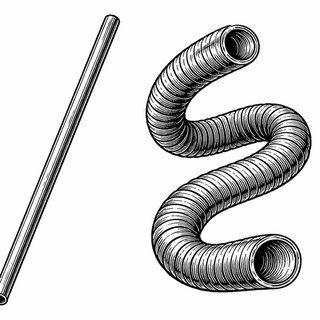
The paper frames the central challenge clearly: traditional small-diameter artificial vessels struggle to balance mechanical strength and compliance. Strength is the ability to hold up under pressure. Compliance is the ability to flex and expand the way a normal artery does. Real arteries do both. Many synthetic replacements are better at one than the other. That tradeoff has been a persistent problem, and when the mechanics are wrong, clotting and graft failure become more likely.
What this team built
The researchers took inspiration from the corrugated, curled structure of collagen fibers in natural arteries. Instead of making a plain tube, they designed a composite tubular scaffold with two parts.
First, they used a gelatin-based hydrogel as the matrix. In plain English, this is the softer background material meant to mimic the extracellular matrix in a real artery. Gelatin-based hydrogels are attractive because they are generally biocompatible, which is a very nice quality in anything you plan to put near blood. "Please do not alarm the immune system" is a low but meaningful bar.
Second, they added an ultra-fine fiber network made with high-precision 3D printing. This network has a metamaterial structure, meaning its behavior comes not just from what it is made of, but from how it is geometrically arranged. That printed network is designed to imitate the curled shape of collagen fibers, which matters because collagen does not behave like a rigid stick. It gradually engages as the vessel stretches.
That detail is the heart of the paper. The scaffold was built to reproduce the J-shaped stress-strain curve of native arteries. That phrase sounds like it escaped from a biomechanics exam, but the idea is pretty intuitive. Real arteries are not equally stiff at every level of stretch. They are more forgiving at first, then become stiffer as strain increases. That lets them handle normal pulsation while still resisting dangerous overexpansion. It is a smart built-in safety feature, like leggings that somehow also moonlight as a seatbelt.
What the numbers mean in real life
The researchers report that by changing the geometry of the metamaterial units, they could tune the scaffold's axial modulus from 0.091 to 0.55 MPa and its burst resistance from 820 to 3250 mmHg. They also adjusted compliance to a range of 6.25% to 13.28%.
If you are not in the habit of casually comparing blood vessel mechanics over breakfast, here is the practical takeaway: they were able to customize how stiff, strong, and stretchable the graft was. That matters because arteries are not all mechanically identical throughout the body. A one-size-fits-all tube is not ideal. A tunable design is much more interesting.
This is the part that moved the paper from "neat engineering" to "possibly useful someday." A graft that can be mechanically tailored to better match different native arteries could reduce the mismatch problem that helps drive complications. Better matching may mean smoother blood flow, less irritation at the connection points, and possibly fewer failures. That is still a "may," not a promise, but it is a meaningful one.
Why this is interesting beyond the lab bench
A lot of biomedical device work sounds impressive until you ask whether it solves the actual problem patients face. Here, the problem is real and stubborn. Small-diameter vascular grafts are badly needed in cardiovascular surgery and related settings, but performance has been limited. The body is not impressed by good intentions. It wants the graft to behave properly under real biological conditions.
What I like about this study is that it does not try to bully biology into accepting a simplistic material. It studies what natural arteries are doing mechanically and then borrows those design principles. That is usually a stronger strategy than pretending the body will adapt to our convenience. Nature has had a long head start and, annoyingly for engineers, remains pretty good at this.
The use of a bio-inspired metamaterial is also a reminder that "stronger" is not always better in medicine. Parents hear that word and think durable, safe, reliable. But in blood vessels, a replacement that is too stiff can be part of the problem. Sometimes the right answer is not "make it tougher." It is "make it tougher in the right way, and flexible in the right way, at the right time."
The obvious caveat
This paper presents a design and fabrication approach. It gives promising mechanical data. It does not show that these grafts are already proven in long-term human use. That is a very large gap. Before anything like this could genuinely help patients, researchers would still need to show how it performs with blood exposure, healing, clot prevention, durability over time, and eventually in animal and clinical studies.
That does not make the study less valuable. It just puts it in the proper bucket. This is not a cure. It is not a product. It is an engineering advance that could make later medical advances more realistic. There is a difference, and it matters.
So, will this help my kid?
Maybe one day, indirectly or directly, yes. If a child or adult ever needs a small vascular graft, the best version of that graft will probably come from exactly this kind of work: better materials, smarter architecture, and a closer imitation of what healthy tissue actually does. The road from a promising scaffold to a reliable surgical option is long, but this paper tackles a bottleneck that has frustrated the field for years.
For families, that means this research is worth watching, even if it is not ready for prime time. It is the kind of progress that looks modest from a distance because it lives in materials science and biomechanics. But those details are often where future treatments either succeed or quietly fall apart. Sometimes the difference between "helpful device" and "failed implant" is not flashy. It is a tiny tube learning how to bend without acting weird.
This blog post discusses research findings and should not be taken as medical advice. If you have concerns about vascular disease, blood vessel surgery, or graft-related treatment options, please consult a healthcare provider. Research discussed here represents ongoing scientific investigation and clinical validation is still in progress.
All images used in this post are decorative illustrations only and do not represent or reflect the accuracy, reality, or correctness of the referenced research.
Primary Source: PubMed Record 42052639. Bio-inspired metamaterial structured small-diameter vascular grafts for emulation of native arterial mechanics. Available at: https://pubmed.ncbi.nlm.nih.gov/42052639/