
A deep skin wound is sitting there like a construction site after the subcontractors stopped answering their phones. The inflammatory crew showed up, the rebuilding materials are late, blood supply is patchy, and the surface still looks like it lost an argument with a belt sander. That is the scene this new research is trying to clean up, using a hydrogel loaded with adipose-derived mesenchymal stem cells, or ADSCs for those of us who prefer acronyms to full paragraphs.
The paper, titled An adipose-derived mesenchymal stem cell-loaded polysaccharide hydrogel promotes wound healing through angiogenesis, takes aim at one of regenerative medicine's recurring headaches: how to get therapeutic cells to the wound, keep them there, and give them an environment where they can do something useful instead of quietly failing in the corner.
Why wound healing is such a stubborn engineering problem
Wound repair sounds simple until you actually look at it. The body needs to control inflammation, build new blood vessels, regrow surface tissue, lay down collagen, and then remodel the whole patch job into something functional. That is a lot of moving parts for a process we often talk about as if it were just "skin closing."
From a device and biomaterials perspective, the challenge is not only biology. It is logistics. Cells are fragile cargo. Wounds are messy environments. And if you want anything to become clinically relevant, it has to be manufacturable, reasonably stable, and not so fussy that every dressing change turns into a graduate thesis.
That is where hydrogels keep showing up. They can act as a scaffold, hold moisture, fill irregular defects, and serve as a delivery vehicle for cells or bioactive molecules. In principle, they are the slow cooker of tissue repair: low heat, steady support, and ideally no dramatic flare-ups.
What this study actually built
The researchers developed a self-healing polysaccharide hydrogel made from oxidized dextran and carboxymethyl chitosan. Those are both widely sourced polysaccharide materials, which matters more than it may seem. In translational work, "widely sourced" is often code for "someone in operations may eventually stop hyperventilating."
The hydrogel was designed to be simple to prepare and biocompatible. It also served as a three-dimensional culture environment for adipose-derived mesenchymal stem cells. That 3D piece matters. Cells behave differently when they are suspended in a material that better mimics tissue architecture versus being handled in flatter, less realistic conditions.
ADSCs are attractive in this setting because they are not just passive building blocks. They respond to the wound microenvironment and secrete signaling molecules that can influence inflammation, tissue regeneration, and vascular growth. The cell therapy story here is less "magic replacement parts" and more "biological foreman coordinating the job site."
The headline result: faster healing, with better blood supply
In a full-thickness skin defect model in nude mice, the ADSC-loaded hydrogel significantly improved wound closure compared with controls. The study also reported stronger collagen deposition, better epidermal regeneration, and improved angiogenesis and vessel maturation.
That last point is the one worth underlining. Angiogenesis, the growth of new blood vessels, is often where promising wound therapies either earn their keep or start making excuses. You can have a nice-looking material and viable cells, but if the tissue does not get a functional blood supply, the whole thing is frosting without cake.
This hydrogel-cell combination seems to have helped create a more favorable wound microenvironment, allowing the repair process to move forward more effectively. Not just faster closure, but a more organized repair response. In wound care, speed alone can be a misleading metric. A rushed patch is still a patch.
Why this is interesting beyond the mouse data
There is a practical elegance to the concept. Instead of expecting injected cells to survive a hostile wound bed on their own, the hydrogel gives them a place to sit, interact, and release helpful signals. Think of it as giving the cells a booth at the trade show instead of making them network in the parking lot.
From an industry angle, the appeal is obvious. A cell-loaded wound product that improves vascularization and tissue regeneration could sit at the intersection of advanced wound care, regenerative medicine, and biomaterials. That is a crowded intersection, yes, but also one where a product that is simple enough to deploy and robust enough to scale can get serious attention.
The self-healing nature of the hydrogel is also notable. Materials that can maintain integrity after mechanical disruption are useful in real wound settings, where dressings shift, tissue moves, and the patient does not politely remain motionless for the sake of the materials science.
What problem this approach is trying to solve
Standard wound management can handle many injuries well enough, but difficult wounds are expensive, slow, and clinically frustrating. Large wounds, chronic wounds, and wounds with poor vascularization do not just need coverage. They need a better biological operating system.
Cell therapy alone has promise, but delivery remains a recurring bottleneck. Many cells do not persist long enough or localize well enough to produce a reliable effect. Biomaterial scaffolds alone can support healing, but sometimes they are biologically too quiet. Pairing the two is the obvious recipe, and like many obvious recipes, it only works if the proportions are right and nobody burns the garlic.
This study suggests that combining ADSCs with a polysaccharide hydrogel may improve that balance by giving the cells both shelter and purpose.
The sober part: what still needs to happen
This is where the medical device and biotech crowd puts down the party hat.
The study was done in nude mice, not humans. That does not make the data unhelpful, but it does mean there is a long road between "interesting preclinical result" and "reimbursed clinical product." Wound healing in people is influenced by infection, diabetes, vascular disease, immune status, age, and the unpleasant fact that patients do not live in standardized lab conditions.
There are also the usual translation questions. How reproducible is the hydrogel manufacturing process? How stable is the final product? How are the ADSCs sourced, expanded, qualified, and stored? What is the regulatory path for a cell-loaded biomaterial system that behaves partly like a scaffold and partly like a biologic? Those conversations tend to turn lively around the third slide and then remain lively for years.
Even so, the paper addresses a real need with a design that at least respects the realities of product development. Simple preparation, common material inputs, and a defined cell delivery role are all better than hand-waving.
Why it matters
What makes this research worth watching is not that it claims to have solved wound healing forever. Thankfully, the paper does not try to sell snake oil in a lab coat. It presents a plausible platform: a self-healing hydrogel made from accessible polysaccharides, carrying stem cells that can shape the wound environment and support angiogenesis.
If later studies support these findings, this kind of system could become a more sophisticated wound dressing platform, one that does more than cover and absorb. It could actively participate in repair. That is the direction many advanced wound technologies want to move, from passive protection to guided regeneration.
For now, the result is best viewed as a well-seasoned preclinical proof of concept. Not dinner yet, but the kitchen smells promising.
This blog post discusses research findings and should not be taken as medical advice. If you have concerns about wound healing or tissue repair, please consult a healthcare provider. Research discussed here represents ongoing scientific investigation and clinical validation is still in progress.
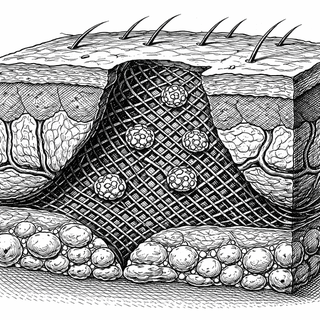
All images used in this post are decorative illustrations only and do not represent or reflect the accuracy, reality, or correctness of the referenced research.
Primary Source: An adipose-derived mesenchymal stem cell-loaded polysaccharide hydrogel promotes wound healing through angiogenesis. PubMed Record 42012438. https://pubmed.ncbi.nlm.nih.gov/42012438/