
You won't believe what researchers are doing with a smartphone: turning it into part of a bacteria-detecting setup that can help tell not just whether target bacteria are present, but whether they are alive. That second part matters. Finding bacterial DNA is useful, but DNA can hang around after bacteria die, like molecular glitter after a craft project. The new question is sharper: are we seeing living troublemakers, or just the biological leftovers?
A recent PubMed-indexed study describes a dual CRISPR/Cas-driven, amplification-free surface-enhanced Raman scattering biosensor, nicknamed cc-SERS, designed for simultaneous detection of total and live target bacteria. That is a mouthful, yes. But underneath the acronym soup is a clever idea: combine CRISPR systems, molecular signals, Raman spectroscopy, and a smartphone into a detection strategy that could make bacterial testing faster and more informative.
Why “Alive or Dead?” Is Not a Small Detail
When testing for bacteria, a simple positive-or-negative answer can be misleading. Imagine cleaning a surface, testing it afterward, and finding bacterial DNA. Panic? Maybe not. DNA can persist after cells are no longer viable. It is the microbial equivalent of footprints in the mud: evidence that someone was there, not proof they are still hiding in the pantry.
Live bacteria are the real concern because they can grow, spread, produce toxins, and cause infection or contamination. Total bacteria counts are still useful, but live counts often tell a more practical story.
This is especially relevant for food safety, clinical diagnostics, water monitoring, and environmental surveillance. A test that distinguishes live from dead bacteria could help avoid false alarms, guide treatment decisions, and make contamination checks more meaningful.
The Trick: DNA Stays, RNA Fades
The cc-SERS system is built around a biological difference that is beautifully simple: DNA tends to remain stable after bacterial death, while some RNA degrades quickly.
That means DNA can act as a marker for total bacteria, including both live and dead cells. RNA, by contrast, can act as a stronger hint that bacteria are alive, because certain RNA molecules disappear rapidly once the cell dies.
The researchers paired this logic with two CRISPR-associated enzymes:
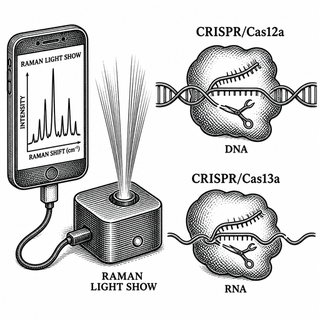
- CRISPR/Cas12a, which responds to target DNA
- CRISPR/Cas13a, which responds to target RNA
If live target bacteria are present, both DNA and RNA can activate the system. If dead target bacteria are present, DNA may still activate Cas12a, but RNA should not meaningfully activate Cas13a. If no target bacteria are present, neither pathway gets switched on.
It is a tidy molecular sorting hat, minus the hat and with much better lab safety paperwork.
Wait, CRISPR Is a Diagnostic Tool Too?
Most people hear CRISPR and think of gene editing. That is fair, since CRISPR has become practically synonymous with molecular scissors. But CRISPR systems are also excellent at recognizing specific genetic sequences.
In diagnostics, that recognition ability can be used as a molecular alarm system. When a CRISPR enzyme finds the sequence it was designed to detect, it becomes activated. Some CRISPR systems then cut nearby reporter molecules, producing a measurable signal.
Cas12a is often used for DNA detection. Cas13a is famous for RNA detection. Pair them, and suddenly you have a two-channel test that can ask two related questions at once: Is the target organism’s DNA here? Is its RNA here too?
That combination is what makes this study intriguing. The test is not simply looking for a microbial calling card. It is trying to infer whether the caller is still standing at the door.
The SERS Part: Tiny Signals, Big Amplification
Now for the “surface-enhanced Raman scattering” part, also known as SERS.
Raman spectroscopy measures how light scatters when it interacts with molecules. Most of the scattered light behaves normally, but a tiny fraction shifts in energy depending on the molecular structure. That shift creates a kind of molecular fingerprint.
The catch? Raman signals are usually faint. SERS boosts them by using special surfaces, often involving nanoscale metallic structures, that dramatically enhance the signal. Think of ordinary Raman scattering as someone whispering across a room, and SERS as handing that person a very enthusiastic microphone.
In this study, the CRISPR reactions are connected to SERS readouts. The abstract notes a characteristic Raman signal at 1079 cm⁻¹, which serves as part of the detection output. The system is designed so the signal changes depending on whether DNA, RNA, both, or neither are detected.
That means the biosensor can produce information about total bacteria and live bacteria without needing conventional nucleic acid amplification.
Why Amplification-Free Matters
Many sensitive genetic tests rely on amplification, meaning they make many copies of DNA or RNA so the target becomes easier to detect. PCR is the classic example. Amplification is powerful, but it can also add time, equipment needs, temperature control, trained personnel, and contamination risk.
An amplification-free test avoids that step. If it can still deliver useful sensitivity, that is a big practical win. Fewer steps can mean faster workflows, simpler devices, and better chances of use outside centralized labs.
That is where the smartphone connection becomes especially interesting. A phone-linked biosensor suggests the possibility of more portable, field-friendly testing. Not “your phone magically diagnoses bacteria while you scroll messages,” unfortunately. The phone is part of a detection and readout setup, not a wizard rectangle. Still, the idea of pairing molecular biosensing with everyday electronics is exactly the kind of practical engineering that can move lab science toward real-world use.
What Problems Could This Help Solve?
A test like cc-SERS could be useful anywhere people need to know whether dangerous bacteria are present and viable.
Food safety is an obvious example. Detecting dead bacteria after heat treatment might not carry the same risk as detecting live bacteria capable of multiplying. Water testing is another. Hospitals and clinics could also benefit from faster methods that give more nuanced microbial information, especially if future versions become robust enough for clinical workflows.
There is also a broader point here: diagnostics are getting smarter. The goal is shifting from “Can we detect a molecule?” to “Can we interpret what that molecule means in context?” DNA alone says one thing. DNA plus RNA says something richer.
That is the scientific equivalent of upgrading from “someone was in the kitchen” to “someone is currently eating the last slice of cake.” Both are useful. One is more actionable.
What Still Needs to Happen?
This is research, not a finished commercial test. Before a technology like this could become widely used, it would need validation across real samples, different bacterial targets, mixed microbial environments, and practical field conditions.
Researchers would need to answer questions like:
- How sensitive is the system across different bacteria?
- How well does it work in messy samples such as food, blood, soil, or wastewater?
- Can it distinguish closely related bacterial strains?
- How stable are the reagents outside ideal lab conditions?
- Can the smartphone-linked readout be standardized and made user-friendly?
Those are not minor details. Real-world samples are famously rude. They contain proteins, fats, salts, debris, inhibitors, and all sorts of chemical background noise. A biosensor that behaves beautifully in controlled conditions still has to prove it can handle the molecular equivalent of a crowded subway at rush hour.
The Big Picture
What makes this study exciting is not just one ingredient. CRISPR diagnostics? Interesting. SERS? Powerful. Smartphone readout? Practical. Live-versus-total bacteria detection? Very useful.
The real spark is the combination. The researchers are stacking several modern tools into a system that asks a smarter diagnostic question: not only “Are target bacteria here?” but “How much of what we are seeing may be alive?”
That is a meaningful step toward more informative microbial testing. If future work confirms the approach in real-world settings, technologies like cc-SERS could help make bacterial detection faster, more portable, and less ambiguous.
And honestly, any day a smartphone teams up with CRISPR and laser-based molecular fingerprinting is a good day for science. Slightly intimidating for bacteria, perhaps, but excellent for the rest of us.
This blog post discusses research findings and should not be taken as medical advice. If you have concerns about bacterial infection, contamination, or exposure, please consult a healthcare provider or qualified public health professional. Research discussed here represents ongoing scientific investigation and clinical validation is still in progress.
All images used in this post are decorative illustrations only and do not represent or reflect the accuracy, reality, or correctness of the referenced research.
Primary Source: Dual CRISPR/Cas-driven amplification-free surface-enhanced Raman scattering biosensor combined with a smartphone for simultaneous detection of total and live target bacteria. PubMed Record ID: 41610742. PubMed link