
Remember when “advanced medical materials” meant something that looked like it had been borrowed from a 1980s dental office, beige plastic and all? We have come a long way from the era when medical technology seemed designed by a committee whose main aesthetic brief was “fax machine, but sterile.” Today, some of the most interesting progress in surgery is happening at a scale so small it would lose a fight with dust: microscopic particles, surface coatings, and materials engineered to behave politely once inside the body.
That brings us to bioactive glass S53P4, a material with a name that sounds like a government procurement code but is actually quite elegant. Bioactive glass is used in bone-related applications because it can interact with body fluids and support mineral formation on its surface. In plain English: it does not just sit there like a tiny mineral paperweight. Under the right conditions, it can participate in the early chemistry that helps bone-like mineral layers form.
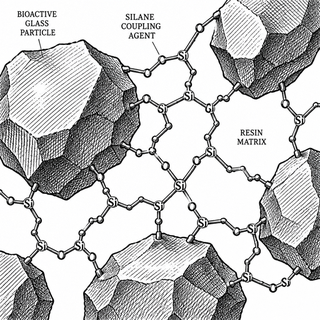
A new PubMed-indexed study looked at what happens when this glass is treated with γ-MPS, short for 3-(methacryloyloxy)propyltrimethoxysilane. Yes, that is a molecule name with the confidence of a zoning ordinance. But the idea is straightforward: γ-MPS is a silane coupling agent, a chemical bridge often used to help inorganic fillers bond better with polymer materials.
That matters because bone surgery increasingly uses composite materials, especially resorbable resin composites. These are materials designed to do their job and then gradually break down or be replaced as healing proceeds. The policy dream, naturally, is a device that performs well, avoids unnecessary revision surgery, clears regulatory review without causing anyone to develop a nervous twitch, and does not require a hospital purchasing committee to hold three emergency meetings.
Why Coat Bioactive Glass?
In resin composites, bioactive glass particles can improve biological performance, but they also need to hold together mechanically inside the polymer matrix. Think of it like adding chocolate chips to cookie dough, except the chips are bioactive glass, the dough is a surgical resin, and the cookie has to survive inside a human body while pleasing regulators, surgeons, patients, and materials scientists. A modest assignment.
Silane treatment is commonly used because it can improve adhesion between inorganic particles and polymer matrices. In resorbable composites, that early mechanical strength can matter before the material begins to leach, dissolve, or interact more actively with the surrounding biological environment.
But here is the catch: if you chemically modify bioactive glass to make it behave better mechanically, do you accidentally make it worse biologically? That is the kind of tradeoff medical device development lives on. Every improvement comes with a form, a test, and possibly a subcommittee.
This study asked whether treating micro-sized S53P4 bioactive glass particles with different concentrations of γ-MPS would change their physicochemical behavior or their compatibility with bone-forming precursor cells.
The Study, Without the Lab Coat Fog Machine
The researchers treated bioactive glass particles using γ-MPS at three concentrations: 1%, 1.5%, and 2%. The silanization solution used 95% ethanol adjusted to pH 4.5 with acetic acid. That acidic ethanol environment helps the silane chemistry do its job on the glass surface.
After treatment, the particles were studied using ATR-FTIR and scanning electron microscopy. ATR-FTIR helps identify chemical bonds and surface chemistry. SEM gives a close-up look at particle morphology. Together, they help answer the basic materials question: did the surface treatment actually change what we think it changed?
The researchers then dissolved the particles in cell culture medium for seven days. During that time, they tracked pH continuously and measured silicon ion release at the end. This matters because bioactive glass releases ions as it dissolves, and those ions are part of the biological signaling and mineralization story.
Finally, they tested biocompatibility using MC3T3-E1 pre-osteoblastic cells. These are cells commonly used in bone biology research because they can model early bone-forming behavior in vitro. Not actual clinical healing, of course, but a useful early checkpoint before anyone starts polishing the regulatory binder.
What They Found
The short version: γ-MPS treatment did not appear to wreck the biological behavior of the bioactive glass.
During dissolution, pH varied slightly between treated and untreated particles. That is worth noting because pH shifts can affect cells and mineralization. However, by the end of the seven-day period, the groups showed no meaningful differences in silicon ion release. All groups released roughly 55 mg/L of silicon ions.
That finding matters because silicon release is one of the signals associated with bioactive glass behavior. If silanization had sharply reduced ion release, it might have suggested that the coating was blocking one of the material’s useful properties. Instead, the glass still released silicon at similar levels.
The study also found no differences in in vitro biomineralization on the glass surfaces after γ-MPS treatment. In other words, the treated particles still supported mineral formation, a central feature of bioactivity.
Cell viability also looked good. The γ-MPS-treated and untreated bioactive glass groups showed no statistically significant difference in viability for MC3T3-E1 pre-osteoblastic cells, with p > 0.05. That is a technical way of saying the cells did not appear to stage a protest against the surface treatment.
Why This Is More Interesting Than It Sounds
Surface chemistry can feel like the administrative law of biomaterials: highly technical, easy to underestimate, and responsible for far more real-world outcomes than anyone at a dinner party wants to admit.
But this is where better implants often begin. Not with a dramatic operating room breakthrough, but with a small materials decision that makes a composite stronger, more predictable, or easier to manufacture while preserving its biological function.
If γ-MPS silanization can improve mechanical integration of bioactive glass in resorbable resin composites without undermining bioactivity or cell compatibility, that supports further development of composite materials for bone surgery. The goal is not merely to create something that looks promising under a microscope. The goal is to build materials that can eventually meet the combined demands of biology, surgical handling, manufacturing consistency, and regulatory review.
And regulatory review is not the villain here. It is more like the world’s most cautious librarian: sometimes slow, sometimes maddening, but deeply invested in making sure the shelves do not collapse on anyone.
The Bigger System Problem
Bone repair materials sit at the intersection of clinical need and system pressure. Surgeons need materials that are workable, reliable, and suited to specific defects. Patients need healing with fewer complications and fewer repeat procedures. Health systems need products that justify their cost and do not add complexity for no clinical gain.
That means research like this has implications beyond the chemistry bench. If surface treatments can help manufacturers create stronger, bioactive, resorbable composites, the downstream impact could include better device performance, more standardized production, and potentially fewer failures related to poor material integration.
Still, this is early-stage evidence. The study used in vitro testing, which is necessary but limited. Cells in culture are not bones in bodies. They do not have blood flow, immune response, surgical variability, comorbidities, billing codes, or the astonishing ability of real clinical settings to complicate clean scientific assumptions.
Future work would need to test how these treated particles behave inside actual composite materials, under mechanical stress, and eventually in animal or clinical models. The big question is not just whether γ-MPS-treated bioactive glass remains bioactive by itself. It is whether that treatment helps produce a better-performing surgical material in the messy, regulated, budget-constrained world where implants actually live.
A Small Step Toward Smarter Bone Materials
This study gives a useful signal: treating S53P4 bioactive glass with γ-MPS at the tested concentrations allowed in vitro biomineralization and did not reduce pre-osteoblastic cell viability. Silicon ion release remained similar across treated and untreated groups after seven days.
That is not a revolution, and it should not be marketed as one. It is a building block. But medical progress often looks exactly like this: one careful compatibility test, one surface chemistry tweak, one fewer reason for a future device to fail.
For a field trying to build resorbable bone repair materials that are mechanically useful and biologically friendly, that is a meaningful bit of progress. Small, technical, and possibly destined to appear in a regulatory appendix someday. Which, in medical technology, is basically where many good ideas go to become real.
This blog post discusses research findings and should not be taken as medical advice. If you have concerns about bone repair, surgical implants, or related conditions, please consult a healthcare provider. Research discussed here represents ongoing scientific investigation and clinical validation is still in progress.
All images used in this post are decorative illustrations only and do not represent or reflect the accuracy, reality, or correctness of the referenced research.
Primary Source: Effects of γ-MPS silanization on the physicochemical and biological properties of bioactive glass S53P4. PubMed. https://pubmed.ncbi.nlm.nih.gov/41535145/