
A model is training in one hospital basement server room, another is updating itself across town, and a third is learning from scans in a different country entirely - yet no one is emailing around giant folders of patient data like it's 2009 and we all make questionable attachment decisions. That, in a nutshell, is the promise of federated learning in healthcare: teaching AI collaboratively without pooling everyone's sensitive medical records into one giant, anxiety-inducing data pile.
A recent review, Federated Learning in Healthcare: From Research to Real-World Deployment, takes stock of where this field stands and why so many people are excited about it. The short version is that healthcare AI has had a classic "looks amazing in the paper, harder in the clinic" problem. Models can perform beautifully in research settings, then wobble when they meet the messy, uneven, deeply real world of actual hospitals. Federated learning, or FL, is one of the most interesting attempts to fix that.
Why healthcare AI keeps hitting the same wall
AI in medicine has obvious appeal. Give a model enough examples and it may learn to detect disease patterns, predict complications, or help clinicians make faster decisions. But medicine has one especially stubborn obstacle: the best models usually need lots of diverse data, and healthcare data is notoriously hard to move around.
Why? For several very good reasons:
- Patient privacy
- Legal restrictions
- Institutional policies
- Technical incompatibilities between systems
- The general fact that hospitals are not built like social media companies with one giant, tidy database
So the traditional approach - centralized learning - asks multiple institutions to send their data to a single place where the model gets trained. On paper, that sounds efficient. In practice, it often runs into compliance concerns, negotiation headaches, and enough logistical friction to make everyone quietly stare at their shoes.
So what is federated learning?
Federated learning flips the setup.
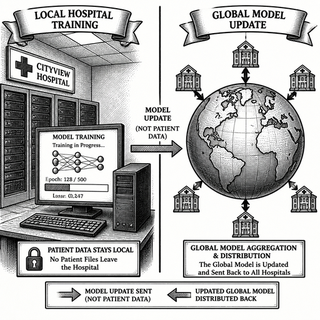
Instead of sending patient data to the model, you send the model to the data. Each hospital trains a local version of the model on its own records, then shares only model updates - not the underlying patient files - with a central coordinator. Those updates are combined into an improved global model, which gets sent back out for another round.
If centralized learning is like asking every hospital to dump its library into one warehouse, federated learning is more like sending out a master librarian who takes notes at each branch and comes back smarter without hauling away the bookshelves.
That sounds almost suspiciously neat, so the next reasonable question is: does this actually solve the privacy problem?
Better for privacy is not the same as magically private
One of the strongest appeals of FL is that raw patient data stays local. That matters a lot. But the review makes a careful point here: keeping data local does not automatically make a system fully private or fully secure.
Model updates can still leak information under some circumstances. So researchers have been building extra layers of protection, including:
- Differential privacy - adding carefully controlled noise so individual patient information is harder to infer
- Secure aggregation - combining updates in a way that prevents the coordinator from seeing each institution's contribution separately
- Confidential computing - using protected hardware environments for sensitive computations
This is where the field gets interesting fast. FL is not a single trick. It's more like a stack of methods, engineering choices, and governance decisions all pretending to be one tidy acronym.
The really annoying problem: hospitals are different
Even if privacy were perfectly handled, healthcare data has another personality trait: it is wildly non-identical across institutions.
One hospital might serve an older population. Another may use different imaging machines. A third may code diagnoses differently, collect different lab values, or have very different rates of certain conditions. In machine learning terms, these are non-identical data distributions. In normal-human terms: the data does not match from place to place, because real life refuses to standardize itself for our convenience.
That matters because many machine learning methods assume the training data is reasonably similar across sites. Federated learning has to work even when one hospital's "normal" looks quite different from another's.
The review highlights algorithmic strategies designed to handle this mismatch. These methods try to make collaborative models more robust, more generalizable, and less likely to perform well only for the institutions that happen to look most like the original training set. That's a big deal if the goal is clinically useful AI rather than a paper that gets framed and admired from a distance.
Why this could matter for actual patients
This is the point where a smart reader might ask: okay, but what changes for patients if this works?
Potentially, quite a lot.
If FL succeeds at scale, hospitals could build AI systems using broader and more representative data without having to centralize sensitive records. That could produce models that are:
- More accurate across different populations
- Less biased toward one institution's quirks
- More useful in community hospitals, not just elite research centers
- Easier to keep updated over time as practice patterns change
The review frames FL as a path toward generalizable, equitable, and clinically impactful AI. Those are ambitious words, but they get at a real problem. A medical model is not very impressive if it only shines in the place where it was born. Healthcare does not need more hot-house orchids. It needs sturdy plants that survive outside the greenhouse.
Why this still isn't routine in hospitals
And here comes the inevitable catch: real-world deployment is hard.
The paper emphasizes that moving FL from research to everyday clinical use requires more than better algorithms. It needs infrastructure - scalable, interoperable systems that can function across institutions with different software, workflows, security rules, and regulatory obligations.
That includes things like:
- Reliable ways to coordinate training across many sites
- Standards for data and model interoperability
- Monitoring and maintenance after deployment
- Governance frameworks that align with regulation
- Trustworthy workflows that clinicians and institutions will actually use
This is the less glamorous side of innovation, but honestly it's where many promising ideas either mature or quietly wander off into the fog. Building a clever federated model is one challenge. Running it persistently, safely, and in compliance with healthcare regulations is an entirely different sport.
The review also points to the idea of FL-as-a-service platforms - essentially making federated learning easier to deploy and manage so hospitals do not each need to reinvent the machinery from scratch. That may sound mundane, but "boring infrastructure" is often the thing standing between an elegant prototype and something that helps a patient on a Tuesday morning.
A paradigm shift, if the plumbing gets built
The authors describe FL as a paradigm shift, and that feels fair. Traditional multi-institutional AI efforts have often been bottlenecked by the need to centralize data. Federated learning offers a different philosophy: collaborate without surrendering data custody.
That has obvious appeal in biomedicine, where data sensitivity is not a footnote - it's the whole room.
Still, the most grounded takeaway from this review is not "problem solved." It's more like: here is a promising route through a thicket of privacy, data fragmentation, and deployment barriers, but the route still needs paving. The algorithms are improving. The privacy tools are getting more sophisticated. The vision is compelling. The infrastructure and operational side now need to catch up.
And if that happens, healthcare AI could become less of a series of isolated pilot projects and more of a durable system that learns from many places while respecting the boundaries that medicine has good reason to keep.
That would be a quiet revolution, which is often how the useful ones arrive.
This blog post discusses research findings and should not be taken as medical advice. If you have concerns about healthcare AI, medical data privacy, or clinical decision-making, please consult a qualified healthcare provider or relevant institutional expert. Research discussed here represents ongoing scientific investigation and clinical validation is still in progress.
All images used in this post are decorative illustrations only and do not represent or reflect the accuracy, reality, or correctness of the referenced research.
Primary Source: Federated Learning in Healthcare: From Research to Real-World Deployment. PubMed Record 41563839. PubMed link