
Neurons get extremely busy very fast, and scientists have struggled to figure out exactly how they avoid running out of fuel mid-thought. A new paper fixes part of that problem by inventing a tool that can actually watch the energy juggling act happen inside a single living cell, in real time.
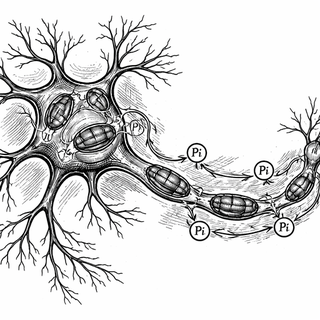
That is the translation. Now let's dig into why this is quietly one of the more elegant problems in neuroscience.
The Energy Problem Nobody Talks About
Your brain accounts for roughly 2% of your body weight and consumes somewhere between 20-25% of your total energy budget. You have probably heard this statistic before, usually deployed to make the brain sound impressively greedy. What gets less attention is how fast the situation can change.
When a neuron fires - really fires, during intense activity like a seizure, a complex thought, or learning something genuinely new - its energy demand spikes dramatically within milliseconds. Not minutes. Milliseconds. The mitochondria, which are the cell's actual power generators, need to scale up production nearly instantaneously to match.
The question that has vexed researchers is simple to state and annoyingly hard to answer: how does the mitochondrion know?
It does not have a phone. It cannot see the synapse firing at the other end of the cell. Something has to carry the message that says "we need more ATP, and we need it right now."
Enter the Humble Phosphate Ion
The lead suspect is inorganic phosphate - written as Pi in biochemistry shorthand, which makes it sound like a minor character in a math textbook. But Pi may actually be one of the most important signal molecules you have never heard of.
Here is the rough logic. ATP, the cell's energy currency, gets broken down into ADP plus a free phosphate ion every time it powers something. That released phosphate - the Pi - does not just float around uselessly. It is a direct chemical signal that energy has been spent. And conveniently, it is also the raw ingredient the mitochondria need to make more ATP in the first place.
The hypothesis, which has been kicking around the field for some time, is that Pi acts as a metabolic messenger: it rises rapidly when neurons are active, and that rise simultaneously signals mitochondria to ramp up production and provides some of the substrate to do it. Elegant. Plausible. Extremely difficult to actually demonstrate.
The difficulty has been measurement. Inorganic phosphate is small, abundant, fast-moving, and - until recently - had no reliable way to be tracked inside a single living neuron at the timescales that matter.
A Glowing Solution
The new work addresses this with a custom-engineered fluorescent biosensor designed specifically to monitor cytosolic Pi levels in living cells with the spatial and temporal precision the problem demands.
Biosensors of this type work by exploiting proteins that change their fluorescence properties when they bind a target molecule. Build one that binds Pi selectively, express it inside neurons, shine a light on it, and you can watch Pi concentrations rise and fall in real time as the cell does things. The engineering challenge is considerable - you need the sensor to be sensitive enough to catch the fast dynamics, specific enough not to respond to a dozen other abundant metabolites, and quantitative enough that you can actually trust the numbers you get.
Getting all three right at once, in a system as chemically complex as a neuron's cytoplasm, is not trivial. The fact that they managed it is the real technical achievement here.
Why Spatiotemporal Precision Matters
One phrase in the abstract deserves a moment: "spatiotemporal precision in single live cells." This is doing a lot of work.
The brain is not a homogenous soup. Pi dynamics in the dendrites - the branching input regions of a neuron - may be completely different from Pi dynamics at the cell body or near the mitochondria themselves. If you only measure the average Pi level across the whole cell, you might miss gradients and local signals that are doing the actual communication. The biosensor approach allows the researchers to watch specific compartments of a neuron during activity, which is a meaningfully different type of experiment than anything possible before.
This kind of subcellular resolution is why the tool matters as much as any finding it has produced so far. It is a new instrument, not just a new result.
The Bigger Picture
Understanding how neurons match energy supply to demand has implications well beyond basic neuroscience curiosity. Failures in this coupling are implicated in a range of neurological conditions. Epilepsy, for instance, involves runaway neuronal activity that presumably makes extreme demands on local energy production. Neurodegenerative diseases like Parkinson's and Alzheimer's are increasingly understood as involving mitochondrial dysfunction - the power plants start failing before the neurons themselves do. Even normal aging may partly reflect a gradual erosion of this tight metabolic coordination.
Better tools for watching the Pi-mitochondria relationship in action may eventually point toward intervention targets. If Pi signaling is a key step in the energy-coupling chain, then it is also potentially a point where that chain can break, and perhaps a point where it could be therapeutically reinforced.
That is a longer road, and this paper is early on it. But the instrument itself - a quantitative, real-time Pi biosensor for living neurons - is exactly the kind of enabling technology that tends to accelerate a field once it arrives.
The Unglamorous Hero
Inorganic phosphate is not the flashiest molecule in the brain. It has no catchy name, no documentary, no celebrity disease association. It is simply one of the most abundant ions in the cell, the molecular residue left behind every time your neurons do anything at all.
The suggestion that this chemical leftover is also a key signal coordinating the entire energy economy of the neuron is the kind of finding that makes you appreciate evolution's sense of economy. Why invent a separate signaling molecule when the waste product of energy use is already proportional to energy demand, already present in the right place, and already needed by the machine that produces energy?
Sometimes the obvious answer is obvious because it is correct. Now we have a way to actually watch it happen.
This blog post discusses research findings and should not be taken as medical advice. If you have concerns about neurological conditions or brain health, please consult a healthcare provider. Research discussed here represents ongoing scientific investigation and clinical validation is still in progress.
All images used in this post are decorative illustrations only and do not represent or reflect the accuracy, reality, or correctness of the referenced research.
Primary Source: Inorganic phosphate and the rapid mobilization of metabolic energy in neurons. PubMed. 2026. PMID: 41875165