
The future has developed a habit of arriving in tissue culture dishes. In this case, not with chrome-plated robots or glowing cityscapes, but with living neurons grown in vitro and coaxed into communicating quickly while sipping energy like a miserly laptop on 3 percent battery. That is the broad intrigue of this PubMed-listed study: biological neuronal networks, grown outside the body, can be paired with a carefully engineered electrode system and stimulated in predictable ways that appear to support both low-power operation and high-speed communication. Science fiction tends to imagine intelligence as metal and sparks. Biology, naturally, shows up late and smug with a more efficient design.
Why This Paper Is Interesting
Most conversations about intelligent systems eventually end up circling silicon. Faster chips. Bigger models. More computing power. More electricity. More heat. More data centers the size of a moderately judgmental suburb. The irony is hard to miss: we keep trying to build brain-like systems using hardware that behaves very much unlike a brain.
Biological neural networks, or BNNs, are different. These are living networks of neurons that can process signals in parallel and do so with extraordinary energy efficiency. The human brain, after all, has been performing complicated real-time computation on a power budget that would barely impress a kitchen appliance. Researchers have long suspected that biology may have useful computational tricks left to teach us.
The problem has not been enthusiasm. The problem has been consistency. If you want to understand how living neural networks compute, you need experimental systems that can stimulate and record them in a standardized, reliable way. Otherwise, every experiment risks becoming a slightly fancier séance.
What The Researchers Built
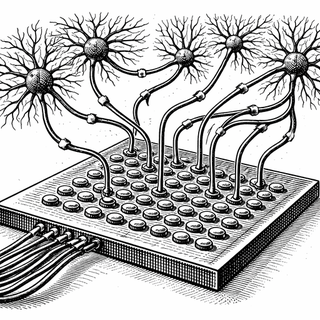
According to the summary provided, the team fabricated a 256-channel in vitro microelectrode array, or MEA. Think of an MEA as a highly organized listening and talking surface for neurons. It can both record electrical activity from cells and deliver stimulation back to them. If you want to study how a neuronal network responds, learns, adapts, or routes information, this is the sort of platform you need.
What makes this setup notable is the coating. The array was modified with platinum nanoparticles and PEDOT:PSS, a conductive polymer that has become a favorite in bioelectronics for good reason. Together, these materials created a hybrid interface with low impedance and high charge-storage capacity. Translated from engineering dialect into ordinary English, that means the electrodes can exchange signals with the neurons more efficiently and with less electrical resistance getting in the way.
The reported impedance was 15.33 ± 0.63 kOhm at 1 kHz, along with a high charge-storage capacity of 87.30 ± 5.82 mC cm. Those numbers matter because better electrical coupling generally means cleaner recording, more effective stimulation, and less wasted energy. In a field chasing low-power, high-fidelity biological computing, that is not decorative detail. That is the plumbing.
The Big Idea: Predictable Stimulation
The title points to the real conceptual centerpiece: predictable stimulation.
That phrase sounds almost disappointingly tidy, but it gets at a serious challenge. Living neurons are not transistors. They are variable, adaptive, and occasionally temperamental in the way only living systems can be. If researchers can discover stimulation patterns that reliably produce fast, controlled communication across a biological network, that moves the field from “interesting biology experiment” toward “usable computational platform.”
In other words, this is not merely about poking neurons and seeing what happens. It is about building a structured dialogue with a living network. The less chaotic and more reproducible that dialogue becomes, the more plausible it is that BNNs could be harnessed for defined computational tasks.
That would be a meaningful step, because one of the persistent criticisms of bio-derived computing is that it sounds fascinating right up until someone asks how you standardize it, scale it, or reproduce it on a Tuesday. Predictability is the answer researchers keep needing.
Why Low Power Matters So Much
Energy efficiency is not a glamorous topic until the electric bill arrives. Modern AI systems are powerful, yes, but they are also hungry. Training and running them can require enormous computational resources. Brains, by contrast, achieve remarkable performance with astonishing thrift.
If in vitro neuronal networks can communicate rapidly while using relatively little power, that makes them scientifically interesting and technologically provocative. The dream here is not that tomorrow's laptop will contain a tiny petri dish, which I suspect would create warranty complications. It is that biology may reveal computational principles or hybrid architectures that conventional hardware has not yet mastered.
There is also a broader lesson. Sometimes the most advanced engineering move is not to overpower a problem, but to cooperate with a system that evolution has already spent a few hundred million years optimizing.
What Challenges This Research Is Trying To Solve
This work addresses several bottlenecks at once.
First, it tackles the interface problem. Neurons are delicate, analog, and biologically alive. Electronics are rigid, synthetic, and usually happiest when everything behaves on schedule. Getting those two worlds to communicate efficiently is a nontrivial materials challenge.
Second, it tackles the standardization problem. The field needs repeatable platforms and paradigms if it wants to move beyond proof-of-concept spectacle.
Third, it tackles the speed-versus-power problem. In technology, we often want both and receive a lecture about tradeoffs instead. A system that supports high-speed communication without guzzling energy is exactly the sort of result that gets people thinking bigger.
What This Could Mean In The Real World
If follow-up work holds up, there are a few plausible long-term implications.
One is neuromorphic computing. Biological networks may inspire or directly participate in computing systems that operate differently from standard digital architectures. Another is better brain-machine interfaces, since improved low-impedance, high-capacity electrode materials are valuable anywhere electronics must speak clearly with neural tissue. There may also be implications for basic neuroscience, because a more controllable in vitro network gives researchers a better test bed for studying how neurons encode and transmit information.
Still, this is where the grown-up voice has to enter the room. This is not a consumer technology. It is not a clinical treatment. It is not evidence that living neurons are about to replace silicon in your phone, your car, or your annoyingly conversational refrigerator. It is foundational research. Foundational research is often where the real revolutions start, but it also tends to spend a while looking modest and technical before anyone outside the field notices.
The Takeaway
What I like about this study is that it refuses the usual false choice between biology and engineering. It treats living neuronal networks not as mysterious blobs and not as crude machine parts, but as systems that can be studied, interfaced with, and perhaps eventually used in disciplined ways. That is a more interesting story than “brains are amazing,” which, while true, does not narrow the methods section.
The paper suggests that with the right electrode design and the right stimulation strategy, biological neuronal networks can achieve something engineers worship with almost religious intensity: speed without extravagant power consumption. It is an elegant reminder that nature still has a few design notes we have not fully copied yet. Probably many more than a few, if we are being honest.
This blog post discusses research findings and should not be taken as medical advice. If you have concerns about neurological conditions or neurotechnology-related care, please consult a healthcare provider. Research discussed here represents ongoing scientific investigation and clinical validation is still in progress.
All images used in this post are decorative illustrations only and do not represent or reflect the accuracy, reality, or correctness of the referenced research.
Primary Source: PubMed Record 41983381. In Vitro Biological Neuronal Networks Achieve Low-Power Consumption and High-Speed Communication through Predictable Stimulation. Available at: https://pubmed.ncbi.nlm.nih.gov/41983381/