
Here’s a sentence I never thought I’d write: a wound dressing for diabetic infections is being pitched almost like a stage manager, changing cues over time so the healing environment gets the right nudge at the right moment instead of the same treatment on loop. That is a genuinely intriguing idea. Most dressings are more like a decent band playlist from 2007 - they pick a vibe and stick with it. This one, at least on paper, wants to adapt.
The study behind this claim is titled Self-Evolving Hydrogel Dressing Temporally Accelerates Infected Diabetic Wound Healing and comes from PubMed record 42011839. The core problem it targets is very real: diabetic wounds are notoriously stubborn, especially when infection joins the party. These wounds often sit in a biochemical mess of inflammation, oxidative stress, and impaired immune balance, which is a terrible recipe for tissue repair and an excellent recipe for prolonged suffering.
Why diabetic wounds are such a headache
A normal wound heals in stages. First comes defense and cleanup, then tissue rebuilding, then remodeling. Diabetic wounds often get stuck in the early phases. Inflammation lingers. Harmful reactive oxygen species can pile up. Immune activity becomes disorganized. Bacteria take advantage. The result is not just slow healing, but a kind of biological traffic jam where several systems are misfiring at once.
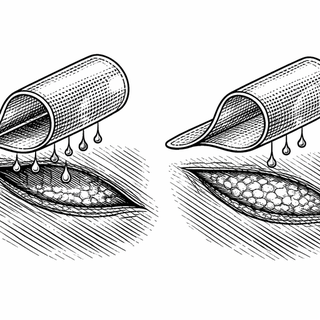
That is why these wounds are so hard to treat with a single clever ingredient. Kill bacteria alone, and you may still have a wound environment that is too inflamed to rebuild. Soothe inflammation alone, and you may leave microbes happily renting the place. A therapy that can do both, and do them in sequence, would address a problem that clinicians have been wrestling with for a long time.
What this hydrogel seems to be trying to do
From the summary provided, the dressing is a hydrogel built from hyaluronan and poly(aspartic acid). Hydrogels are appealing for wound care because they can hold water, conform to tissue, and act as delivery platforms for active compounds. Hyaluronan is already familiar territory in tissue repair research because it is part of the body’s extracellular matrix and tends to play well with healing tissues.
The interesting twist is the “self-evolving” part. The authors say existing strategies struggle to combine potent antibacterial activity with temporal modulation of the wound microenvironment. In plain English, the field has a timing problem. A wound does not need exactly the same intervention on day 1 as on day 7. The proposed dressing seems designed to meet that challenge by changing what it does over time.
The abstract snippet also mentions “in situ Ag,” which strongly suggests silver-based antibacterial chemistry generated or incorporated within the gel. Silver is not a new celebrity in wound care. It has been drafted into antimicrobial service for years because bacteria tend not to enjoy contact with it. The more novel claim here is not “silver kills bacteria.” We have known that for a while. The novel claim is that the material may coordinate antibacterial action with later shifts in the wound environment, rather than treating healing as one long emergency broadcast.
Why that timing idea matters
This is the part worth taking seriously.
Infected diabetic wounds are a moving target. Early on, reducing bacterial burden can be essential. But if a dressing keeps hammering the tissue indiscriminately, it can also risk interfering with cells needed for repair. A smarter material would ideally come in strong when infection is the main issue, then ease into a more regenerative role once the battlefield is less chaotic.
If this hydrogel truly changes function across time, that is more than a chemistry trick. It is an attempt to match biology’s sequence rather than bully biology into a single response. In wound care, that is a sensible design principle, and frankly an overdue one.
The good news, with the brakes gently applied
Methodologically, the study’s premise deserves credit. It is tackling a clinically meaningful problem, and it is doing so with a mechanistic idea that maps onto what we know about diabetic wound pathology. That is the kind of translational research pitch you want to see: not just “here is a shiny material,” but “here is why timing and microenvironment matter.”
But let’s not hand this dressing its Nobel tuxedo just yet.
For one thing, the summary available here is limited. We do not have the full dataset in front of us, and the abstract excerpt cuts off before key details are spelled out. That means several important questions remain unanswered in this snapshot alone:
How strong was the antibacterial effect, and against which organisms?
How was “temporal” modulation measured?
Was the healing benefit large, modest, or one of those statistically tidy improvements that look less thrilling outside a graph?
And perhaps most importantly, was the work done in cell systems, animal models, or human patients?
That last question matters a lot. The distance between “works beautifully in a controlled preclinical setting” and “improves outcomes in a clinic full of real people with complicated diabetes, circulation problems, and mixed infections” is not a gap. It is a canyon with paperwork.
The usual material-science caveats
Advanced wound dressings often shine in early studies because the experimental conditions are unusually well-behaved. Real wounds are not. They vary by blood supply, glucose control, bacterial species, patient age, immune status, and whether someone is actually able to keep the dressing in place and follow care instructions.
There are also familiar concerns with silver-based approaches. Antibacterial activity is useful, but balance matters. Too little does nothing. Too much can raise toxicity concerns for host tissues. A “smart” dressing has to be smart in the unglamorous ways too, including dose control, degradation behavior, manufacturing consistency, shelf stability, and cost. Science loves a heroic mechanism. Hospitals, meanwhile, would also like something that can be produced reliably and not cost the same as a used sedan.
None of this means the approach is overhyped. It means the burden of proof is still doing its job.
What success would look like in the real world
If follow-up studies hold up, a dressing like this could matter because diabetic wound care needs options that are better than simple coverage and less cumbersome than stacking multiple partial solutions together. A material that reduces infection pressure while steering the wound toward a healthier healing state could lower complication rates, shorten recovery, and potentially reduce the march toward chronic ulcers and amputations.
That is the hopeful case.
The more measured case is that this study may represent a promising design strategy rather than a near-ready product. And that distinction matters. People dealing with diabetic wounds do not need another round of “breakthrough” headlines that turn out to be three lab benches, two mice, and a very optimistic press office. They need therapies that survive contact with clinical reality.
The bottom line
This paper is interesting because it does not treat infected diabetic wounds as a one-note problem. It recognizes that these wounds are dynamic and biologically messy, and it proposes a dressing meant to respond in phases rather than with a single blunt function. That is clever, and more importantly, it is clinically logical.
Still, the phrase “self-evolving hydrogel” should trigger curiosity, not surrender. The concept is strong. The disease target is important. The idea of timed microenvironment control makes sense. But until the full evidence shows how robust, safe, and generalizable the effect really is, this belongs in the “promising and worth watching” folder, not the “medicine has entered its wizard era” folder.
That may sound cautious. It is. Caution is underrated. It is also how you avoid falling in love with a material before it has done the very awkward task of proving itself.
This blog post discusses research findings and should not be taken as medical advice. If you have concerns about diabetic wounds or wound infections, please consult a healthcare provider. Research discussed here represents ongoing scientific investigation and clinical validation is still in progress.
All images used in this post are decorative illustrations only and do not represent or reflect the accuracy, reality, or correctness of the referenced research.
Primary Source: Self-Evolving Hydrogel Dressing Temporally Accelerates Infected Diabetic Wound Healing. PubMed Record 42011839. Source link