
Imagine your brain as a house with two roommates. One roommate keeps the energy low - they're the one closing blinds, suggesting naps, and making sure you don't do anything too wild on a Tuesday night. The other roommate is a party animal - constantly wanting to redecorate, start new projects, and convince you that 3 AM is a perfectly reasonable time to reorganize the entire garage.
In bipolar disorder, these roommates are constantly fighting over the thermostat. And sometimes, the party animal locks the other one in a closet and goes absolutely bananas.
A clinical trial (NCT04696471) is using something called theta burst stimulation to figure out exactly how mania happens in the brain - and potentially, how to flip it off. Welcome to one of the most fascinating areas of neuroscience research today.
What Actually IS Mania?
Let's be clear: mania isn't just "being really happy" or "having a lot of energy." It's a distinct brain state that, for people experiencing it, can feel incredible until it absolutely wrecks their lives.
During a manic episode, people might:
- Sleep only 2-3 hours a night (and feel fantastic)
- Start multiple ambitious projects simultaneously
- Spend money they don't have on things they don't need
- Talk faster than most people can think
- Make decisions that seem brilliant at the time and catastrophic in retrospect
- Experience grandiose beliefs about their abilities or importance
The tricky part? During the episode, many people feel better than they've ever felt. They're productive, creative, confident. The problem is that mania is fundamentally unsustainable - the crash is coming, and it often brings severe depression with it.
Bipolar disorder affects approximately 2.8% of the U.S. adult population, and the cycling between manic and depressive episodes creates enormous challenges for treatment and quality of life.
Your Prefrontal Cortex: The Adult in the Room
To understand mania, we need to talk about the prefrontal cortex - specifically, the dorsolateral prefrontal cortex (DLPFC). This region sits right behind your forehead and is basically the brain's supervisor. It handles executive functions like planning, impulse control, working memory, and emotional regulation.
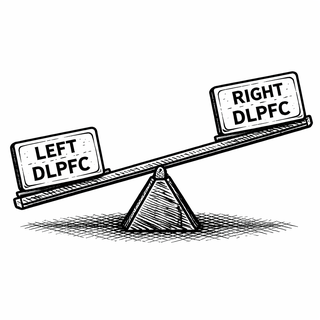
Here's where things get interesting. Brain imaging studies have consistently shown that in depression, the left DLPFC tends to be underactive, while the right DLPFC is relatively overactive. Think of it as a seesaw that's tilted the wrong way.
The theory for mania is essentially the opposite pattern - the left side gets hyperactive while the right becomes relatively suppressed. The supervisor who usually says "maybe don't spend $10,000 on a trampoline" is now saying "trampolines are an INVESTMENT."
As Hett and Marwaha (2020) noted in Therapeutic Advances in Psychopharmacology, "In patients with mania, it was believed that there is a relative increase in metabolism on the left side, whereas the right side has a lower anterior metabolism" (DOI: 10.1177/2045125320973790).
Enter Theta Burst Stimulation
Traditional repetitive transcranial magnetic stimulation (rTMS) has been used to treat depression for years. The FDA approved it in 2008, and it's become an important option for treatment-resistant depression. The basic principle is simple: deliver magnetic pulses to the left DLPFC to boost its activity, counteracting the underactivity seen in depression.
But rTMS sessions are long - traditionally about 37 minutes each - and patients need to come in five days a week for weeks. That's a significant time commitment that limits who can actually complete treatment.
Theta burst stimulation (TBS) is the express version. It delivers pulses in a pattern that mimics natural brain rhythms (the "theta" refers to 4-7 Hz oscillations that occur naturally in the hippocampus and cortex). This allows the same neuroplastic effects to be achieved in just 3-10 minutes per session.
There are two main flavors:
- Intermittent TBS (iTBS): Brief bursts of stimulation with pauses in between - generally excitatory (increases activity)
- Continuous TBS (cTBS): Uninterrupted stimulation - generally inhibitory (decreases activity)
The 2024 meta-analysis by Berlim et al. in Molecular Psychiatry found that theta burst stimulation protocols are effective for depression, with similar efficacy to standard rTMS but in a fraction of the time.
The Mania Problem
Here's the twist: the same stimulation that treats depression can sometimes cause mania. Case reports have documented patients with bipolar disorder who developed hypomanic or manic episodes during or after left DLPFC iTBS treatment for depression.
As Suhas and Rao (2023) reported in the Indian Journal of Psychiatry, "The manic switch may even occur in the presence of mood stabilizers and antipsychotic medications."
This seems like a bug, but it might actually be a feature - at least for research purposes. If we can accidentally trigger mania by over-stimulating certain brain circuits, maybe we can learn exactly which circuits are involved. And if we can turn mania ON, theoretically we should be able to turn it OFF.
The clinical trial NCT04696471 is specifically designed to study these neural mechanisms. By carefully applying different TBS protocols while measuring brain activity and mood symptoms, researchers hope to map out exactly how the mania switch gets flipped.
The Seesaw Theory
One leading theory suggests that treating mania might require the opposite of treating depression. If left DLPFC overactivity contributes to mania, then perhaps:
- cTBS to the left DLPFC (to reduce its activity) or
- iTBS to the right DLPFC (to boost the relatively suppressed side)
...could help rebalance the system.
A randomized controlled trial published in Archives of Biological Psychiatry tested this approach, using iTBS to the right DLPFC combined with cTBS to the left DLPFC in patients with acute mania. The results were mixed - active stimulation didn't separate from sham as clearly as hoped - but the study established that the approach is safe and feasible.
What Else Is Going On Down There?
The DLPFC doesn't work in isolation. It has extensive connections to deeper brain structures, particularly the subgenual anterior cingulate cortex (sgACC) - a region that seems to be hyperactive in depression.
Here's the elegant part: the left DLPFC and sgACC appear to have an anticorrelated relationship. When one goes up, the other goes down. Stimulating the left DLPFC might help depression not just by directly activating it, but by indirectly calming down the overactive sgACC.
This connectivity model might explain the manic switch. If you over-stimulate the left DLPFC, you might over-suppress the sgACC, disrupting the normal balance and triggering a flip to the opposite mood state.
Research using interleaved TBS and fMRI has begun mapping these effects in real time. Scientists can now watch what happens in the whole brain network while stimulation is being delivered - it's like having a window into the mood-regulation machinery as it operates.
The Serotonin Connection
There's also a neurochemical piece to this puzzle. The 5-HT1A receptor - a serotonin receptor found throughout the prefrontal cortex - may be involved in TBS's mechanism of action.
A 2023 study in Translational Psychiatry found that bilateral theta burst stimulation changed 5-HT1A receptor availability in the DLPFC. The researchers speculated that this could lead to "disinhibition of neurotransmission and increase in neuronal activity" - potentially the desired effect in depression, but potentially problematic if it goes too far.
Why This Research Matters
Bipolar disorder is notoriously difficult to treat. The medications that work often have significant side effects - weight gain, cognitive dulling, thyroid problems, and more. Many patients cycle between medication trials, never finding something that works well enough without costs that feel too high.
If we truly understood the neural mechanisms of mania, we might be able to:
- Develop more precisely targeted treatments
- Predict who is at risk for manic switch during depression treatment
- Create neuromodulation protocols specifically for mania (which barely exist currently)
- Personalize treatment based on individual brain patterns
The theta burst stimulation research is particularly exciting because it offers a window into mechanism. Unlike medications that affect the whole brain, TBS can be aimed at specific circuits. By carefully mapping what happens when different circuits are stimulated or inhibited, we can build a causal understanding of mood regulation.
The Road Ahead
Clinical trial NCT04696471 represents one piece of a much larger puzzle. Researchers at institutions around the world are using various combinations of brain stimulation and neuroimaging to decode the neural basis of bipolar disorder.
The ultimate vision is a precision psychiatry where treatments are matched to individual brain patterns - where we don't just try medications and hope for the best, but actually target the specific circuit abnormalities causing each person's symptoms.
We're not there yet. But every study that helps us understand how the brain generates and regulates mood states brings us closer. The party animal and the homebody in your head might always be in tension - but at least we're learning the rules of their game.
References:
- Hett, D., & Marwaha, S. (2020). "Repetitive transcranial magnetic stimulation in the treatment of bipolar disorder." Therapeutic Advances in Psychopharmacology, 10, 2045125320973790. DOI: 10.1177/2045125320973790
- Berlim, M.T., et al. (2024). "Theta burst stimulation for depression: a systematic review and network and pairwise meta-analysis." Molecular Psychiatry. DOI: 10.1038/s41380-024-02630-5
- Suhas, S., & Rao, N.P. (2023). "Mania triggered by intermittent theta burst stimulation - A case study." Indian Journal of Psychiatry, 65(9), 960-962.
- Desmyter, S., et al. (2016). "Neuromodulation of the subgenual anterior cingulate cortex in depression." Brain Stimulation, 9(4), 528-538.
- Kaster, T.S., et al. (2023). "Effects of bilateral sequential theta-burst stimulation on 5-HT1A receptors in the dorsolateral prefrontal cortex in treatment-resistant depression." Translational Psychiatry, 13, 319.
Disclaimer: This blog post is for informational purposes only and does not constitute medical advice. Clinical trials are ongoing research and results are not yet confirmed. Bipolar disorder is a serious medical condition that requires professional treatment. Never attempt brain stimulation outside of clinical settings. Always consult with qualified healthcare professionals regarding mental health conditions and treatments. Images and graphics are for illustrative purposes only and do not depict actual medical devices, procedures, mechanisms, or research findings from the referenced studies.