
Replacing the vitreous body should be simple by now. It is, after all, a clear gel sitting in the middle of the eye, not a tiny diva with impossible demands. And yet this new PubMed study is a good reminder that the vitreous is less like harmless jelly and more like a very picky houseguest: too much swelling, wrong breakdown pattern, or an overly welcoming surface for cells, and suddenly everything gets complicated.
Why the vitreous matters
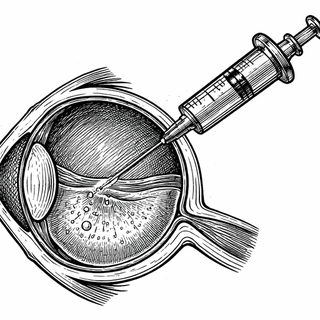
The vitreous is the transparent gel that fills most of the eyeball and helps maintain its shape while supporting the retina. In surgery, especially when the retina is damaged or detached, ophthalmologists sometimes need to remove that gel. Then comes the obvious question: what do you put back?
That question has kept researchers busy for years, because the ideal vitreous substitute needs to do several things at once. It should be clear, stable, gentle on surrounding tissues, and mechanically appropriate for the eye. It also should not swell unpredictably or invite the wrong cells to set up camp. In medicine, the phrase “close enough” rarely ends well, and inside the eye it ends even less well.
This study focuses on a hyaluronic acid-based hydrogel. Hyaluronic acid, or HA, is already familiar in medicine and biology. It is a naturally occurring molecule found in connective tissues and in the eye itself, which makes it an appealing material for a vitreous substitute. But appealing is not the same as ready for prime time.
What this study set out to fix
The researchers were not just asking whether an HA hydrogel is biocompatible. That is the starting line, not the finish. They wanted to refine the material around three practical issues that matter if this ever moves closer to patient care:
- How much the hydrogel swells inside eye-like conditions
- How it responds to enzymes that might break it down
- Whether fibroblasts, the cells involved in scarring, like to attach and grow on it
That last point deserves extra attention. One feared complication after retinal surgery is proliferative vitreoretinopathy, or PVR, where cells proliferate and create scar-like membranes that can pull on the retina. In plain language, the eye starts doing an unhelpful version of wound healing in exactly the wrong place. A vitreous substitute that discourages that process would be doing clinicians and patients a real favor.
The swelling problem is not a small detail
Swelling sounds boring until you remember where this material is supposed to live. The eye is a tightly controlled, enclosed space. A hydrogel that expands too much is not being “enthusiastic.” It is being dangerous.
In this study, the researchers tested UV-crosslinked HA hydrogels in two forms: chunks and injectable extrudates. They also varied osmolarity and used physiological media, including a dehydration-rehydration protocol. That matters because handling and storage conditions can change what happens after placement.
The headline finding is that swelling depended on both the formulation and the physical format. Pre-dehydrated extrudates reached up to 1.8 times their baseline weight. That is a useful warning sign and a useful engineering clue. It tells us this is not just about what the material is made of, but also how it is prepared and delivered.
From a bedside perspective, this is exactly the sort of detail that can separate an elegant material in the lab from a trustworthy one in the operating room. Surgeons do not need surprises. Patients definitely do not need surprises. The retina, if it could file complaints, would likely agree.
Not all enzymes are equal
The team also looked at degradation using hyaluronidase, trypsin, and collagenase. Only hyaluronidase led to hydrogel degradation. The proteases did not.
That is interesting for two reasons. First, it suggests a level of selectivity in how the material breaks down. Second, it gives researchers a better map of what biological forces matter most for this hydrogel system. Since HA is a natural substrate for hyaluronidase, the result makes mechanistic sense. It is less a case of random collapse and more a case of the right key fitting the right lock.
For translation, controlled degradation is a balancing act. You do not want the substitute to disappear before it has done its job, but you also do not want it to linger in a way that causes new trouble. The eye is not fond of either chaos or clutter.
The antifibrotic angle may be the quiet star here
One of the more encouraging results is that fibroblasts showed reduced proliferation on the hydrogel surface. That suggests the material may be less hospitable to the cell behavior linked with PVR.
This does not mean the hydrogel is now a magic anti-scarring shield. Research almost never hands us magic, which is rude but consistent. Still, reduced fibroblast proliferation is a meaningful feature. In retinal care, preventing traction and scar formation can be every bit as valuable as replacing lost volume.
As someone who lives mentally with one foot in the lab and one in the clinic, I find this part especially compelling. Materials science can sometimes sound abstract until you connect it to what a patient actually needs after surgery: a better chance at healing without a second act of avoidable damage.
Why this paper is more interesting than it first appears
At first glance, this might read like a technical optimization study. Swelling curves, enzyme assays, adhesion data. Very neat. Very controlled. Very easy for a casual reader to skip.
That would be a mistake.
What this paper really shows is that building a useful vitreous substitute is not about finding a clear gel and declaring victory. It is about tuning behavior. How does it behave when injected? What happens in a physiologic environment? Does it hold together appropriately? Does it encourage or discourage the wrong cells? These are not side questions. These are the questions.
And that is where the notion of a customized vitreous substitute becomes genuinely exciting. If developers can tailor swelling, stability, and cellular interactions, future materials may be matched more carefully to surgical goals and patient needs. Not every retinal case is identical, and our biomaterials probably should stop pretending otherwise.
What comes next
This study moves the field forward, but it does not mean the hydrogel is ready to become tomorrow’s routine implant. More preclinical work is needed, followed by the long, careful path toward clinical validation. Researchers will need to confirm safety, optical performance, long-term behavior, and real surgical practicality.
Still, this is how serious progress usually looks. Not flashy. Not instant. Just smart iteration on the problems that actually matter.
For patients with severe retinal disease, that kind of progress matters a lot. Better vitreous substitutes could one day support retinal repair more effectively, reduce complications, and improve visual outcomes. That is not a small ambition for something that, to most people, sounds like “just eye gel.”
This blog post discusses research findings and should not be taken as medical advice. If you have concerns about retinal disease, vitreoretinal surgery, or eye health, please consult a healthcare provider. Research discussed here represents ongoing scientific investigation and clinical validation is still in progress.
All images used in this post are decorative illustrations only and do not represent or reflect the accuracy, reality, or correctness of the referenced research.
Primary Source: Towards a Customized Vitreous Substitute: Swelling Behavior, Enzymatic Degradation, and Cellular Adhesion of a Hyaluronic Acid-Based Hydrogel. PubMed. https://pubmed.ncbi.nlm.nih.gov/42008370/