
Hot take: continuous glucose monitors may be less like medical devices and more like very judgmental fitness mirrors - except instead of asking why you wore those shoes, they quietly report what happened after your “healthy” smoothie.
A recent PubMed-indexed study looked at continuous glucose monitoring, or CGM, in physically active adults without diabetes who had mild dysglycemia at baseline. That phrase, “mild dysglycemia,” sounds like something a lab report says while adjusting its spectacles. In plain English, these were healthy, active people whose glucose readings were spending more than 5% of the time outside a fairly tight range: 70 to 140 mg/dL.
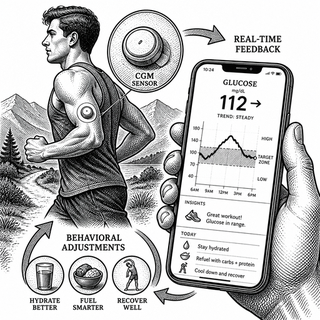
The researchers followed 225 participants over eight weeks using a real-time CGM device, the Glucose Sport Biosensor, paired with a smartphone app. The group skewed male, with 174 men and 51 women, average age about 45 years, and average body mass index around 23.4 kg/m². These were not sedentary patients discovering that stairs exist. These were physically active adults, which makes the findings more interesting and faintly ironic, as biology enjoys reminding us that a gym membership is not a force field.
What the Study Measured
CGM devices measure glucose in the fluid between cells and generate a steady stream of data. Instead of a single fasting glucose value, you get a moving picture: highs, lows, patterns after meals, overnight trends, and the occasional spike that makes you question whether a granola bar has been falsely advertising itself.
This study focused on CGM-derived metrics over four sensor-wear periods across eight weeks. Two key measurements were:
TITR, or time in tight range, meaning the percentage of time glucose stayed between 70 and 140 mg/dL.
TBR, or time below range, meaning the percentage of time glucose dropped below the lower threshold.
In diabetes care, CGM metrics are already familiar. Time in range has become a practical way to understand glucose control beyond hemoglobin A1c, which is useful but rather like judging a movie by its average brightness. CGM gives the plot.
Here, the population was different: active adults without diabetes, but with enough glucose variability to raise an eyebrow.
The Interesting Part: Glucose Metrics Improved
The study found significant effects over repeated sensor periods on both TITR and TBR. In participants whose baseline TITR was below 95%, repeated CGM use coincided with improvements in glucose control. The authors describe both cumulative and day-to-day gains, suggesting that wearing the sensor may have helped people make behavioral adjustments that nudged their glucose patterns in a better direction.
That is the central finding: short-term CGM use was associated with improved glucose metrics in people who were already healthy and active, but not metabolically perfect.
This does not mean the sensor magically improved glucose. CGMs do not secrete insulin, block dessert, or slap a muffin from your hand in the clinic parking lot. They provide feedback. The plausible mechanism is behavioral: people saw their glucose responses and changed something. Meal timing, food composition, exercise timing, sleep, alcohol intake, stress management - all the usual suspects were probably loitering near the scene.
But the study did not directly measure those lifestyle behaviors, which is a key limitation. We can reasonably infer that feedback may have influenced choices, but we cannot say exactly which choices changed.
Why This Matters
For decades, glucose monitoring outside diabetes was mostly limited to research settings, unusual medical evaluations, or the intensely curious. Commercial CGM apps have changed that. Now athletes, wellness enthusiasts, and metabolically anxious spreadsheet people can watch glucose curves in real time.
The appeal is obvious. People want personalized nutrition data. Two people can eat the same meal and have very different glucose responses. One person has oatmeal and remains serene. Another has oatmeal and produces a glucose curve that looks like it is auditioning for a roller coaster.
This study adds to the idea that CGM feedback may help some non-diabetic adults identify patterns they would otherwise miss. In particular, it may be useful for people who look healthy on paper but have early signs of glucose variability.
That said, more data is not automatically more wisdom. A CGM can produce useful insights, but it can also turn breakfast into a forensic investigation. The goal should be better metabolic understanding, not becoming emotionally dependent on a tiny adhesive oracle.
Mild Dysglycemia Is Not Nothing
The study’s inclusion criterion matters: participants had more than 5% of time outside 70 to 140 mg/dL at baseline. That is not diabetes, but it is not metabolically invisible either.
Glucose regulation exists on a spectrum. Before type 2 diabetes develops, many people pass through years of insulin resistance, impaired fasting glucose, exaggerated post-meal spikes, or subtle variability. Traditional testing may miss some of this, especially if fasting glucose and A1c are still normal.
CGM can reveal the daily texture of glucose control. A fasting lab value is a snapshot. CGM is surveillance footage, minus the ominous music.
For active adults, this can be especially intriguing. Physical activity generally improves insulin sensitivity and glucose handling. So when active people still show dysglycemic patterns, it raises practical questions: Is the issue diet composition? Meal timing? Recovery? Sleep debt? Overtraining? Genetics? Stress? The pancreas, alas, does not issue press releases.
What We Should Not Overclaim
This study is encouraging, but it should not be inflated into a universal prescription for everyone to wear CGM indefinitely.
First, this was a short-term study over eight weeks. We do not know whether improvements persist after people stop wearing sensors. Anyone who has ever bought a fitness tracker knows the honeymoon phase can be powerful. For a few weeks, one becomes a disciplined citizen of the biometric republic. Then the charger disappears.
Second, the study found associations with sensor use, but without direct measurements of lifestyle changes, we cannot identify the drivers. Did participants change breakfast? Add walks after meals? Eat fewer late-night snacks? Sleep better? Panic less? Panic more? The data do not answer that.
Third, CGM in people without diabetes raises questions about interpretation. Not every glucose rise is pathology. Glucose is supposed to increase after meals. Exercise can raise or lower glucose depending on intensity and context. A single spike after food is not a moral failure, nor is it necessarily a medical emergency.
The risk is that people may overreact to normal physiology. Medicine already has enough trouble with incidental findings. We do not need to transform toast into a diagnostic event.
Where This Could Go Next
The next generation of studies should connect CGM metrics with actual behavioral data. That means tracking meals, exercise timing and intensity, sleep, stress, alcohol, and perhaps body composition. The useful question is not merely “Did glucose improve?” but “What changed, for whom, and why?”
It would also be useful to know which people benefit most. CGM may be more helpful for individuals with early dysglycemia, family history of diabetes, prior gestational diabetes, metabolic syndrome, or unexplained post-meal symptoms. It may be less helpful for people with normal glucose patterns who are simply looking for another app to scold them.
There is also a broader public health angle. If CGM feedback can help motivated individuals improve metabolic patterns before diabetes develops, that could be valuable. Prevention is usually less dramatic than treatment, but it is also where the best wins often live. No one throws a parade for a disease that never happened, which is frankly poor civic planning.
The Bottom Line
This study suggests that repeated use of a commercial CGM system in physically active adults without diabetes, but with mild baseline dysglycemia, coincided with short-term improvements in glucose metrics. The likely explanation is that real-time feedback helped participants modify behavior, though the study did not directly prove which behaviors changed.
For clinicians, the message is cautious interest. CGM may become a useful tool for selected non-diabetic patients who want to understand glucose patterns and improve metabolic health. For consumers, the message is equally cautious: data can be helpful, but it needs context. A glucose curve is not a personality test.
The most useful CGM is not the one that makes you fear carbohydrates. It is the one that helps you notice patterns, make reasonable changes, and then go live your life without treating every sandwich like a peer-reviewed threat.
This blog post discusses research findings and should not be taken as medical advice. If you have concerns about glucose control, diabetes risk, or symptoms related to blood sugar changes, please consult a healthcare provider. Research discussed here represents ongoing scientific investigation and clinical validation is still in progress.
All images used in this post are decorative illustrations only and do not represent or reflect the accuracy, reality, or correctness of the referenced research.
Primary Source: Continuous Glucose Monitoring-Derived Glucose Metrics Over Time in Physically Active Adults Without Diabetes Using a Commercial Continuous Glucose Monitoring Application. PubMed Record ID 41773465. PubMed