
Cancer screening has a frustrating habit of asking for either patience, invasive follow-up, or a bit too much luck. By the time many cancers make enough noise to get noticed, they may already be several steps ahead. So the obvious question is: can we spot trouble earlier with something as ordinary as a blood sample? A new study suggests we might get closer by listening to some extremely tiny biological gossip.
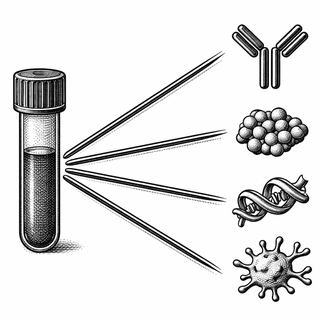
The research focuses on small extracellular vesicles, or sEVs. These are microscopic packets released by cells into the bloodstream. If that sounds suspiciously like a cellular group chat, that is because it kind of is. Cells send out these vesicles carrying proteins and other molecular cargo, and cancer cells can leave behind a distinctive fingerprint in the process.
In this study, researchers identified a four-protein signature inside these vesicles that may help detect cancer at an early stage. The proteins are thrombospondin-1, nidogen-1, pentraxin-3, and versican. Those names sound like a law firm made entirely of proteins, but together they may form a practical clue set for spotting multiple cancers.
Why Tiny Vesicles Are Such a Big Deal
One of the hardest parts of cancer detection is finding a signal that is both early and reliable. Tumors can be small, hidden, and biologically messy. Blood, meanwhile, is crowded with all kinds of molecules, many of which are not remotely interested in making our jobs easier.
That is where sEVs become interesting. Because they are released by cells and carry material from their cell of origin, they may preserve a more specific snapshot of what is happening inside tissues. If a cancer cell is active, it may shed vesicles that carry telling proteins into circulation. In theory, a blood test could pick up those signs before a tumor becomes obvious on imaging or causes symptoms.
That is a very appealing idea. It means a cancer screen might one day be less like hunting for a needle in a haystack and more like finding a suspicious shipping label on the package.
What This Study Actually Did
The researchers started by looking at proteomic profiles, essentially large-scale protein patterns, from an isogenic cancer cell line model. From that work, they narrowed the field to a four-protein biomarker panel. Then they put that panel through broader testing across 22 cancer cell lines and 764 retrospective plasma or serum samples covering multiple cancer types.
The reported performance was strong, with area under the curve, or AUC, values ranging from 0.91 to 1.00. For non-specialists, AUC is one way of measuring how well a test distinguishes between groups, such as cancer versus non-cancer. A score of 1.00 is perfect separation. A score of 0.5 is basically a coin flip wearing a lab coat. So 0.91 to 1.00 is impressive territory.
The team did not stop at identifying the protein signature. They also built a multiplex detection device designed to measure all four proteins at the same time. That matters, because a biomarker is only clinically useful if you can detect it in a way that is practical outside a research paper.
The Device Part Is Quietly Important
This detection platform combines nanoshearing-based microfluidics with surface-enhanced Raman scattering, or SERS. Those are technical terms, but the basic point is straightforward: the device is engineered to isolate and read multiple vesicle-associated protein signals efficiently from blood samples.
Why should anyone outside a lab care? Because clever biology alone does not get a test into clinics. Diagnostics live or die on whether they can be scaled, simplified, and run at reasonable cost. A test that works beautifully but requires heroic effort, rare equipment, or the patience of a saint usually stays parked in the research phase.
The study argues that this device could help solve that translation problem. It is meant to be scalable, relatively simple, and cost-effective, which is exactly the sort of unglamorous practicality that often determines whether a promising idea becomes real medicine or just a very admired conference poster.
What Happened in Real Patients
The researchers also tested the device in a prospective cohort of 68 patients. That is a notable step because prospective testing is closer to real clinical use than purely retrospective sample analysis.
In that group, the device accurately distinguished early-stage lung cancer from benign lung changes. That is especially interesting because benign lung abnormalities can be a diagnostic headache. Imaging can reveal something unusual, but not everything suspicious is cancer. A blood-based tool that helps sort out which changes deserve serious concern and which do not could reduce uncertainty for both patients and clinicians.
And if you have ever seen how often medicine has to say, "This looks concerning, now let us order three more things," the appeal here is obvious.
Why This Research Feels Different
There is no shortage of excitement around liquid biopsy and blood-based cancer detection. The challenge is that excitement has often outrun everyday clinical reality. Many approaches look promising in principle but stumble when asked to be reproducible, affordable, and useful across varied patient populations.
What makes this paper intriguing is the combination of three elements in one package:
- A specific four-protein signature rather than a vague molecular fishing expedition
- Validation across multiple cancer cell lines and hundreds of retrospective samples
- A purpose-built detection device aimed at real-world deployment
That does not mean the problem is solved. It means the work is trying to solve the right problems at the same time.
The Questions a Smart Skeptic Should Still Ask
A good early study should make you excited and slightly annoying. Excited because the idea is promising. Slightly annoying because you want to know what happens next.
For one thing, the prospective cohort was still fairly small at 68 patients. That is useful, but not enough to settle how the test will perform across broader populations, different healthcare settings, or people with other inflammatory and non-cancer conditions that might muddy the signal.
There is also the big multi-cancer question. The paper is about early-stage multi-cancer detection, and the retrospective data span multiple cancer types, which is encouraging. But large-scale screening tools need to prove not just that they can detect cancer, but when they detect it, what they are actually detecting, how early, and with what false-positive tradeoffs. Nobody wants a screening test that is hypersensitive in the way a smoke alarm is when you make toast.
Then there is the issue of workflow. Even a cost-effective device has to fit into real lab systems, regulatory pathways, and clinical decision-making. Those details are not glamorous, but they are where medical technology either matures or quietly wanders off.
What the Bigger Picture Could Be
If follow-up studies hold up, this kind of approach could become part of a future screening ecosystem where blood tests help flag risk earlier, guide imaging decisions, and sort out ambiguous findings. That would not replace every existing screening tool, and it probably should not. But it could make the whole system smarter.
The dream here is not a magical one-test-for-everything moment. Medicine is rarely that tidy. The more realistic hope is a blood-based test that gives clinicians another strong, early clue, especially when cancer is still small and treatable.
That would be a meaningful shift. Catching cancer earlier is one of those goals that sounds almost too obvious to say out loud, yet remains maddeningly hard in practice. Studies like this remind us that progress sometimes comes not from one giant breakthrough, but from learning how to read quieter signals more clearly.
And in this case, those signals may be tucked inside tiny vesicles floating through blood, carrying protein hints that, until recently, we did not know how to use nearly this well.
This blog post discusses research findings and should not be taken as medical advice. If you have concerns about cancer screening or possible cancer-related symptoms, please consult a healthcare provider. Research discussed here represents ongoing scientific investigation and clinical validation is still in progress.
All images used in this post are decorative illustrations only and do not represent or reflect the accuracy, reality, or correctness of the referenced research.
Primary Source: Early-stage multi-cancer detection through a plasma extracellular vesicle protein signature. PubMed. https://pubmed.ncbi.nlm.nih.gov/41881025/