
Two truths and a lie: (1) A slimy freshwater cyanobacterium from Japan produces one of the largest polysaccharides ever discovered. (2) Scientists just turned that slime into a hydrogel that spontaneously sprouts blood vessels. (3) The whole process requires a complex cocktail of expensive synthetic growth factors. If you picked number three, congratulations - your skepticism of costly biologics is well-placed. The gel does it on its own.
Meet Aphanothece sacrum, the Overachieving Pond Dweller
Somewhere in the freshwater streams of Japan, a cyanobacterium called Aphanothece sacrum has been quietly producing a polysaccharide so absurdly large that calling it "sugar" feels like calling the Pacific Ocean "a puddle." This organism, traditionally known as "suizenji-nori" and consumed as a delicacy in parts of Kyushu, secretes a sulfated polysaccharide (ASP) with a molecular weight that dwarfs most biological polymers. We're talking a supergiant among sugars.
What makes ASP interesting beyond its sheer size is its resume of biological talents. It's anti-inflammatory. It's an antioxidant. It hydrates like nobody's business. Think of it as the overachiever who aced every class, ran track, and still had time for student government. The kind of molecule that makes other biomaterials feel inadequate at conferences.
The Hydrogel Problem (and Its Surprisingly Elegant Solution)
Here's where the story gets scientifically juicy. Polysaccharides with these properties are prime candidates for tissue engineering scaffolds - those 3D structures that give cells a place to live, grow, and organize into functional tissue. The catch? ASP, for all its biological charm, has been stubbornly resistant to forming hydrogels under conditions that won't murder the cells you're trying to nurture.
Tissue engineers know this frustration well. You find a gorgeous biomaterial with perfect biocompatibility, and then it demands harsh crosslinking conditions that would make any self-respecting cell pack its bags and undergo apoptosis.
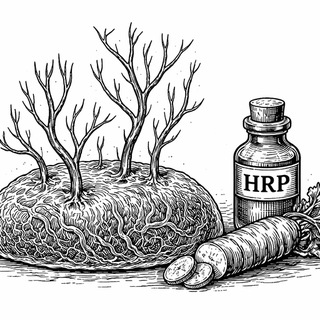
The research team's solution was elegant: graft phenol groups onto the ASP backbone, creating what they dubbed ASP-Ph. These phenol decorations serve as molecular handles that can be crosslinked enzymatically using horseradish peroxidase (HRP) and a dash of hydrogen peroxide. The reaction is mild, cell-friendly, and happens at physiological conditions. No UV radiation. No toxic chemical crosslinkers. Just an enzyme borrowed from a root vegetable doing what it does best.
Blood Vessels From a Gel - No Growth Factors Required
Now, the part that genuinely raised my eyebrows. Most hydrogels designed for tissue engineering need supplemental growth factors - proteins like VEGF (vascular endothelial growth factor) - to coax blood vessels into forming. These factors are expensive, finicky, and have a habit of diffusing away before they finish the job. It's like hiring a contractor who leaves halfway through your kitchen renovation.
The ASP-Ph hydrogel, however, demonstrated intrinsic angiogenic activity. That means it promoted the formation of new blood vessels all by itself, without being loaded with exogenous growth factors. In vivo testing confirmed enhanced vascularization - new blood vessel networks forming within and around the implanted gel.
Why does this matter? Because vascularization is the bottleneck of tissue engineering. You can build the most beautiful scaffold in the world, seed it with the right cells, provide all the structural support imaginable - but without blood vessels to deliver oxygen and nutrients, anything thicker than about 200 micrometers is going to necrose. It's the "you can build a city but forgot to install plumbing" problem.
The Sulfated Polysaccharide Advantage
The angiogenic properties likely stem from ASP's heavily sulfated structure. Sulfated polysaccharides have a well-documented affinity for heparin-binding growth factors and cell surface receptors. They essentially mimic components of the extracellular matrix, the natural scaffolding that surrounds cells in living tissue. Heparan sulfate proteoglycans in native tissue play starring roles in growth factor signaling, and ASP appears to be auditioning for the same part - and nailing it.
This isn't the first time sulfated polysaccharides have shown vascular promise. Fucoidan from brown seaweed and carrageenan from red algae have both demonstrated pro-angiogenic effects in various contexts (Fitton et al., 2019). But the combination of ASP's extraordinary molecular weight, its anti-inflammatory profile, and now its ability to form cell-compatible hydrogels with built-in angiogenic activity puts it in a rather exclusive category.
What This Could Mean for Regenerative Medicine
Let's indulge in some cautious optimism. If ASP-Ph hydrogels can reliably promote vascularization without supplemental growth factors, the implications ripple across several fields:
Wound healing: Chronic wounds, particularly diabetic ulcers, fail to heal in large part because of inadequate blood vessel formation. A hydrogel dressing that actively promotes angiogenesis while also being anti-inflammatory could be a meaningful step forward.
Tissue engineering scaffolds: The holy grail remains building thick, vascularized tissue constructs. A scaffold material that handles both structural support and vascular induction simultaneously reduces the complexity of the engineering challenge considerably.
Cost reduction: Recombinant growth factors are expensive. A biomaterial that provides angiogenic cues intrinsically could dramatically reduce the cost of engineered tissue products, potentially bringing them closer to clinical and commercial viability.
The Caveats (Because There Are Always Caveats)
Before anyone starts planning their "pond scum saves humanity" TED talk, a few speed bumps worth noting. This is early-stage research. In vivo results are promising but preliminary. The leap from "works in animal models" to "works in humans" remains one of biomedical science's most treacherous chasms - littered with the wreckage of therapies that looked brilliant in mice and face-planted in clinical trials.
There are also scalability questions. Aphanothece sacrum isn't exactly a high-yield industrial organism. The natural supply of suizenji-nori has actually been declining due to environmental changes, and the species is considered endangered in Japan. Any serious therapeutic application would need to address sourcing, possibly through aquaculture optimization or biosynthetic production of the polysaccharide.
And while "intrinsic angiogenic activity" sounds fantastic, the degree of vascularization, the maturity of the vessels formed, and the long-term stability of these networks all need rigorous characterization. A gel that sprouts capillary-like structures is exciting; proving those structures become functional, perfused vasculature is another matter entirely.
The Bottom Line
A team of researchers took slime from a Japanese freshwater cyanobacterium, gave it a chemical makeover with phenol groups, crosslinked it with an enzyme from horseradish, and ended up with a hydrogel that grows blood vessels without being asked. If that's not a satisfying day in the lab, I don't know what is.
The marriage of natural polysaccharide chemistry and enzymatic crosslinking has produced something genuinely novel here - a biomaterial that checks multiple boxes simultaneously. Whether it survives the gauntlet from bench to bedside remains to be seen, but it's the kind of creative, bioinspired approach that makes regenerative medicine such a fascinating field to watch.
Sometimes the best innovations come from the most unlikely places. In this case, a pond.
This blog post discusses research findings and should not be taken as medical advice. If you have concerns about wound healing or vascular conditions, please consult a healthcare provider. Research discussed here represents ongoing scientific investigation and clinical validation is still in progress.
All images used in this post are decorative illustrations only and do not represent or reflect the accuracy, reality, or correctness of the referenced research.
Primary Source: Phenol-grafted Aphanothece sacrum polysaccharide hydrogels with intrinsic angiogenic activity and enhanced in vivo vascularization. PubMed. 2026. PMID: 41861877