
A worst-case day in farming: your crops are minding their photosynthetic business, then bacteria and fungi crash the party, spread through the field or storage room, and suddenly dinner has become a microbiology crime scene. The usual response is often chemical pesticides, which can work, but come with baggage. Environmental persistence, safety concerns, resistance problems, and the general vibe of “maybe spraying more harsh stuff forever is not the master plan” make researchers keep hunting for better options.
This is where things get surprisingly elegant. Plants already make volatile compounds, basically tiny airborne chemical messages, that help them communicate, defend themselves, and respond to stress. Think of them as botanical group chats, except instead of “who took my charger,” the message is “fungal invasion detected, please activate defenses.”
The problem? Plant volatiles are volatile. Shocking, I know. They evaporate, drift away, degrade, and generally behave like extremely useful molecules with commitment issues.
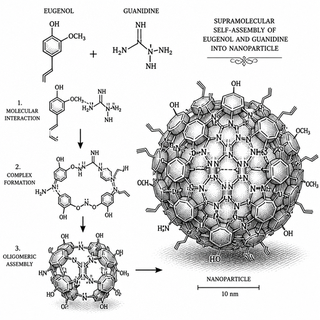
So this study asked a very fun question: what if we could trap one of these plant-derived antimicrobial molecules inside a water-based nanoassembly, help it stick around longer, and release it when conditions are right?
Wait, it gets better.
The Star Molecule: Eugenol
The researchers focused on eugenol, a hydrophobic plant volatile best known as a major component of clove oil. Eugenol has antimicrobial activity, which makes it attractive as a potential biopesticide ingredient. But it is also oily, poorly water-compatible, and prone to disappearing into the air like it remembered an urgent appointment elsewhere.
That is a serious problem for real-world crop protection. A compound can look fantastic in a lab dish, but if it evaporates too quickly, washes off leaves, or refuses to mix nicely into sprayable water-based formulations, it becomes much less useful in the field.
The team’s answer was supramolecular self-assembly, which is a fancy way of saying they got molecules to organize themselves into tiny structures through non-covalent interactions. No hazardous adjuvants, no complicated chemical scaffolding, just a clever pairing of ingredients that assemble into nanoparticles.
Guanidines Enter the Chat
To build the nanosystems, the researchers paired eugenol with two hydrophilic guanidine-containing molecules: arginine and polyhexamethylene biguanide. The result was two eugenol nanoparticle systems, called EA NPs and EP NPs.
These were not vague “nano-ish” blobs either. They were tidy little particles around 161 nanometers and 157 nanometers in size. That is small enough to feel absurd: you could line up thousands of them across the width of a human hair, and they would still be waiting politely for more space.
The loading rates were also impressive: 48.53% for EA NPs and 42.79% for EP NPs. In plain terms, a large fraction of each nanoparticle system was actually carrying the active eugenol payload. That matters because a delivery system that carries barely any active ingredient is basically a tiny empty suitcase. Cute, but not useful.
The particles also had low polydispersity values, meaning they were fairly uniform in size, and high positive zeta potentials, which suggests strong colloidal stability. Translation: they were not immediately clumping into sad nano-oatmeal.
Why Nanoparticles Help
The big practical win here is bioavailability. Plant volatiles have potential, but they are hard to use because they can evaporate and disappear before doing enough work. These nanoassemblies improved several properties at once: lower volatilization, better storage stability, improved wettability, and stronger adhesion.
That combination is a very big deal for crop spraying. If a treatment does not wet the leaf surface well, it beads up and rolls away. If it does not adhere, rain, irrigation, or time can remove it. If it volatilizes too fast, the pathogen gets a brief whiff of trouble and then carries on being a menace.
By making eugenol more stable and better behaved in a water-based system, the researchers moved it closer to something that could actually be used in agricultural settings.
And yes, I am deeply amused that the solution to a flighty plant perfume is essentially molecular Tupperware.
Smart Release With pH Response
One of the cooler parts of the study is that the nanoparticles responded to pH changes. That means they could release eugenol in a controlled way depending on environmental conditions.
Controlled release is valuable because antimicrobial action often needs persistence. You do not want the entire active compound dumped instantly, especially if the disease pressure lasts longer than five minutes. A longer release profile can keep the protective effect going, which is exactly the kind of practical detail that separates “neat experiment” from “possible field tool.”
The researchers reported long-lasting controlled release of eugenol from these nanoassemblies. That is the kind of phrase that sounds dry until you realize it means the system is solving one of the central problems with volatile plant compounds: they are useful, but they do not naturally hang around.
The Pathogens: Bacteria and Fungi Behaving Badly
The study tested the nanoparticles against two major plant pathogens: Pseudomonas syringae and Botrytis cinerea.
Pseudomonas syringae is a bacterial plant pathogen associated with disease in many crops. Botrytis cinerea, often known for causing gray mold, is a fungal pathogen with a talent for ruining fresh produce before and after harvest. It is basically the uninvited guest who shows up in the field, then follows your strawberries home.
The eugenol nanoparticles showed antimicrobial efficacy in vitro, in vivo, and in postharvest testing. That range matters. Lab-dish results are useful, but pathogens become much more annoying in real plant environments. Seeing activity across different testing contexts strengthens the case that this platform is worth further development.
The Biosafety Piece
A sustainable pesticide platform cannot just be effective against pathogens. It also has to avoid harming the crop, the surrounding ecosystem, or whoever handles it.
The study reports benign biocompatibility in biosafety tests. Even more interesting, spraying the eugenol nanoparticles promoted crop seedling growth. That detail made me sit up a little straighter. A formulation that manages pathogens while being gentle to plants, and possibly supportive of early growth, is exactly the kind of multitasking we like to see. Not all heroes wear lab coats; some self-assemble at 157 nanometers.
Of course, this does not mean the formulation is ready to replace conventional agrochemicals tomorrow morning. Field conditions are messy. Sunlight, rain, soil chemistry, crop species, microbial communities, regulations, cost, manufacturing scale, and long-term ecological impacts all get a vote. Science may be elegant, but agriculture is where elegance meets weather.
Why This Research Is So Interesting
The core idea here is bigger than eugenol alone. The study offers a strategy for turning hydrophobic volatile plant compounds into water-based, stable, adhesive, controlled-release nanopesticides.
That could open the door to a broader family of plant volatile-based biopesticides. Instead of dismissing these natural compounds because they evaporate too quickly or do not mix well with water, researchers may be able to package them in smarter delivery systems.
The sustainability angle is also compelling. Conventional pesticides are not going away overnight, but agriculture needs more tools that reduce environmental burden while still protecting yield. Crop disease is not a minor inconvenience. It affects food supply, farmer income, storage stability, and waste. A safer, plant-inspired antimicrobial delivery system could be genuinely useful if it continues to perform outside controlled research settings.
The Big Takeaway
This research is exciting because it takes something plants already use for defense, eugenol-like volatile chemistry, and gives it a nanoscale upgrade. The nanoparticles help keep the compound stable, reduce off-target loss, improve surface behavior, and release the active ingredient over time.
That is not just “nature is good, chemicals are bad” oversimplification. It is more interesting than that. This is chemistry learning from biology, then engineering a delivery system that makes biology’s tools more practical.
Tiny plant volatiles were already doing useful work. This study basically gave them a backpack, a raincoat, and a calendar reminder to show up when needed.
This blog post discusses research findings and should not be taken as agricultural, environmental, or medical advice. If you have concerns about crop disease management or pesticide use, please consult qualified agricultural extension specialists or relevant regulatory guidance. Research discussed here represents ongoing scientific investigation and practical validation is still in progress.
All images used in this post are decorative illustrations only and do not represent or reflect the accuracy, reality, or correctness of the referenced research.
Primary Source: Plant volatiles-based supramolecular nanoassembly induced by guanidines for sustainable phytopathogen management. PubMed Record ID 41570716. PubMed