
When Edward Jenner noticed in 1796 that milkmaids who caught cowpox never seemed to get smallpox, he made a leap that sounds slightly unhinged on paper: borrow something from one species to protect another. It worked, vaccination was born, and the rest is a couple of centuries of public health history. A new study channels that same "let's repurpose biology from a totally different organism" energy, except instead of cowpox and milkmaids, the cast list includes insect egg yolk and the cholesterol-handling machinery on your cells. Stay with me, because this gets delightfully weird.
The Problem: Great Drugs, Terrible Delivery Service
Let me set the stage. RNA interference, or RNAi, is one of the slickest tricks in modern molecular biology. The idea is that small interfering RNA (siRNA) can walk up to a specific gene's messenger RNA and effectively hit the mute button on it. Want to silence a gene that's misbehaving in a disease? siRNA is your candidate for the job.
The catch is the same one that haunts basically every promising drug since the dawn of pharmacology: getting it to the right place. Cells are not welcoming hosts. The cell membrane treats incoming siRNA roughly the way a velvet-rope nightclub treats someone in flip-flops. siRNA is large, negatively charged, and has no business sneaking across a lipid membrane on its own. So you can have the world's most elegant gene-silencing molecule and it will accomplish absolutely nothing if it's stuck loitering in the bloodstream.
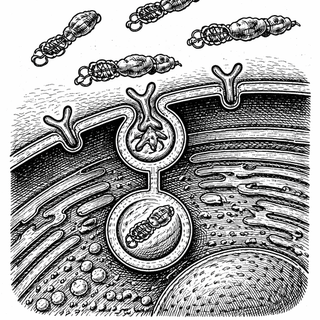
This is the delivery problem, and it has been the field's white whale for years. The whole point of this research is to hand siRNA a fake ID and a backstage pass.
The Clever Bit: Hijacking the Cholesterol Door
Here is where the team gets sneaky. Your cells are studded with LDL receptors (LDLR), the proteins that grab onto low-density lipoprotein, the famous "bad cholesterol," and pull it inside through a process called receptor-mediated endocytosis. Think of it as the cell's regular grocery delivery, with the LDL receptor as the doorman who recognizes a familiar package and waves it through.
Now for the twist that earns this study its nerd credentials. It turns out the LDL receptor isn't a snob about which organism its cargo comes from. In particular, vitellogenin (Vg), the yolk protein that invertebrates load into their eggs, can latch onto the human LDL receptor. The yolk protein from a bug egg can knock on a human cell's door, and the doorman, being a bit gullible, recognizes the knock.
The researchers' working hypothesis was beautifully simple: if a Vg-derived peptide can ring the LDLR doorbell, why not bolt that peptide onto something that carries siRNA, and let the cell's own delivery system do the smuggling? It's the molecular equivalent of taping your letter to the back of a package the mail carrier already trusts.
Building the Chimera
To pull this off, the team engineered two chimera proteins. If "chimera" makes you think of the fire-breathing lion-goat-snake mashup from Greek mythology, you've got the right mental image, just shrink it down a few billion-fold and make it useful. Each chimera fused two parts:
- A stretch of amino acids derived from vitellogenin, the part that schmoozes the LDL receptor and gets you in the door.
- A double-stranded RNA-binding domain (dsRBD) pulled from a crustacean transcriptomic library, which acts as the grip that holds onto the siRNA cargo.
So one end of the protein says "I'm here to see the LDL receptor," and the other end is firmly clutching the gene-silencing payload. Link siRNA to the chimera, and you've assembled a complex that's ready to ride the cell's natural import lane straight into the interior. It's less Trojan horse, more Trojan delivery van with proper credentials.
Did It Actually Work?
This is the part where a lot of clever ideas quietly fall apart, so the results are genuinely satisfying. When the team introduced their chimera-siRNA complexes to several different mammalian cell lines, the siRNA got delivered through the LDL receptor and triggered RNAi as hoped. The headline number: roughly 50% gene silencing across various target genes.
Cutting a target gene's activity in half through the cell's front door, using a peptide borrowed from invertebrate egg yolk, is a strong proof of concept. It's not 100%, but for a first-generation delivery tool riding a native biological pathway, knocking out half the signal is the kind of result that makes molecular biologists put down their coffee.
The Part That Matters for Patients: It Played Nice
A delivery system can be brilliant in a dish and still be a non-starter in a living body if it sets off alarms. The immune system is essentially a very twitchy security team, and anything that looks foreign can provoke a response that ranges from "mild inflammation" to "absolutely not." So the team tested the chimera proteins in mice.
The encouraging news is that the mice showed no detectable toxicity and no systemic immune response. That biocompatibility is arguably as important as the silencing itself. A non-toxic, low-immune-profile delivery tool built on a mechanism the body already uses every day is exactly the kind of foundation you want before anyone whispers the words "therapeutic application."
Why This Is Worth Getting Excited About
The appeal here is the elegance. Rather than inventing some exotic nanoparticle and praying the body tolerates it, this approach leans on a native cellular mechanism that's been quietly running since before humans existed. That tends to be a smart bet in biology, where reinventing the wheel usually ends with the wheel attacking you.
For now, the realistic payoff is a simple, reliable, targeted tool for switching off specific genes in mammalian cells, which is a genuine gift for basic research into how diseases work. Looking further down the road, the authors are clear-eyed but optimistic: a delivery system grounded in a native mechanism could eventually open a path toward safe in vivo gene silencing and drug delivery, and maybe one day, human gene-silencing therapies for certain diseases.
That's still a long road, with plenty of validation between here and the clinic. But every once in a while, the best new idea in medicine turns out to be hiding inside something as humble as a bug egg, waiting for someone curious enough to ask what its yolk protein does to a human cell.
This blog post discusses research findings and should not be taken as medical advice. If you have concerns about a genetic condition or any disease, please consult a healthcare provider. Research discussed here represents ongoing scientific investigation and clinical validation is still in progress.
All images used in this post are decorative illustrations only and do not represent or reflect the accuracy, reality, or correctness of the referenced research.
Primary Source: Facilitating siRNA delivery into mammalian cells via the LDL receptor. PubMed. 2026. PMID: 41956189