
Your ovaries have a secret, and scientists just figured it out. Or rather, they may have found a sharper way to listen in. A new PubMed-listed study describes the development of a surface plasmon resonance sensor for assessing infertility based on anti-Mullerian hormone, or AMH, levels. That sounds like a sentence built in a lab and released without supervision. But the idea behind it is simple enough: measure a fertility-related hormone with a sensitive optical sensor, and you may get quicker, more precise information about ovarian reserve.
That matters because infertility is common, emotionally draining, and often maddeningly slow to investigate. People show up looking for answers, and the body responds with a shrug, a stack of blood tests, and a calendar.
Why AMH gets so much attention
AMH is one of the better-known hormonal markers in fertility medicine. It is produced by cells in ovarian follicles, and clinicians often use it as a rough indicator of ovarian reserve. In plain English, that means it offers a clue about how many eggs remain in the ovaries. Not egg quality, not a prophecy, not a crystal ball. Just a clue. Biology rarely gives out full spoilers.
Still, clues matter. AMH testing is already used in fertility workups, especially when doctors are trying to estimate ovarian response during assisted reproduction or better understand diminished ovarian reserve. A very low AMH level can suggest fewer remaining follicles. A higher level can suggest more. But interpretation is never one-size-fits-all. Age, medical history, and the broader hormonal picture still matter.
That is where better testing technology becomes interesting. If a sensor can measure AMH more accurately, more quickly, or with less hassle than existing approaches, that could improve how fertility assessments are done.
So what is surface plasmon resonance?
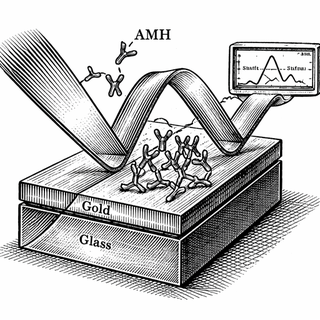
Surface plasmon resonance, mercifully shortened to SPR, is a sensing technique that detects molecular interactions at a surface. Think of it as molecular eavesdropping with fancy optics. Light hits a thin metal surface, usually gold, in a very controlled way. When a target molecule binds to that surface, the optical signal shifts. The system reads that shift and translates it into evidence that something has attached itself.
In this case, that "something" would be AMH.
The appeal of SPR is that it can be highly sensitive and often works in real time. Researchers like it because it can detect very small biological changes without requiring bulky labels or elaborate chemical decoration. In the world of diagnostics, that is attractive. The best tests are often the ones that do not ask biology to wear a name tag first.
What this paper appears to be doing
Based on the paper's title, the researchers developed an SPR-based sensor specifically aimed at assessing infertility through AMH levels. That suggests the heart of the work is not simply "AMH is useful," because that part is already known. The novel piece is the sensor platform itself.
That is an important distinction.
A lot of medical innovation lives in this middle ground between discovery and practice. We already know a biomarker matters. The real challenge is turning that biomarker into a test that is reliable, practical, affordable, and easy enough to use outside a highly specialized setup. A new sensor is an attempt to solve that translation problem.
If successful, such a device could help move fertility assessment toward testing that is faster and potentially more accessible. It could also reduce dependence on slower or more cumbersome assay formats. Nobody gets into fertility testing because they love waiting around for lab logistics.
Why this is intriguing beyond the lab bench
Infertility workups can be complex because they pull together hormones, imaging, timing, age, medical history, and sometimes male factor testing too. There is rarely a single dramatic answer waiting behind curtain number three. More often, clinicians are building a profile from multiple small signals.
That makes a better signal worth paying attention to.
AMH is already part of that profile. A sensor that measures it with high sensitivity could be useful in several ways:
- It could potentially support earlier screening.
- It could help refine fertility assessments in clinics.
- It might improve monitoring in assisted reproduction settings.
- It could eventually support smaller, faster diagnostic platforms.
That last point is especially appealing. Medical technology has been inching toward compact, high-performance biosensors for years. The dream is a test that keeps the science rigorous while cutting some of the friction. Less waiting, less complexity, fewer moving parts. The body is already high-maintenance enough.
The hard part is never just building the gadget
A prototype sensor is not the same thing as a clinically validated diagnostic test. That is the sober part of the story, and it matters.
For a device like this to make a real-world difference, several questions have to be answered. How accurate is it compared with standard AMH testing methods? How reproducible are the results? Does it work well across different AMH concentrations? How does it perform in messy, real human samples rather than idealized lab conditions? Can it distinguish signal from noise when biology decides to be uncooperative, as biology often does?
Then comes the even bigger hurdle: clinical meaning. A sensor may detect AMH beautifully, but clinicians still need to know whether those readings improve decisions for actual patients. That requires validation, comparison studies, and eventually integration into care pathways that already have established practices.
In other words, the engineering can be elegant and the medicine still has homework.
Why fertility diagnostics need this kind of thinking
Fertility medicine sits at the intersection of biology, hope, timing, and stress. That is exactly the sort of area where better diagnostics can matter disproportionately. Even modest improvements in testing can shape difficult decisions about treatment timing, egg freezing, IVF planning, or when to pursue further evaluation.
A more refined AMH sensor would not solve infertility on its own. It would not replace full clinical assessment. And it certainly would not turn reproductive biology into a tidy spreadsheet. Reproduction has never shown much interest in being tidy.
But better tools can reduce uncertainty. They can sharpen conversations between patients and clinicians. They can turn a vague impression into a measurable result. In medicine, that is often how progress arrives. Not with fireworks. With a cleaner signal.
The bigger picture
This study fits into a larger scientific trend: using advanced biosensors to make established biomarkers more clinically useful. That may sound modest, but modest is underrated. Medicine does not only advance through miracle cures and dramatic headlines. Sometimes it advances because someone improves the ruler.
If this SPR-AMH approach proves robust in further testing, it could become part of a broader shift toward faster and more precise reproductive diagnostics. That would be welcome news in a field where uncertainty is expensive, emotionally and otherwise.
For now, the main takeaway is this: researchers are working not just on understanding fertility, but on building better ways to measure it. And when the measurement improves, the questions get clearer. In science, that is often the moment things start moving.
This blog post discusses research findings and should not be taken as medical advice. If you have concerns about infertility or fertility testing, please consult a healthcare provider. Research discussed here represents ongoing scientific investigation and clinical validation is still in progress.
All images used in this post are decorative illustrations only and do not represent or reflect the accuracy, reality, or correctness of the referenced research.
Primary Source: Development of a surface plasmon resonance sensor for assessing infertility based on Anti-Mullerian hormone levels. PubMed Record 42021307. https://pubmed.ncbi.nlm.nih.gov/42021307/