
Abalone shells do it. Spider silk does it. Bone does it spectacularly well. Across millions of years, natural materials have cracked the code on being simultaneously tough, stiff, and lightweight by organizing themselves across multiple length scales - from nanometers to centimeters - in ways that would make any materials engineer weep with envy. Now, thanks to a convergence of 3D imaging, computational modeling, and good old-fashioned data science, we're finally learning how to do it too.
A sweeping new review published in 2025 lays out the roadmap for what the authors call a "data-driven multiscale design paradigm" for composite biomaterials. Translation: we're getting serious about using numbers, not just intuition, to design the next generation of implants and scaffolds. And the numbers? They're telling us some fascinating things.
The Scale Problem (It's Bigger Than You Think - and Also Smaller)
Here's what makes biomaterials design so maddeningly complex. A hip implant doesn't just need to be strong. It needs to be strong at the macro level (don't snap when someone stands up), tough at the micro level (don't crack under repeated loading cycles), and biocompatible at the nano level (don't trigger an immune meltdown). That's at least three orders of magnitude in length scale, each with its own physics, its own failure modes, and its own characterization techniques.
Natural bone handles this beautifully. Hydroxyapatite mineral crystals at the nanoscale provide stiffness. Collagen fibrils at the microscale provide toughness. The trabecular architecture at the macroscale provides damage tolerance. It's an engineering marvel that self-repairs, adapts to loading, and runs on sandwiches and calcium supplements.
Synthetic composites? They've been playing catch-up. Until now, most design approaches treated each scale independently - optimize the nanoparticle filler here, tweak the scaffold geometry there, hope it all works together. Spoiler: it often doesn't.
Enter the Data-Driven Paradigm
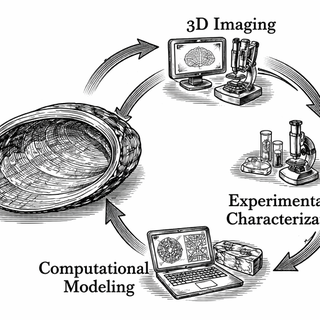
The review outlines a framework that stitches together three pillars: experimental characterization, 3D imaging, and computational modeling. What's new isn't any one of these individually - it's the feedback loop between them, powered by data.
On the experimental side, we're talking about a full toolkit: nanoindentation for probing mechanical properties at the sub-micron level, dynamic mechanical analysis (DMA) for understanding viscoelastic behavior, rheology for characterizing flow during processing, and bulk mechanical testing for the big-picture performance metrics. Each technique captures a different slice of the multiscale puzzle.
Then there's the imaging. Micro-CT scanning, confocal microscopy, and other 3D imaging modalities now let researchers capture the actual internal architecture of both natural tissues and synthetic scaffolds. Not idealized geometries. Not assumptions. The real, messy, heterogeneous structure - voxel by voxel.
The computational piece ties it all together. Finite element models built directly from imaging data can simulate mechanical behavior across scales. Machine learning algorithms can identify structure-property relationships that would take a human researcher decades to spot in the data. The result is a closed loop: image a material, model its behavior, compare to experiments, refine the design, repeat.
Why Bone Is Still the Gold Standard (and What We're Stealing From It)
The review spends considerable time on bone as a design inspiration, and for good reason. Consider the numbers: cortical bone achieves a fracture toughness of roughly 2-12 MPa·m^(1/2) while maintaining a stiffness of 15-25 GPa. For a material that's mostly made of a brittle ceramic (hydroxyapatite) and a soft polymer (collagen), those are absurdly good numbers. The secret is hierarchical organization - each level of structure contributes a different toughening mechanism, from crack deflection at osteon boundaries to fibril bridging at the nanoscale.
The data-driven approach lets us reverse-engineer these tricks. By imaging bone microstructure, building computational models, and running virtual experiments, researchers can identify which architectural features contribute most to performance - and then translate those features into 3D-printable scaffold designs.
From Lab Bench to Bedside (The Gap Is Shrinking)
The practical implications here are significant. Current orthopedic implants, tissue engineering scaffolds, and dental materials are largely designed through trial-and-error experimentation. Each design iteration requires fabrication, testing, and characterization - a process that can take months. The data-driven multiscale approach promises to compress that timeline dramatically by front-loading the design work computationally.
Imagine feeding a machine learning model the desired mechanical properties for a spinal fusion cage - the stiffness needs to match adjacent vertebral bone (to avoid stress shielding), the porosity needs to promote cell ingrowth, and the fatigue life needs to exceed 10 million cycles. The model could propose candidate architectures, simulate their multiscale behavior, and rank them by predicted performance, all before a single prototype gets printed.
We're not fully there yet, of course. The review is honest about current limitations: computational costs remain high for full multiscale simulations, experimental validation is still essential, and the training datasets for machine learning models in this space are relatively small compared to other domains. But the trajectory is clear, and the pace of progress has been accelerating.
The Bottom Line
The convergence of advanced imaging, computational modeling, and data science is transforming biomaterials design from an art into something that looks increasingly like a quantitative science. Nature spent millions of years optimizing hierarchical composite architectures through evolution. We're trying to get there in a few decades, armed with micro-CT scanners and gradient descent. The data says we're making real progress - and the next generation of implants and scaffolds will be better for it.
Sometimes the best engineering strategy is humility: study what works in nature, measure it obsessively, model it computationally, and iterate. The abalone shell already solved this problem. We just needed the right tools to read its homework.
This blog post discusses research findings and should not be taken as medical advice. If you have concerns about biomaterials, implants, or tissue engineering, please consult a healthcare provider. Research discussed here represents ongoing scientific investigation and clinical validation is still in progress.
All images used in this post are decorative illustrations only and do not represent or reflect the accuracy, reality, or correctness of the referenced research.
Primary Source: Data-driven multiscale design of composite biomaterials: Integrating experiments, imaging, and computational modeling for biomedical engineering. 2025. DOI: PubMed 41732390