
Seeking long walks through microscopic channels, enjoys splitting and recombining streams, hates messy cleanroom drama, and can be ready in under 90 minutes. If this 3D-printed micromixer had a dating profile, I would at least admit it sounds efficient. And in medical technology, efficient plumbing is sometimes the difference between a clever idea and something that actually helps real families.
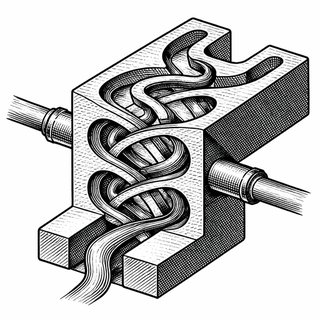
This paper looks at a very specific piece of lab hardware: a split-and-recombine micromixer built into a tiny fluid-handling device. That may sound like the sort of thing only an engineer could love, but stay with me. A lot of modern diagnostics and drug-testing systems depend on moving very small amounts of liquid through very small channels. When those liquids do not mix properly, the whole setup can get fussy, inconsistent, or just plain unreliable. Tiny labs, it turns out, can be as temperamental as toddlers asked to put on socks.
What is a micromixer, and why should any parent care?
A micromixer is exactly what it sounds like: a tool that mixes fluids, but on a miniature scale inside a microfluidic device. These devices are often called "labs on a chip" because they can perform chemical or biological testing in a compact system.
Why does mixing matter so much? Because many medical tests, screening tools, and experimental treatment platforms rely on precise concentrations of liquids. If one fluid is supposed to blend evenly with another and instead stays streaky or uneven, the test result can drift. That is bad in any setting, but especially bad when people are hoping for faster, cheaper, more reliable ways to study disease or tailor treatment.
From a parent perspective, this is where my ears perk up. No, this is not a gadget your child would use next week at the pediatrician's office. But it is part of the backstage machinery that could eventually make diagnostic tools better, smaller, faster, and more accessible. Boring plumbing has a habit of becoming very exciting once it starts affecting wait times, accuracy, and cost.
What this team actually built
The researchers created a fully monolithic 3D-printed split-and-recombine, or SAR, micromixer. "Monolithic" here means the whole thing was printed as one integrated piece rather than assembled from multiple layers, molds, or bonded parts.
That matters because traditional microfluidic fabrication can be a pain. It often involves soft lithography, multiple steps, specialized facilities, and design limits that make truly three-dimensional structures harder to produce. In plain English: you can build the thing, but you may need a lot of patience, equipment, and tolerance for manufacturing drama.
This new design uses stereolithography digital light processing, or SLA-DLP, 3D printing to make the entire device in a single step. No molds. No bonding. No cleanroom processing. For anyone who has ever assembled a toy at midnight and discovered there are 14 "simple" steps before the fun begins, eliminating those steps is not a small perk.
The mixer works by repeatedly splitting fluid streams, turning them, and recombining them. That repeated reshuffling helps the fluids mix more thoroughly than they would if they simply flowed side by side through a straight little channel.
Why the results are interesting
The headline result is that the device achieved mixing efficiencies above 0.90 across Reynolds numbers from 0.1 to 100. You do not need to memorize the fluid mechanics here. The practical point is that the mixer performed well across a wide range of flow conditions, which is exactly what you want if you hope to use a device in varied real-world setups.
The paper also reports that computer simulations matched the experimental results closely. That is encouraging because it suggests the design behaves predictably, not just under one lucky test condition.
Then the researchers integrated the micromixer into a five-output concentration gradient generator. That sounds technical, but the idea is fairly intuitive: the system creates multiple stable concentrations from the same starting materials. This is useful for experiments where researchers need to expose cells, proteins, or other samples to different dose levels in a controlled way.
In this study, the device produced stable and reproducible concentration profiles for both fluorescent tracers and protein solutions. Translation: it did not just work with easy demo fluids. It also handled biologically relevant material, which makes the work feel more connected to actual biomedical applications.
So, will this help my kid?
Not directly today. That is the honest answer.
This is a platform technology, not a treatment. It is not curing an illness, shrinking a tumor, or stopping seizures on its own. What it can do is improve the tiny fluid systems that support research, diagnostics, and screening tools. That may sound one step removed, because it is. But medicine is full of one-step-removed advances that later become the reason a test is faster, cheaper, or available in more places.
If follow-up development goes well, a device like this could help researchers build better point-of-care tests, more reliable drug screening systems, and compact lab devices that are easier to manufacture. For families, that matters if it eventually means fewer samples, quicker turnaround, or wider access outside major research centers. I am always interested in technologies that reduce the "you need a specialized facility for that" problem, because that problem has a nasty habit of turning into delays and unequal access.
What problem this research is trying to solve
The challenge here is not that scientists cannot mix tiny amounts of fluid at all. It is that doing it well, consistently, and cheaply inside enclosed microchannels is harder than it looks. At very small scales, fluids do not behave the way you might expect from stirring soup in a pot. They can slide along in layers and resist mixing unless the channel geometry forces the issue.
That is why the 3D design matters. The more freedom engineers have to shape the path of the fluids, the better they can coax mixing without adding bulky external equipment. This paper leans into that geometric freedom and pairs it with a manufacturing method that is faster and simpler than many standard approaches.
Printing the complete device, including channels and functional features, in under 1.5 hours on a standard desktop SLA-DLP system is not just a neat engineering flex. It points toward a more accessible workflow. And accessible workflows are often what move good ideas from "cool paper" to "something people actually use." Science has enough pretty prototypes already. It does not need more shelf decor.
The bottom line
What I like about this study is that it tackles an unglamorous but real bottleneck. Better microfluidic mixing is not splashy dinner-party conversation, unless your dinner parties are unusually specific, but it underpins a lot of tools researchers want to build.
The paper does not promise a miracle, and that is part of why I trust it more. It shows a compact, sturdy, single-step 3D-printed micromixer that performs well, integrates into a useful gradient generator, and could make advanced microfluidic systems easier to produce. For parents trying to sort the hype from the helpful, that lands in the "worth watching" category.
No, it is not helping a sick child tomorrow morning. But it is the kind of enabling technology that could quietly improve the medical tools of tomorrow. And sometimes progress arrives wearing a lab coat; sometimes it arrives as very smart plumbing.
This blog post discusses research findings and should not be taken as medical advice. If you have concerns about diagnostic testing, treatment options, or a specific health condition, please consult a healthcare provider. Research discussed here represents ongoing scientific investigation and clinical validation is still in progress.
All images used in this post are decorative illustrations only and do not represent or reflect the accuracy, reality, or correctness of the referenced research.
Primary Source: Monolithic 3D-printed split-and-recombine micromixer integrated into a microfluidic concentration gradient generator. PubMed Record 41859780. https://pubmed.ncbi.nlm.nih.gov/41859780/