
I'll be honest, when I first read this title - "A novel zebrafish luminescent biosensor for kidney tubulopathy" - I thought someone had accidentally merged two completely unrelated grant applications. Glowing fish? Kidney disease? Drug screening? It reads like the world's worst game of Mad Libs played exclusively by PhD students at 2 a.m. But the more I dug into this research, the more I realized these scientists have built something genuinely clever. They've essentially turned a tiny fish into a living, breathing kidney disease alarm system. And it might just change how we test drugs for toxicity.
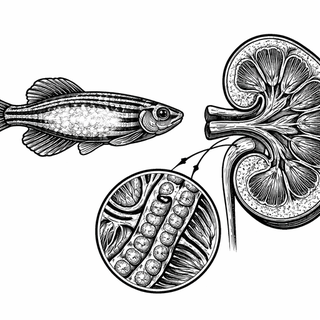
Your Kidneys Are Running a Recycling Center (and You Don't Even Know It)
To understand why this matters, we need a quick detour into what your kidneys actually do. Most people think kidneys are just fancy coffee filters for your blood - stuff goes in, pee comes out. But your kidneys are way more sophisticated than that. Specifically, the proximal tubule (PT) cells lining the early part of each kidney tube are running a high-speed recycling operation.
Think of it like a warehouse fulfillment center. Blood gets filtered, and a bunch of useful small proteins - called low-molecular-weight (LMW) proteins - end up in the filtrate. Your PT cells are supposed to grab those proteins back before they leave the building. They do this through a process called endolysosomal processing, which is basically the cellular equivalent of a conveyor belt sorting system. Proteins get scooped up, pulled inside the cell, broken down, and recycled.
When that conveyor belt breaks down - whether from a genetic defect, toxic metals, or certain medications - those valuable proteins just sail right out in your urine. That's tubulopathy. And detecting it early has been, well, kind of a pain.
Enter the Glow-in-the-Dark Fish
This is where zebrafish come in. Now, I know what you're thinking: "Why zebrafish?" It's a fair question. But zebrafish are the unsung heroes of biomedical research. Their kidneys (technically a simpler structure called a pronephros) work on the same basic principles as ours, they're transparent as larvae so you can literally watch their organs work in real time, and they breed like... well, like fish. You can test hundreds of them simultaneously, which is roughly the throughput of testing a single mouse very impatiently.
Researchers have now created a new zebrafish line called ½vdbp-NanoLuc, and it's as cool as it sounds. They took vitamin D-binding protein - one of those LMW proteins that your proximal tubule is supposed to recycle - and fused it to something called NanoLuc luciferase. NanoLuc is essentially a molecular flashlight. It produces bioluminescence, meaning it literally glows.
Here's the elegant part: in a healthy fish, the PT cells grab that tagged protein and process it normally. Low glow. But if the PT cells aren't working right? The protein accumulates where it shouldn't, or gets dumped into the fish equivalent of urine. High glow. It's like putting a tracking tag on a package - if it ends up at the wrong address, you know the sorting system failed.
Stress-Testing the Alarm System
A fancy biosensor is only useful if it actually works when things go wrong. So the research team threw everything they had at these fish.
First up: genetic kidney diseases. They tested the biosensor against fish models of monogenic endolysosomal diseases - rare inherited conditions where the protein recycling machinery is broken from birth. The ½vdbp-NanoLuc system picked up the dysfunction reliably. Alarm triggered. Check.
Next: drug-induced kidney damage. If you've spent any time in clinical medicine, you know that gentamicin and cisplatin are notorious kidney offenders. Gentamicin is an antibiotic that's incredibly effective at killing bacteria and, unfortunately, also pretty good at damaging PT cells. Cisplatin is a chemotherapy workhorse that's saved countless lives from cancer while simultaneously putting kidneys through the wringer. The biosensor caught both. Two for two.
Then came the heavy metals - and not the fun kind with electric guitars. Cadmium and copper contamination are real-world environmental health problems. Cadmium accumulates from industrial pollution and cigarette smoke. Copper can leach from old plumbing. Both are known to damage kidney tubules, but the exact mechanisms have been murky. The glowing fish didn't just detect the damage - they actually provided new mechanistic insights into how these metals mess up PT cell function.
That last part is what elevates this from a neat party trick to a genuinely useful research tool.
Why This Matters Beyond the Fish Tank
Drug-induced kidney injury is one of the leading causes of drug candidates failing in clinical trials. It's also one of the main reasons medications get pulled from the market after approval. The current testing pipeline relies heavily on cell cultures (which don't behave like real kidneys) and rodent models (which are expensive, slow, and raise ethical concerns).
A luminescent zebrafish biosensor sits in a sweet spot. It's a whole living organism, so you get the complexity of real biology. But it's small, fast, and scalable. You could theoretically screen thousands of drug candidates for kidney toxicity in the time it takes to run a handful of mouse experiments. It's like going from hand-counting ballots to using a scanning machine - same job, wildly different throughput.
The environmental toxicology angle is equally promising. Testing whether a new industrial chemical might damage kidneys currently involves... a lot of waiting and a lot of rodents. A zebrafish-based screening platform could accelerate those assessments dramatically.
The Caveats (Because There Are Always Caveats)
Before anyone starts claiming zebrafish will replace all kidney research, let's pump the brakes. A zebrafish pronephros is simpler than a human kidney. It has a single nephron equivalent per side, while humans have about a million per kidney. Drug metabolism differs between species. And bioluminescence assays, while sensitive, have their own technical quirks.
This is a screening tool, not a replacement for clinical trials. Think of it as the metal detector at the airport - it tells you something interesting is going on, but you still need a human to figure out if it's a belt buckle or something actually dangerous.
Still, as a first-pass screening system for kidney toxicity? As a way to study rare genetic kidney diseases without breeding colonies of mice? As a platform that gives you mechanistic insights along with a simple yes-or-no readout? That's a genuinely valuable addition to the toolkit.
These little fish might be small, but their glow could light the way toward safer drugs and a better understanding of kidney disease. And honestly, any research that involves glowing animals gets an automatic cool point from me.
This blog post discusses research findings and should not be taken as medical advice. If you have concerns about kidney health or medication side effects, please consult a healthcare provider. Research discussed here represents ongoing scientific investigation and clinical validation is still in progress.
All images used in this post are decorative illustrations only and do not represent or reflect the accuracy, reality, or correctness of the referenced research.
Primary Source: A novel zebrafish luminescent biosensor for kidney tubulopathy, metal toxicity, and drug screening. PubMed. 2026. PMID: 41943637