
Fair warning: things are about to get weird. We're going to talk about using sunlight and Pepto-Bismol's metallic cousin to murder bacteria in open wounds. If your first reaction is "that sounds like something a mad scientist pitched after three espressos," congratulations - your instincts are excellent. But the science is real, it's genuinely wild, and it might just change how we handle one of the nastiest problems I see in the ER on a daily basis.
The Problem: Bugs That Won't Die
Here's what keeps me up at night more than any season finale cliffhanger. Infected wounds are a war zone - and right now, the bacteria are winning. Every shift, I see wounds crawling with organisms that laugh at our antibiotics like they're breath mints. Drug-resistant bacteria have turned chronic wound management into a game of whack-a-mole, except the moles have body armor.
The stats aren't pretty. Antibiotic resistance is climbing globally, and infected wounds - burns, surgical sites, diabetic ulcers - are ground zero for this fight. Inflammation spirals, healing stalls, and patients end up cycling through increasingly desperate antibiotic regimens. We need new weapons. Preferably ones that bacteria can't just evolve around in six months.
Enter: nanoparticles made of bismuth that kill bacteria using light. Yes, light. Stick with me.
Bismuth Goes Nano: Not Your Grandma's Stomach Remedy
Bismuth - element 83 on the periodic table - is the same metal that gives Pepto-Bismol its bacterial-fighting properties in your gut. But researchers have taken this familiar element and engineered it into functionalized nanoparticles that operate on a completely different level.
A recent study published in 2025 describes a multifunctional nano-bismuth platform designed for infected wound healing. The approach combines two light-activated therapies into a single system, which is about as elegant as smashing two hammers together - except it actually works beautifully (Li et al., 2025).
The nanoparticles pull double duty through two mechanisms: photodynamic therapy (PDT) and photothermal therapy (PTT). Think of it as a one-two punch where sunlight throws the first hook and near-infrared light delivers the knockout.
Photodynamic Therapy: Death by Sunlight
Here's where it gets fun. Photodynamic therapy works by generating reactive oxygen species - basically, tiny molecular grenades - when a photosensitizing material absorbs light. These reactive oxygen species are indiscriminate little destroyers. They rip through bacterial cell membranes like tissue paper.
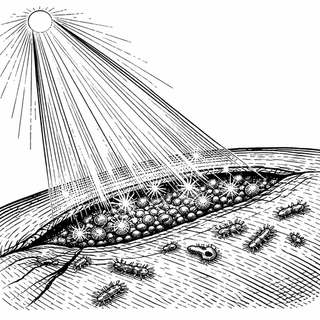
The clever part? These nano-bismuth particles are engineered to activate under sunlight. Not some expensive specialized laser that costs more than my car. Regular, garden-variety sunlight. The nanoparticles absorb those photons and convert that energy into a localized burst of oxidative stress that bacteria simply cannot survive.
And here's why bacteria can't develop resistance to this: you can't evolve your way out of having your cell membrane shredded by free radicals. It's like trying to become bulletproof through willpower. Reactive oxygen species don't care about your efflux pumps or your beta-lactamases.
Photothermal Therapy: A Gentle Roast
The second mechanism is photothermal therapy, and the keyword here is mild. When exposed to near-infrared light, the nano-bismuth particles convert that energy into heat. But we're not talking about cauterization-level temperatures. This is a controlled, gentle warming - enough to destabilize bacterial membranes and disrupt biofilms, but not enough to torch the healthy tissue you're trying to save.
Think of it like sous vide for bacteria. Low and slow. Except in this case, "slow" is relative - the thermal effect is localized and targeted, concentrating right where the nanoparticles sit in the wound bed.
The synergy between these two mechanisms is where the magic happens. The mild heat from PTT makes bacterial membranes more permeable, which means the reactive oxygen species from PDT penetrate more effectively. It's a feedback loop of bacterial destruction, and it's honestly kind of beautiful in a deeply morbid way.
Why This Matters in the Real World
Let me paint the clinical picture. You've got a patient with a chronic infected wound - maybe a diabetic foot ulcer that's been colonized by methicillin-resistant Staphylococcus aureus. You've burned through two lines of antibiotics. The wound's not closing. The infection's spreading.
Now imagine applying a nano-bismuth dressing and letting sunlight do the heavy lifting. No systemic antibiotics needed. No resistance development. The treatment is localized, targeted, and leverages something as universally available as daylight.
That's the promise here. We're talking about a platform that addresses multiple failures simultaneously: it fights infection through a mechanism bacteria can't easily resist, it reduces inflammation, and it creates conditions favorable for tissue regeneration. The multifunctional aspect of these nanoparticles means they're not just killing bugs - they're actively promoting the wound healing cascade.
The Fine Print (Because There's Always Fine Print)
Before anyone starts rubbing bismuth on their paper cuts, let's be clear: this is still in the research phase. The jump from lab bench to bedside is long, expensive, and littered with the corpses of promising technologies that didn't survive clinical trials. Questions about long-term biocompatibility, optimal dosing, nanoparticle clearance from the body, and manufacturing scalability all need answers.
There's also the practical matter of light penetration. Sunlight and near-infrared work great on surface wounds, but deep tissue infections are a different story. This technology likely has its sweet spot in superficial and moderately deep wound infections - which, to be fair, covers an enormous patient population.
The Bottom Line
Twenty years in the ER have taught me to be skeptical of miracle cures and optimistic about good science. This nano-bismuth approach lands firmly in the "good science" category. It's clever, it's mechanistically sound, and it attacks the antibiotic resistance problem from an angle that bacteria haven't seen before.
Will it replace antibiotics? No. Will it become another tool in our increasingly depleted arsenal against drug-resistant infections? I'd bet on it. And honestly, there's something poetically satisfying about weaponizing sunlight against the same bacteria that have been making our lives miserable. The sun giveth life, and apparently, the sun also taketh it away - one reactive oxygen species at a time.
This blog post discusses research findings and should not be taken as medical advice. If you have concerns about wound infections or antibiotic resistance, please consult a healthcare provider. Research discussed here represents ongoing scientific investigation and clinical validation is still in progress.
All images used in this post are decorative illustrations only and do not represent or reflect the accuracy, reality, or correctness of the referenced research.
Primary Source: Li et al. Synergistic Sunlight-Activated Photodynamic and Near-Infrared-Induced Mild Photothermal Therapy for Infected Wound Healing Using Functionalized Nano-Bismuth. 2025. DOI: PubMed 41964279