
Let's be real - most photothermal cancer therapy agents kind of suck. Here's why: they only absorb light at narrow wavelength bands, which means you need the exact right laser tuned to the exact right frequency, and even then your tissue penetration is mediocre at best. It's like trying to charge your phone with a cable that only works if you hold it at a 37-degree angle during a full moon. Functional? Technically. Practical? Not so much.
Enter a team of researchers who apparently watched The Avengers and thought, "What if we assembled a nanoparticle dream team?" Their creation: hyperbranched black gold nanoparticles that absorb light across a ridiculously broad spectrum, built using guanosine quartets (yes, from the same molecular family as your DNA) and dextran, a sugar-based polymer. If regular gold nanoparticles are Iron Man - flashy, powerful, but limited - these black gold assemblies are the whole MCU roster working in concert.
Wait, Gold Can Be Black?
Here's where the materials science gets deliciously weird. We all know gold as that shiny yellow metal your grandma keeps in a safety deposit box. At the nanoscale, gold nanoparticles can appear red, purple, or blue depending on their size and shape, thanks to a phenomenon called surface plasmon resonance. It's the same physics that makes stained glass windows glow - tiny metal particles interact with light in ways the bulk metal never would.
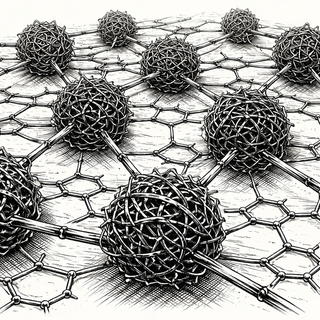
But black gold? That's a whole different beast. When you create an interconnected network of gold atoms - imagine a three-dimensional web of metallic branches rather than neat little spheres - the plasmonic modes overlap and couple with each other so extensively that the material absorbs light across the entire visible and near-infrared spectrum. Nothing bounces back. It's basically Vantablack's metallic cousin. The researchers achieved this by growing gold within a scaffolding of self-assembled guanosine quartets, producing nanostructures that look less like particles and more like tiny metallic tumbleweeds.
The Recipe: DNA Cousins Meet Sugar Polymers
The synthesis here is genuinely elegant, and I say that as someone who has spent too many hours babysitting temperamental chemical reactions. The recipe has two star ingredients working in tandem.
Guanosine quartets (G4s) are supramolecular structures formed when guanosine - one of the four nucleoside building blocks of DNA and RNA - spontaneously self-assembles into flat, four-sided arrangements stabilized by hydrogen bonds. Think of it like molecular origami, except the molecule folds itself. These G4 structures serve as the template, the blueprint that guides where and how gold atoms deposit. If you've ever seen how coral provides scaffolding for an entire reef ecosystem, you're getting the right mental picture.
Dextran is the unsung hero of this story. This branched polysaccharide (fancy word for sugar polymer) acts as what the researchers call a "multifunctional polymeric co-matrix." In plain English, dextran does everything. It helps organize the guanosine molecules into their quartet formations. It influences how gold nucleates and grows within the structure. It controls how the particles connect to each other. And it keeps the whole assembly stable in solution so it doesn't just clump together and fall out of suspension like a failed soufflé. Dextran is basically the Samwise Gamgee of this nanoparticle system - doing all the heavy lifting while gold gets all the glory.
Why Broadband Absorption Is a Big Deal
Here's the thing about photothermal therapy (PTT): the concept is simple. You inject nanoparticles into a tumor, hit them with light, they heat up, and the tumor cells cook. It's essentially a molecular microwave for cancer. The problem has always been in the details.
Most conventional photothermal agents - like standard gold nanospheres or nanorods - have sharp, narrow absorption peaks. A gold nanorod might absorb beautifully at 808 nm but be nearly transparent at 650 nm or 1064 nm. This means clinicians are locked into using specific laser wavelengths, and if the tissue depth or tumor environment shifts the optimal treatment window, tough luck.
Broadband absorbers change the game entirely. These black gold nanoassemblies soak up photons across a wide swath of the spectrum like a sponge dropped in a bathtub. Visible light? Absorbed. Near-infrared? Absorbed. This gives clinicians flexibility to choose wavelengths optimized for tissue penetration depth rather than being constrained by whatever narrow band their nanoparticles happen to like. It's the difference between a TV remote that only works from one specific spot on your couch versus one that works from anywhere in the room.
The Aqueous Advantage
One detail that made me do a little fist pump: this entire synthesis happens in water. No toxic organic solvents. No extreme temperatures. No elaborate multi-step protocols requiring a chemistry PhD and a prayer. The researchers describe it as a "straightforward aqueous synthesis," which in materials science translates roughly to "we didn't need to sacrifice a goat to make this work."
This matters because any nanoparticle destined for biomedical use eventually needs to play nice with biological systems - which are, you know, mostly water. Starting in an aqueous environment means you skip the headache of phase-transferring your particles from some organic solvent into something biocompatible. It's like building IKEA furniture and discovering it actually came pre-assembled. Suspicious? Maybe. But also deeply satisfying.
Where Does This Go From Here?
To be clear, we're still in the "exciting lab results" phase, not the "available at your local oncologist" phase. The road from benchtop nanoparticle synthesis to clinical photothermal therapy is long, winding, and paved with regulatory paperwork. Questions about biodistribution (where do these particles go in the body?), clearance (how do they leave?), and long-term toxicity (do they cause problems six months later?) all need answering.
But the foundational concept here - using biological self-assembly to template metallic nanostructures with superior optical properties - is the kind of approach that gets materials scientists and biomedical engineers equally excited. It's biomimetic design at its finest: borrowing nature's organizational playbook to build something nature never intended. Like teaching a spider to weave with gold thread.
The combination of broadband absorption, aqueous synthesis, and biocompatible building blocks puts these black gold nanoassemblies in a genuinely promising position. If subsequent studies confirm favorable biological behavior, this platform could represent a meaningful step forward for photothermal cancer therapy - and maybe, finally, give clinicians a photothermal agent that doesn't kind of suck.
This blog post discusses research findings and should not be taken as medical advice. If you have concerns about cancer treatment options, please consult a healthcare provider. Research discussed here represents ongoing scientific investigation and clinical validation is still in progress.
All images used in this post are decorative illustrations only and do not represent or reflect the accuracy, reality, or correctness of the referenced research.
Primary Source: Dextran-driven hyperbranched black gold nanoparticles templated by guanosine quartets as broadband absorbers for photothermal therapy. DOI: PubMed 42034137