
For $1,000 - what dirt-cheap, body-friendly metal just proved it can manipulate light at the nanoscale better than anyone gave it credit for?
If you said magnesium, congratulations. You just beat approximately 99% of materials scientists who spent the last two decades betting on gold and silver instead. Turns out the stuff in your multivitamin has been hiding some serious optical talent.
The Underdog Metal Nobody Was Watching
Here's the thing about plasmonic nanoparticles. They interact with light in spectacular ways. When light hits a metal nanoparticle, the free electrons on its surface collectively oscillate - a phenomenon called a plasmon resonance. This is not just pretty physics. Plasmonic nanoparticles power everything from biosensors to cancer therapies to solar energy harvesting.
For decades, gold and silver have dominated this field. Gold is stable. Silver is optically superior. Both are expensive and, depending on the application, not exactly ideal for putting inside a human body.
Enter magnesium. It's abundant. It's cheap. It's biocompatible, meaning your immune system won't throw a tantrum if it shows up. On paper, it's the dream plasmonic material. But there's been a problem. Nobody really understood how individual magnesium nanoparticles absorb and scatter light. All previous measurements looked at billions of particles at once, which is a bit like judging a choir by listening through a wall. You get the general vibe, but the individual voices? Lost in the noise.
One Particle at a Time
A new study published in 2025 finally pulled individual magnesium nanoparticles out of the crowd and interrogated them optically, one by one. The researchers used two complementary techniques: dark-field scattering spectroscopy and photothermal absorption spectroscopy. Together, these methods let them separately measure how each 170-nanometer magnesium spheroid scatters light versus how it absorbs light.
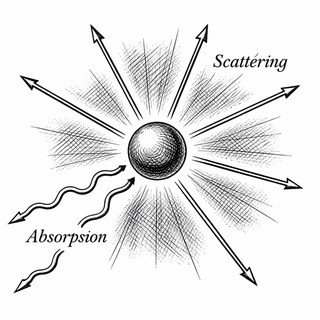
Why does this matter? Because absorption and scattering are fundamentally different processes. Scattering redirects light. Absorption converts it to heat. For any given application - whether you're building a sensor, a photothermal therapy agent, or a photocatalyst - you need to know which process dominates and at what wavelengths.
When the team looked at bulk ensembles of these nanoparticles, they saw what everyone else had always seen: a broad, featureless extinction spectrum. Boring. Uninformative. The optical equivalent of a shrug.
But at the single-particle level? Each nanoparticle showed well-defined plasmon resonances. Sharp peaks. Real spectral structure. The crowd was messy. The individuals were elegant.
The Absorption-Scattering Split
The researchers found something genuinely interesting in the details. On average, individual magnesium nanoparticles absorb and scatter light at roughly the same peak wavelength. So far, so expected. But absorption spectra were consistently broader than scattering spectra.
Think of it this way. If scattering is a laser pointer - focused, narrow, precise - then absorption is more like a floodlight. Same center, wider reach.
The team didn't just observe this and move on. They ran electromagnetic simulations to figure out why. The culprit turned out to be the real part of magnesium's dielectric function, which describes how the material responds to electric fields. Magnesium has unusually large dispersion in this property, meaning it changes rapidly with wavelength. That rapid change smears out the absorption peak while leaving scattering relatively sharp.
This is a fundamental material property, not a fluke of particle shape or size. It means any application relying on magnesium nanoparticle absorption needs to account for this inherent broadening.
Why Bulk Measurements Were Lying to Us
Perhaps the most striking takeaway is just how misleading ensemble measurements can be. When you average over millions of particles, each slightly different in size and shape, the individual resonance peaks blur together into a featureless blob. The ensemble measurement doesn't just lose detail. It actively obscures the physics.
Single-particle measurements revealed that magnesium nanoparticles have well-defined, tunable optical properties. They're not the blunt instruments that bulk spectroscopy made them appear to be. This is a bit like discovering that the musician you dismissed as mediocre was actually playing in a terrible orchestra. Solo, they're quite good.
What This Means for the Future
Magnesium's combination of low cost, earth abundance, and biocompatibility makes it attractive for applications where gold and silver are impractical or too expensive. Photothermal cancer therapy, for instance, benefits from nanoparticles that efficiently convert light to heat inside tumors. Solar energy harvesting needs particles tuned to specific wavelengths. Biosensors require predictable optical responses.
All of these applications demand precise knowledge of how individual particles behave - not just the statistical average of a swarm. This study provides exactly that foundation.
There's also a broader methodological point here. If magnesium nanoparticles look this different at the single-particle level compared to bulk, how many other nanomaterials are we misjudging? The answer is probably "a lot," and this work makes a strong case for single-particle characterization as a standard practice in nanophotonics.
The Bottom Line
Magnesium nanoparticles aren't just cheaper, greener substitutes for gold and silver. They have their own distinct optical personality - one that only becomes visible when you stop averaging and start looking at individuals. The absorption is broader than the scattering. The bulk measurements were hiding real spectral structure. And the whole story only makes sense when you understand the fundamental material physics driving it.
Sometimes the most interesting science comes not from discovering something entirely new, but from finally looking closely enough at something we thought we already understood.
This blog post discusses research findings and should not be taken as medical advice. If you have concerns about nanoparticle-based therapies or plasmonic technologies, please consult a qualified specialist. Research discussed here represents ongoing scientific investigation and clinical validation is still in progress.
All images used in this post are decorative illustrations only and do not represent or reflect the accuracy, reality, or correctness of the referenced research.
Primary Source: Resolving Single-Particle Absorption and Scattering by Plasmonic Magnesium Nanoparticles. PubMed. 2025. PMID: 41920941