
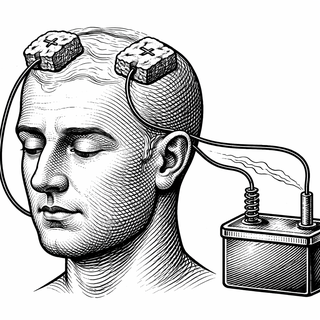
Imagine someone telling you they want to stick wet sponges on your head and run electricity through your brain. Now imagine signing up for it voluntarily. Welcome to the wild and wonderful world of transcranial direct current stimulation, or tDCS for those of us who don't have time to say all those syllables.
The clinical trial NCT07291791 represents the latest chapter in humanity's ongoing quest to figure out whether gently electrifying our skulls can make our brains work better. Spoiler: the answer might actually be yes, and the science behind it is way cooler than you'd think.
Your Brain: Now Available with Electric Upgrades
Let's start with the basics. Your brain runs on electricity - about 20 watts, roughly the same as a dim light bulb. Neurons communicate by generating tiny electrical signals, and the pattern of these signals determines everything from your ability to remember where you put your keys to your capacity for complex abstract thought (like trying to understand your cell phone bill).
tDCS works by applying a weak electrical current - typically 1 to 2 milliamps - through electrodes placed on your scalp. To put that in perspective, 2 milliamps is about one-thousandth of what you'd get from a standard wall outlet. It's enough to make your neurons take notice, but not enough to make your hair stand on end or turn you into a comic book villain.
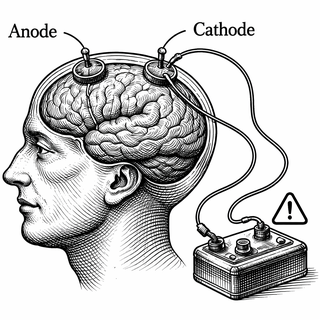
The current flows from a positive electrode (the anode) to a negative electrode (the cathode), and here's where it gets interesting: the direction matters. Anodal stimulation - when you're under the positive electrode - tends to make neurons more excitable, like giving them an extra shot of espresso. Cathodal stimulation has the opposite effect, calming things down like a neurological cup of chamomile tea.
The Mechanism: It's Not Just a Fancy Placebo
I know what you're thinking: "How does such a tiny current actually do anything?" Fair question, skeptical reader. The answer lies in membrane potentials and the concept of subthreshold modulation.
See, neurons aren't just sitting there waiting to fire or not fire - they exist on a continuum of readiness. tDCS doesn't directly make neurons fire (that would require much more current). Instead, it nudges the baseline closer to or further from the threshold for firing. Think of it like adjusting the sensitivity on a smoke detector: you're not setting off the alarm, but you're making it more or less likely to go off when it detects actual smoke.
At the cellular level, anodal stimulation shifts membrane potentials toward depolarization, while cathodal stimulation shifts them toward hyperpolarization. This seemingly subtle change has downstream effects on neurotransmitter systems - potentially enhancing glutamate transmission (your brain's main excitatory signal) and modulating GABA (the inhibitory counterpart), along with effects on dopamine, serotonin, and acetylcholine.
And here's the really cool part: if you stimulate for long enough - typically 10 minutes or more - the effects can outlast the stimulation by up to 90 minutes. Some research suggests that repeated sessions may even produce longer-lasting changes through mechanisms similar to long-term potentiation, the same process involved in learning and memory formation.
The NCT07291791 Trial: What Are We Actually Studying Here?
Clinical trial NCT07291791 focuses on evaluating the neuromodulatory effects of tDCS. While the specific details of this trial involve rigorous scientific methodology, the broader goal is to understand how this technology can be safely and effectively applied to influence brain function.
Trials like this build on decades of research into non-invasive brain stimulation. The field has come a long way from its historical origins - yes, people have been interested in running electricity through brains for a very long time, though the early approaches were considerably more... aggressive.
From Depression to Dementia: The Clinical Promise
tDCS isn't just a research curiosity - it's showing real promise for treating actual medical conditions. Depression is one of the most studied applications. A 2024 study published in Nature Medicine examined home-based tDCS treatment for major depressive disorder and found that active stimulation produced greater improvements in depressive symptoms compared to sham (fake) stimulation.
The appeal here is obvious: depression affects hundreds of millions of people worldwide, and current treatments - medications and psychotherapy - don't work for everyone. A non-invasive, relatively low-cost intervention that can be administered at home? That's potentially game-changing.
But depression is just the beginning. Researchers are exploring tDCS for:
- Chronic pain: Because when your brain processes pain signals, modulating that processing can help
- Stroke recovery: Enhancing plasticity to help the brain rewire around damaged areas
- Cognitive enhancement in Alzheimer's disease: The NICE-AD study showed some promising results
- PTSD: Because trauma changes the brain, and perhaps we can change it back
- Migraine prevention: Randomized controlled trials have tested anodal tDCS for this purpose
The DIY tDCS Movement: Please Don't Try This at Home
I need to pause here and address the elephant in the room: yes, there are people building their own tDCS devices and zapping their brains at home. The internet has tutorials. It's a thing.
Please don't do this.
While tDCS at proper doses appears relatively safe in clinical settings, "relatively safe" and "totally safe to improvise in your garage" are very different things. The electrode placement matters enormously - stimulating the wrong area can have unintended effects. The current parameters matter. The duration matters. And without proper monitoring, you won't know if something's going wrong until it's already gone wrong.
Clinical trials like NCT07291791 exist precisely because we need rigorous, controlled research to establish safety and efficacy. That research involves ethics committees, informed consent, professional oversight, and careful monitoring. Your bathroom does not have these things.
The Technical Details That Make Neuroscientists Excited
For the science nerds among us (and I say that with love - I'm one of you), here are some of the more fascinating technical aspects of tDCS:
Electrode montage: The placement of electrodes determines which brain regions receive stimulation. Common configurations include F3-Fp2 for depression (targeting the left dorsolateral prefrontal cortex) and M1 for motor cortex studies.
Current density: This is calculated as current divided by electrode area, and it matters for both efficacy and safety. Typical densities range from 0.03 to 0.08 mA/cm squared.
Individual differences: Skull thickness, cerebrospinal fluid distribution, and individual anatomy all affect how much current actually reaches the brain. Only a fraction of the applied current penetrates to cortical tissue - most dissipates through skin, skull, and fluid.
Sham stimulation: A crucial aspect of controlled trials involves "sham" conditions where participants believe they're receiving stimulation but aren't. This usually involves brief ramping up and down of current, which produces the characteristic tingling sensation without sustained stimulation.
The Future: Your Brain, Optimized?
The neuromodulation field is evolving rapidly. Beyond tDCS, researchers are exploring transcranial alternating current stimulation (tACS), transcranial random noise stimulation (tRNS), and combinations of stimulation with other interventions like cognitive training or pharmacotherapy.
The dream scenario - and it's not as far-fetched as it sounds - is personalized brain stimulation guided by neuroimaging. Imagine a treatment where your specific brain network abnormalities are mapped using fMRI, and a customized stimulation protocol is designed to address your particular patterns. We're not there yet, but trials like NCT07291791 are laying the groundwork.
The Bottom Line
tDCS represents one of those beautiful convergences of technology and biology - using our understanding of how the brain works electrically to potentially modify how it functions. The clinical trial NCT07291791 is part of the ongoing scientific effort to transform this promising technology into validated medical treatments.
Is tDCS the future of psychiatry and neurology? Maybe not exclusively - but it's almost certainly part of that future. The ability to non-invasively modulate brain activity opens doors that were previously closed, and we're only beginning to explore what's on the other side.
Just remember: if you want to experience tDCS, find a clinical trial or a licensed provider. Leave the home electrical projects to LED light strips and USB charging stations. Your brain will thank you.
Disclaimer: This blog post is for educational and entertainment purposes only and does not constitute medical advice. Clinical trial information was referenced from ClinicalTrials.gov (NCT07291791). Never attempt to build or use DIY brain stimulation devices. Always consult qualified healthcare professionals for medical decisions. Images and graphics are for illustrative purposes only and do not depict actual medical devices, procedures, mechanisms, or research findings from the referenced studies.
References:
- ClinicalTrials.gov. NCT07291791: Evaluation of Neuromodulatory Effects of tDCS
- Bikson M, et al. (2016). Safety of transcranial direct current stimulation: evidence based update 2016. Brain Stimul. DOI: 10.1016/j.brs.2016.06.004
- Fregni F, et al. (2021). Evidence-based guidelines and secondary meta-analysis for the use of transcranial direct current stimulation in neurological and psychiatric disorders. Int J Neuropsychopharmacol.
- Alexander ML, et al. (2024). Home-based transcranial direct current stimulation treatment for major depressive disorder. Nature Medicine. DOI: 10.1038/s41591-024-03305-y