
Everybody expects brain stimulation research to aim straight for the brain. That would be the obvious move. Plot twist: this clinical trial is betting that the real magic might happen lower down, in the cervical spinal cord, where signals from the brain and the hand can meet like two perfectly timed trains pulling into the same station. And honestly, that is such a fun scientific twist I almost want to applaud the timing diagram.
Why this trial grabbed me by the academic lapels
The study, NCT07539025, is called Paired Non-invasive Stimulation of Hand Motor Cortex and Median Nerve to Induce Plasticity in the Cervical Spinal Cord. It is a prospective experimental study in typically developing adults. The basic idea is to pair two kinds of stimulation: one aimed at the hand area of the motor cortex, and one delivered to the median nerve, a major nerve in the arm and hand. The timing is the whole game.
Researchers want these two signals to arrive together in the cervical spinal cord, not up in the motor cortex. That timing-based approach is meant to drive associative plasticity, which is the nervous system's annoyingly impressive ability to rewire itself based on experience and repeated paired activity. Neurons that fire together, wire together, as neuroscience loves to say, and this trial is trying to cash that principle out with surgical timing and zero surgery. Very neat.
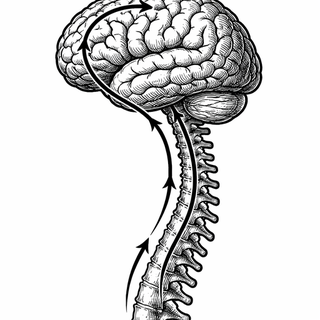
Even cooler, the trial builds on earlier work from the Carmel laboratory suggesting that when stimulation is timed to converge in the cervical spinal cord, it can produce larger upper-limb motor responses than when it is timed to converge in the motor cortex. So this is not just "let's try a thing." It is more like, "we saw a weirdly promising effect, and now we are going back with receipts."
What the researchers are actually testing
The protocol has a name that sounds like a sci-fi gadget but is really a precise physiological strategy: the SCAP-Nerve protocol. The goal is to test whether pairing sub-threshold stimulation of the hand motor cortex with median nerve stimulation can strengthen sensorimotor connections involved in manual dexterity.
A few details matter here.
First, the cortical stimulation is sub-threshold, meaning it is set below the level that would directly trigger a visible motor response on its own. That matters because the researchers are not just trying to brute-force the system. They are trying to nudge it into changing how pathways communicate.
Second, the study is happening first in typically developing adults. That is not a detour. It is the sensible warm-up lap. Before this approach is tested for recovery in people with spinal cord injury or cerebral palsy, the team wants to confirm that the cervical spinal cord is the right target and that the chosen stimulation parameters can actually induce the kind of plasticity they want.
That is good science. Less glamorous than miracle headlines, more useful than miracle headlines.
Why the spinal cord angle is such a big deal
A lot of people hear "movement problems" and immediately think "brain." Fair enough. But movement is a team sport. The brain sends the plan, the spinal cord relays and shapes it, peripheral nerves carry signals outward and inward, and muscles do the final heavy lifting. If one part of that relay gets disrupted, the whole system can get clumsy fast.
The cervical spinal cord is especially relevant here because it contains pathways that help control the arms and hands. And hands, as anyone who has ever tried to button a shirt while half-awake knows, demand exquisite precision. Gross arm movement is one thing. Dexterity is another beast entirely.
That is why this trial feels so intriguing. It is not just asking whether stimulation can make neurons more excitable for a while. It is asking whether carefully timed, non-invasive inputs can tune the circuitry that supports fine hand function. That is a much more ambitious and much more clinically interesting question.
The real-world "so what?"
If this works, the downstream implications are substantial.
The study summary explicitly points toward future translation into efficacy studies for people with spinal cord injury and cerebral palsy. Those are very different conditions, but both can involve disrupted motor pathways and persistent problems with hand function. Better dexterity is not some small, decorative outcome. It changes whether people can text, eat independently, fasten clothing, write, cook, work, and generally bully stubborn jars into opening.
And because this stimulation is non-invasive, the approach is appealing from a practicality standpoint too. No implanted hardware, no surgical recovery, no dramatic operating-room soundtrack. Just a protocol designed around timing, anatomy, and plasticity. Sometimes the most elegant intervention is basically a very sophisticated conversation between two signals.
Wait, it gets better: the trial is not only looking for physiological effects, but also behavioral ones. That matters because nervous systems can do all sorts of interesting things on paper and in recordings that do not always cash out into useful human function. The researchers are trying to connect the circuit story to the hand-use story. That is exactly the bridge you want.
The challenge this research is trying to solve
One of the hardest problems in neurorehabilitation is that recovery is rarely just about turning a system "back on." Damaged or underperforming pathways often need retraining, strengthening, and better coordination across multiple levels of the nervous system. That is a maddeningly complex engineering problem, except the machine is alive and has opinions.
Traditional rehab can help, and so can various stimulation approaches, but fine motor recovery remains stubborn. Hands are hard. The nervous system did not make dexterity easy to build, and it definitely did not make it easy to rebuild.
This trial tackles that challenge by focusing on timing and target selection. Instead of assuming the motor cortex is always the best place to induce change, it asks whether the spinal cord is the more strategic meeting point. That shift in perspective is the part I find most exciting. It is the scientific equivalent of realizing the best place to improve traffic flow is not the highway entrance but the giant interchange where everything snarls.
Why I cannot stop thinking about this one
There is something wonderfully disciplined about this study. It is bold, but not sloppy. It is imaginative, but still anchored to measurable outcomes and a clear translational path. The researchers are not promising to fix every motor disorder on Earth by Tuesday. They are testing a specific mechanism in a careful population to see whether the spinal cord really is the sweet spot for inducing useful plasticity.
That may sound modest, but in neuroscience, a clean answer to a precise question is worth its weight in caffeinated grant proposals.
If the SCAP-Nerve protocol confirms what the preliminary data hint at, it could sharpen the next generation of rehab-focused neuromodulation. And if it does not, that is informative too. Either way, it pushes the field past vague enthusiasm and toward smarter targeting.
Honestly, that is the kind of research update that makes me want to pace around the room explaining signal timing to anyone unlucky enough to make eye contact.
Trial Snapshot
Study record: NCT07539025
Table view: ClinicalTrials.gov Table View
Study purpose: Test whether paired sub-threshold motor cortex and median nerve stimulation can induce associative plasticity in the cervical spinal cord and affect manual dexterity
Intervention: Paired non-invasive stimulation of the hand motor cortex and median nerve using the SCAP-Nerve protocol
Population: Typically developing adults
Study type: Prospective experimental study
Longer-term aim: Inform later efficacy studies in spinal cord injury and cerebral palsy
Disclaimer: This post is for educational purposes only and is not medical advice. It is based on the publicly available study summary for the clinical trial record listed below and does not substitute for peer-reviewed clinical guidance or consultation with a qualified healthcare professional.
Citation: ClinicalTrials.gov. Paired Non-invasive Stimulation of Hand Motor Cortex and Median Nerve to Induce Plasticity in the Cervical Spinal Cord (NCT07539025). Available at: https://clinicaltrials.gov/study/NCT07539025