
The mercury that hides in a tuna steak doesn't announce itself.
Let me write this blog post based on the research data provided.
The cruel thing about mercury poisoning is that it arrives without a receipt. You eat the seafood, you drink the water, you go about your week, and the metal quietly files itself away in your kidneys, your liver, and your nervous system. There's no sharp pain to warn you, no funny aftertaste that makes you put down your fork. By the time the tremors, the numbness, or the brain fog show up, the bill has already been running for years. Mercury is the houseguest who never knocks and never leaves.
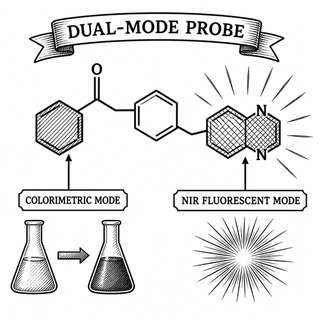
That invisibility is exactly the problem a team of researchers set out to fix, and their solution reads like a clever bit of chemical engineering: a single molecule that does two jobs at once. They call it a colorimetric and near-infrared (NIR) fluorescent dual-mode probe, built from a xanthene-quinoline conjugate. Translated out of journal-speak: they designed a tiny sensor that changes color when it grabs onto a mercury ion, and also lights up under the right kind of light. Two detection methods, one ingredient. In a field where most assays are picky single-taskers, that's the molecular equivalent of a knife that also works as a corkscrew.
Why mercury is such a slippery customer
Let me back up and explain why this is hard in the first place. Mercury ions (Hg2+) are toxic at concentrations so low they make a pinch of salt look generous. Regulatory limits for mercury in drinking water are measured in parts per billion, which is roughly one drop in an Olympic swimming pool. Detecting something at that concentration usually means hauling samples to a lab and running them through instruments with names like "cold vapor atomic absorption spectrometry" - machines that are accurate, expensive, and about as portable as a refrigerator.
The dream has always been a sensor you could use in the field. Dip it in the pond, dab it on the fish, get an answer. The catch is that real-world samples are messy. Water has other metals floating around. Soil is a chemical soup. Seafood is, well, seafood. A good probe has to find its one target ion in that crowd without getting distracted - the analytical equivalent of picking out a single conversation at a wedding reception.
The two-mode trick
Here's where the dual-mode design earns its keep. The colorimetric mode gives you a visible color change, the kind your eyeball can register without any equipment. That's your quick yes-or-no screen. The NIR fluorescent mode is the more sensitive instrument in the toolkit. Near-infrared light is a smart choice because biological tissue and background gunk tend to glow less in that range, so the signal cuts through the noise. Think of it as switching from a crowded AM radio band to a clean frequency where you can actually hear the broadcast.
Having both modes in one molecule means you get a fast field check and a precise measurement from the same reagent. If the two methods agree, your confidence goes up. If they disagree, you've learned something is off with the sample. Redundancy, in measurement, is not waste - it's the seatbelt.
From a beaker to a living mouse
What makes this study more ambitious than a typical "we made a sensor" paper is the range of places they took it. The probe was tested in water, soil, and seafood samples - the three usual suspects in environmental mercury contamination. Seafood especially matters, because mercury bioaccumulates up the food chain, and that fancy piece of fish is sitting near the top.
Then they went further, into living cells and into mice. Moving a probe from a clean test tube into a living organism is a serious jump in difficulty. A live system is warm, wet, chemically chaotic, and deeply uninterested in cooperating with your experiment. The NIR component is what makes this leap plausible: because near-infrared light penetrates tissue better than visible light, you can actually image mercury distribution inside an animal rather than just inferring it. Demonstrating that the probe still works in cells and mice is the difference between a promising idea and one that might survive contact with reality.
The pragmatic view
Now, the industry insider in me has to add the usual seasoning of skepticism. A probe that performs beautifully in a controlled study is a long way from a product sitting on a regulatory inspector's belt. The questions that decide whether this graduates from paper to practice are the boring ones: How stable is the reagent on a shelf? How much does it cost to manufacture? Does it hold up when the operator is tired, the sample is muddy, and the temperature is wrong? Plenty of elegant molecules have died in that gap between the bench and the field, and not because the chemistry was bad - because nobody could make it cheap and rugged.
Still, the design choices here are the right ones. Dual-mode detection hedges against the failure of any single readout. NIR fluorescence solves the real problem of background interference in living tissue. And testing across water, soil, seafood, cells, and mice shows the team was thinking about the whole pipeline, not just the prettiest data point. That's the kind of breadth that suggests someone in the lab was already imagining how this gets used, not just how it gets published.
Why it matters
Mercury contamination is not a solved problem. It rides into our food and water from industrial discharge, mining, and the slow churn of pollution that doesn't respect borders. The people most exposed are often the ones with the least access to a well-equipped lab. A cheap, portable, reliable mercury sensor would put detection where the contamination actually happens - the fishing dock, the village well, the field downstream of a factory.
This particular probe is one step on that road, not the finish line. But it's a thoughtfully built step, and in a research landscape full of sensors that only work under flattering lighting, a molecule that performs in water, soil, fish, and a live mouse is worth paying attention to. The mercury still won't announce itself. But we're getting better at making it confess.
This blog post discusses research findings and should not be taken as medical advice. If you have concerns about mercury exposure or heavy metal poisoning, please consult a healthcare provider. Research discussed here represents ongoing scientific investigation and clinical validation is still in progress.
All images used in this post are decorative illustrations only and do not represent or reflect the accuracy, reality, or correctness of the referenced research.
Primary Source: A colorimetric and NIR fluorescent dual-mode probe based on xanthene-quinoline conjugate for detecting mercury ion in water/soil/seafood samples, living cells and mice. PubMed. 2026. PMID: 41903492