
When I saw this study title, I rolled my eyes. Then I read it. "AI-augmented ultrasound analysis of noninvasive quantification of hydrogels concentration for bioprinting" sounds, at first glance, like a sentence assembled by a committee that had not seen daylight in months. But underneath the heavy coat of jargon is a surprisingly practical question: can we measure the concentration of a hydrogel accurately, without damaging it, using ultrasound and AI? And if the answer is yes, that is a bigger deal than it may sound.
Why hydrogels matter more than they sound like they should
Hydrogels are water-rich materials that can be soft, flexible, and friendly to living cells. In biomedical research, they are widely used in tissue engineering, drug delivery, wound care, and bioprinting. If you are trying to print a structure that behaves a bit like living tissue, the hydrogel is often part of the whole game.
But here is the catch: hydrogel concentration changes everything. Too dilute, and it may behave like a sleepy puddle. Too concentrated, and it can become too stiff, too dense, or less supportive for cells. Researchers need to know the concentration because it influences strength, flexibility, printability, and how cells respond inside the material.
That sounds like a lab problem, but it has bedside implications. If we want bioprinted materials to become more reliable for making tissue models, repairing damage, or building tailored biomedical products, quality control cannot be a shrug and a hopeful glance.
The old problem: measuring without ruining
Traditionally, measuring hydrogel concentration has not been elegant. Some methods are invasive, meaning they disturb or damage the sample. Others are non-invasive but lose precision, especially at the very high or very low ends of concentration. That is awkward, because edge cases are often where the interesting biology and engineering decisions live.
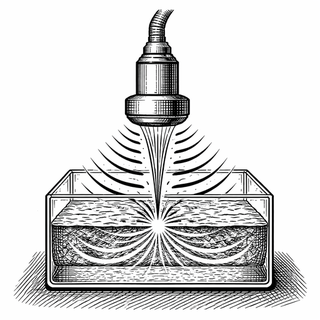
This new study proposes a cleaner approach. The researchers used a single-element ultrasound transducer to gather signal data from hydrogels without destroying the sample. Then they analyzed those complex signal patterns with a convolutional neural network, a type of AI often used to recognize subtle patterns in data.
In plain English: they listened carefully to how ultrasound bounced through the gel, then let AI sort out what those patterns meant. A bit like tapping on a wall and having a very smart assistant tell you not only that it is hollow, but what is behind it and how thick it is. My clinical colleagues may now be quietly wondering whether we should ask the same of every machine in the building. Fair question.
What the study found
The headline result is hard to ignore: the AI-based system classified hydrogel concentration with accuracy above 99%.
That matters because the study is not just saying, "ultrasound can see something." It is saying that ultrasound combined with machine learning may be able to classify concentration accurately across the full range, including the extreme levels where other methods often wobble.
The non-destructive part is especially appealing. In biomedical manufacturing and bioprinting, preserving the original sample is not a luxury. It is often the point. If your quality test damages the construct, you have a method with the social skills of a smoke detector that only works after setting the kitchen on fire.
Why this is interesting beyond the engineering
As someone who thinks constantly about the bridge between bench work and patient care, I find this kind of paper interesting because it addresses a very real bottleneck: reproducibility.
We talk a lot about breakthrough therapies, but future treatments depend on mundane reliability. Can a lab make the same material the same way every time? Can a printed construct be checked quickly before it moves further down the pipeline? Can manufacturers spot bad batches early? Can researchers compare results without wondering whether one group's hydrogel was quietly a little different from another's?
Those are not glamorous questions, but they decide whether a technology matures or stays trapped in promising PowerPoint slides.
If follow-up work confirms these findings in broader settings, an AI-ultrasound method like this could help standardize quality control for hydrogel-based constructs. That could support more consistent bioprinting workflows, reduce waste, and improve confidence in products meant for research and, one day, perhaps clinical use.
What makes ultrasound a smart choice here?
Ultrasound has several advantages in this context. It is non-destructive, relatively accessible, and already familiar in medicine. Most people hear "ultrasound" and think babies, gallbladders, or someone in an emergency department saying "hold still for one second." But fundamentally, ultrasound is a way of probing material properties through sound waves.
Hydrogels have internal structures and physical properties that affect how those sound waves travel and reflect. The challenge is that the signal patterns can be too complex for a simple rule-based system to interpret consistently. That is where the AI layer helps. A convolutional neural network can detect patterns that are difficult to capture with a few handcrafted equations.
The machine is not "understanding" hydrogel concentration the way a scientist does. It is recognizing a pattern that correlates with concentration. That distinction matters. It also keeps us honest, which is always nice when AI is involved and everyone is one headline away from claiming the printer is now sentient.
The important caveats
This is still a technology-development story, not a patient-ready clinical breakthrough. The result is exciting, but several questions remain.
First, we would want to know how well this approach performs across different hydrogel compositions, formulations, temperatures, preparation methods, and lab environments. A model can look brilliant in one controlled setting and then become surprisingly fragile when real-world variability shows up.
Second, classification accuracy is impressive, but practical deployment needs more than a single high number. We would want validation in larger datasets, external testing, and clarity about how the system behaves when confronted with materials it has not seen before.
Third, for clinical translation, the path is long. A tool used for quality control in research or manufacturing may reach utility sooner than something used directly in patient decision-making. That is not a weakness. It is how many useful technologies grow up.
Why patients could eventually care
No patient wakes up asking whether a hydrogel concentration classifier exceeded 99% accuracy. Fair enough. But patients do care whether engineered biomaterials are reliable, whether regenerative products are consistent, and whether new therapies can be manufactured safely and reproducibly.
That is where this work earns its relevance. Better quality control upstream can support safer, more dependable downstream applications. In regenerative medicine and bioprinting, the glamorous future rests on very unglamorous measurements done well.
And sometimes, that is the real story in biomedical progress. Not the single dramatic leap, but the quiet improvement that makes the whole field less fragile.
This study may be one of those quiet improvements. It takes a fussy measurement problem, applies a familiar physical tool plus a modern analytical one, and produces a result that could make hydrogel-based technologies easier to trust. That is not flashy. It is useful. In medicine, useful tends to age very well.
This blog post discusses research findings and should not be taken as medical advice. If you have concerns about a treatment involving biomaterials, implants, or regenerative medicine, please consult a healthcare provider. Research discussed here represents ongoing scientific investigation and clinical validation is still in progress.
All images used in this post are decorative illustrations only and do not represent or reflect the accuracy, reality, or correctness of the referenced research.
Primary Source: AI-augmented ultrasound analysis of noninvasive quantification of hydrogels concentration for bioprinting. PubMed Record 41886792. View source