
Worst case: a beekeeper opens a hive expecting orderly honeybee civilization and instead finds a slow-motion corporate collapse. The queen is gone, the workers are confused, brood production is faltering, and the colony has already spent precious time trying to recover. By the time humans notice, the hive may be well into its “team meeting with no manager” era.
That is the practical problem behind a new biosensor platform designed to monitor queen mandibular pheromone in real time. The study focuses on 9-oxo-2-decenoic acid, usually shortened to 9-ODA, one of the major chemical signals associated with the honeybee queen. The researchers built a functional nanovesicle-embedded hydrogel biosensor paired with a black phosphorus field-effect transistor, or BP-FET, to detect 9-ODA in both aqueous and gaseous environments.
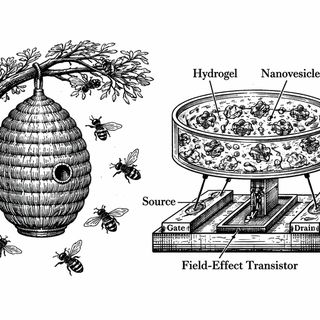
That sounds like a lot of tiny things doing very fancy things, because it is. But the basic idea is refreshingly simple: instead of waiting for a beekeeper to visually inspect a hive and infer whether the queen is present, build a sensor that can detect the chemical “I am queen, please continue operations” signal directly.
Why Queen Pheromone Matters
Honeybee colonies are not just piles of bees with good PR. They are highly coordinated biological systems, and the queen’s chemical signals help regulate colony behavior, reproduction, and social organization. Queen mandibular pheromone is one of the main ways the queen communicates her presence.
When a queen is lost, the colony may eventually notice and attempt to raise a replacement. But “eventually” is not the same thing as “early enough.” Manual hive inspection can miss early signs, and frequent inspection can disturb the colony. Beekeepers are stuck with a familiar tradeoff: check too rarely and risk missing trouble, check too often and become the world’s most disruptive landlord.
A real-time chemical sensor could, in theory, reduce that guesswork. If a device can continuously monitor queen pheromone signals, it may give beekeepers earlier warning when a queen is absent, weak, failing, or not producing normal chemical cues.
That would be useful. Let’s pump the brakes before we crown the sensor queen of the apiary, though.
What the Researchers Built
The study describes a biosensor platform combining three main pieces.
First, there is the target molecule: 9-ODA, a major component of queen mandibular pheromone.
Second, there is the sensing interface: functional nanovesicles embedded in a hydrogel. Nanovesicles are tiny membrane-like structures that can be engineered to interact with specific molecules. A hydrogel provides a hydrated, gel-like environment that can hold biological components in place while still allowing molecules to diffuse through.
Third, there is the transducer: a black phosphorus-based field-effect transistor. Field-effect transistors are devices that convert changes at their surface into measurable electrical signals. Black phosphorus is an interesting material for sensing because it has electronic properties that can make it highly responsive to surface interactions.
Put together, the system is meant to detect 9-ODA directly and in real time. The researchers tested it in both liquid-phase and gas-phase environments, which matters because hive chemistry does not politely stay in one convenient format. Pheromone molecules may be encountered in fluids, on surfaces, or as volatile chemical cues in air.
The gas-phase angle is especially intriguing for beekeeping. A noninvasive sensor that sniffs hive air would be more practical than one requiring repeated sample collection. Bees have enough to do without humans turning the hive into a recurring laboratory practical.
The Clever Part
The cleverness here is not simply “sensor detects molecule.” Scientists have been building chemical sensors for a long time. The more interesting part is the hybrid design: biological recognition elements in a hydrogel combined with an electronically sensitive BP-FET.
That kind of architecture tries to borrow the strengths of biology and electronics at the same time. Biological systems can be remarkably selective. Electronic devices can produce rapid, quantifiable signals. If the two components are well matched, the result can be a sensor that is sensitive, specific, and fast.
The fact that the platform was tested in both aqueous and gaseous settings is also a methodological plus. A sensor that only works in one tidy lab condition may struggle when asked to survive real-world hive conditions, where humidity, temperature, wax, propolis, dust, microbes, and thousands of tiny residents all show up without signing the visitor log.
Why This Could Matter
Queen monitoring is a genuine problem for apiculture. Honeybee colonies support pollination, agriculture, and honey production, and colony health depends heavily on queen status. A technology that detects queen loss earlier could help beekeepers intervene sooner by replacing the queen, combining colonies, or making other management decisions.
This could also fit into the broader trend of precision beekeeping: using sensors, remote monitoring, and data systems to track hive weight, temperature, humidity, acoustics, and now potentially pheromone chemistry. A pheromone sensor would add a more direct biological signal to that toolkit.
That is the promise. The caution is that promise is not the same as field readiness.
The Brakes-Pumping Section
The main limitation is that a successful biosensor demonstration does not automatically become a rugged beekeeping tool. Hives are not sterile benchtops with wings. They are warm, sticky, humid, chemically complex environments. Any real-world device would need to handle long-term exposure, fouling, calibration drift, variable airflow, and interference from other hive chemicals.
Specificity is another key issue. Detecting 9-ODA in controlled settings is one thing. Reliably interpreting queen status from fluctuating pheromone levels inside a living colony is harder. A low signal might mean queen absence, but it could also reflect sensor placement, airflow, colony size, queen age, seasonal state, or environmental conditions. Biology enjoys making simple dashboards difficult.
There is also the question of thresholds. What level of 9-ODA counts as normal? What level signals queen failure? How does that vary across bee subspecies, hive types, climates, and management practices? Without validated field thresholds, a sensor could produce numbers that are scientifically interesting but operationally confusing. A beekeeper does not need a device that says, “The pheromone vibes are ambiguous.”
Durability and cost will matter too. Black phosphorus can be sensitive to environmental degradation, so device stability deserves attention. For widespread adoption, the sensor would need to be affordable, reliable, easy to maintain, and useful enough to justify installation across many hives.
What Would Convince Me Next
The next steps should be field-heavy. Lab testing is necessary, but hive deployment is where the awkward truths live.
Useful follow-up studies would test the sensor in active colonies over time, compare readings with confirmed queen status, track performance across seasons, and evaluate false alarms. It would also help to compare sensor signals with established hive indicators such as brood pattern, worker behavior, acoustic signatures, and beekeeper inspection results.
The best version of this technology would not replace beekeeper judgment. It would act more like an early-warning light: “Something may be off, please check this hive before it turns into a small buzzing governance crisis.”
That is a realistic and valuable role.
A Promising Sensor, Not a Magic Wand
This research is exciting because it targets a real problem with a technically sophisticated approach. Real-time pheromone monitoring could give beekeepers a more direct window into colony reproductive status, and the combination of nanovesicles, hydrogel, and BP-FET sensing is genuinely interesting.
But the path from sensor platform to hive-ready tool is still long. The core question is not only whether the device can detect 9-ODA. It is whether it can detect meaningful queen-status changes accurately, affordably, and reliably in the messy chemistry of real colonies.
For now, this is a promising prototype with a good scientific nose. Whether it becomes a practical beekeeping tool depends on how it performs when the lab coat comes off and the bees start freelancing.
This blog post discusses research findings and should not be taken as medical, veterinary, or beekeeping management advice. If you have concerns about honeybee colony health, please consult an experienced beekeeper, apiculture specialist, or relevant agricultural extension service. Research discussed here represents ongoing scientific investigation and field validation is still in progress.
All images used in this post are decorative illustrations only and do not represent or reflect the accuracy, reality, or correctness of the referenced research.
Primary Source: Functional Nanovesicle-Embedded Hydrogel Biosensors for the Real-Time Monitoring of Queen Mandibular Pheromone in Both Aqueous and Gaseous Environments. PubMed Record 42065258. https://pubmed.ncbi.nlm.nih.gov/42065258/