
Note to self: stop Googling "why is the pond green" at 2 a.m. and start reading about the people actually fixing it. Also, maybe eat fewer shrimp - or maybe eat more, because apparently the shells are saving the planet now.
If you've ever walked past a lake that looked like it was auditioning to be a smoothie bowl - that thick, neon-green, algae-choked disaster - you've witnessed eutrophication in action. The root cause? Too much phosphorus washing into waterways from agricultural runoff, wastewater discharge, and industrial processes. Phosphate, the bioavailable form of phosphorus, acts like an all-you-can-eat buffet for algae. The algae gorge themselves, multiply wildly, deplete the dissolved oxygen, and suddenly every fish in the neighborhood is checking out permanently. The numbers here are sobering: the U.S. EPA estimates that nutrient pollution affects roughly 100,000 miles of rivers and streams, 2.5 million acres of lakes, and 800 square miles of coastal bays annually.
So how do you pull phosphate out of water before it triggers ecological collapse? A research team recently published a clever answer that reads like a chemistry mashup episode: take chitosan (derived from crustacean shells), magnetize it, load it up with lanthanum, and let it hunt phosphate molecules like a guided missile with a built-in GPS home button.
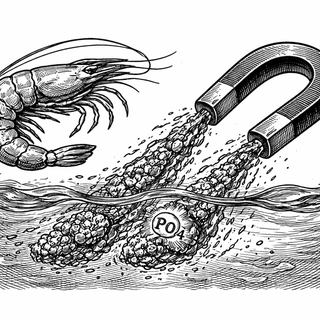
What Exactly Is This Thing?
The material in question is called La-MCS, short for lanthanum-functionalized magnetic chitosan bio-hybrid. Let's unpack that name, because every word is doing actual work here.
Chitosan is a biopolymer obtained by deacetylating chitin - the structural material in shrimp shells, crab exoskeletons, and insect cuticles. It's abundant, biodegradable, cheap, and already widely used in water treatment because its amino and hydroxyl groups naturally attract contaminants. Think of it as the scaffolding.
Magnetic means the researchers incorporated iron oxide nanoparticles (Fe3O4) into the chitosan matrix. Why? Because after the material does its job soaking up phosphate, you need to get it back out of the water. Slapping a magnet on the side of a treatment vessel is infinitely more practical than trying to filter out nanoscale particles. Recovery efficiency matters enormously at scale - if you can't retrieve your adsorbent, it becomes a contaminant itself.
Lanthanum is the star performer. Lanthanum (La), a rare earth element, has an exceptionally high affinity for phosphate ions. When incorporated as lanthanum hydroxide (La(OH)3), it forms strong inner-sphere complexes with phosphate through ligand exchange. In plain English: lanthanum grabs phosphate and does not let go easily.
The synthesis is described as a "facile one-pot route," which in chemistry-speak means you throw everything into one reactor and let it cook - no fourteen-step process, no exotic equipment. That simplicity matters for scalability.
The Numbers (Because That's What We're Here For)
Here's where the quantitative picture gets interesting. Lanthanum-based adsorbents have been studied extensively, but the recurring challenge is making them practical for real-world deployment. A material can have phenomenal phosphate capacity in a pristine lab solution and completely fall apart in actual wastewater containing competing ions like sulfate, carbonate, and chloride.
The La-MCS bio-hybrids were designed to address this gap. By tuning the lanthanum-to-chitosan ratio, the researchers optimized both adsorption capacity and selectivity. The magnetic component means recovery rates can exceed 90% with a simple external magnet - compare that to conventional filtration or centrifugation, which add cost, complexity, and energy consumption at every cycle.
The mechanistic insights the team provides are particularly valuable. Through spectroscopic analysis (XPS, FTIR, and XRD), they confirmed that phosphate removal occurs primarily through ligand exchange at lanthanum hydroxide sites, supplemented by electrostatic attraction from protonated amino groups on the chitosan backbone. This dual-mechanism approach explains why La-MCS outperforms either component alone. It's a genuine 1 + 1 = 3 situation.
Why This Matters Beyond the Lab Bench
Eutrophication is not a boutique environmental concern. The World Health Organization identifies harmful algal blooms as a growing threat to drinking water safety worldwide. The economic toll is staggering: the U.S. alone spends an estimated $2.2 billion annually dealing with the consequences of freshwater eutrophication, according to research published in Environmental Science & Technology.
Current phosphate removal methods - chemical precipitation with aluminum or iron salts, biological nutrient removal, constructed wetlands - all work, but each carries trade-offs. Chemical precipitation generates massive sludge volumes. Biological removal requires precise process control and struggles in cold climates. Adsorption-based approaches like La-MCS offer a middle path: targeted removal, easy recovery, and the potential for regeneration and reuse across multiple treatment cycles.
The "bio-hybrid" angle matters too. Chitosan is derived from waste streams - seafood processing generates roughly 6 to 8 million tons of shell waste globally each year. Turning that into a water treatment material is circular economy thinking at its most satisfying. You're literally using trash from the food industry to prevent ecological trash in waterways.
The Caveats (Because Science Is Honest Like That)
No material is perfect. Rare earth elements like lanthanum, while effective, carry their own supply chain and environmental extraction concerns. The long-term stability of La-MCS under varying pH, temperature, and competing ion conditions in real wastewater will need extensive field validation. Lab-scale synthesis is one thing; producing tons of the material consistently and affordably is another conversation entirely.
There's also the question of what happens to the phosphate-laden adsorbent after it's recovered. Ideally, you regenerate it and reuse it. The best lanthanum-based adsorbents can be regenerated with alkaline washes for multiple cycles, but each cycle typically degrades capacity slightly. Lifecycle analysis - from lanthanum mining through synthesis, use, regeneration, and eventual disposal - will determine whether the environmental math truly adds up.
The Bottom Line
This research represents a genuinely elegant approach to a gnarly environmental problem. A single material that combines the biocompatibility and low cost of chitosan, the magnetic recoverability of iron oxide, and the phosphate-hungry selectivity of lanthanum - all assembled in one step. It's the kind of interdisciplinary materials science that gives you legitimate hope for scalable water treatment solutions.
The green lakes aren't going to fix themselves. But materials like La-MCS suggest we're getting meaningfully better at building the tools to fix them for real.
This blog post discusses research findings and should not be taken as medical or environmental remediation advice. If you have concerns about water quality in your area, please consult local environmental authorities. Research discussed here represents ongoing scientific investigation and real-world validation is still in progress.
All images used in this post are decorative illustrations only and do not represent or reflect the accuracy, reality, or correctness of the referenced research.
Primary Source: Phosphate sequestration from water by an easily recoverable lanthanum-chitosan bio-hybrid: facile synthesis, performance, and mechanistic insights. PubMed. 2025. PMID: 41941913