
A storm front in medicine often begins quietly: a few charged particles here, a shift in acidity there, a pocket of low oxygen brewing inside diseased tissue. To a drug molecule, the body is not a calm spring meadow. It is more like a weather system with traffic lights, locked gates, and the occasional biochemical pothole. The question is: can we build drug carriers that read that forecast and respond at the right time?
That is where nanodiamonds enter the conversation. Yes, diamonds. Not the jewelry-counter kind that makes wallets faint, but carbon-based particles so small they operate at the scale of cells, proteins, and drug molecules. In the review “Stimuli-responsive nanodiamonds for precision pharmacokinetics, pharmacodynamics, and drug delivery applications,” researchers summarize how these tiny carriers may help medicines move through the body with more precision, more control, and fewer wrong turns.
Why Nanodiamonds Are Getting Attention
Pharmacology has always had a delivery problem. We can design powerful therapies, but getting them to the right tissue, at the right dose, for the right amount of time remains a surprisingly stubborn challenge. A drug that behaves beautifully in a lab dish can become a wandering tourist once injected or swallowed, visiting organs it was never meant to bother.
Nanodiamonds are appealing because they bring several useful traits to the table. They can be made in tunable sizes, their surfaces can be chemically modified, and they appear to have strong biocompatibility in many experimental settings. In practical terms, that means scientists can decorate their surface with drugs, targeting molecules, or responsive chemical groups.
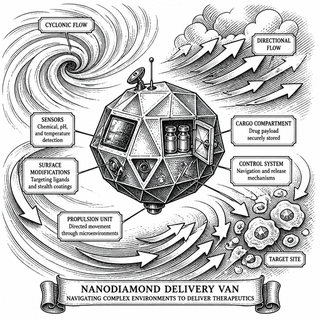
Think of a nanodiamond less as a gemstone and more as a microscopic delivery van with customizable bumpers, doors, and dashboard sensors. It may not sparkle under dinner lighting, but if it can help a chemotherapy drug avoid healthy tissue, nobody is complaining about the lack of romance.
PK and PD: The Body’s Drug Choreography
Two major ideas sit at the heart of this review: pharmacokinetics and pharmacodynamics.
Pharmacokinetics, often shortened to PK, asks what the body does to a drug. How is it absorbed? Where does it go? How long does it stay? How is it cleared?
Pharmacodynamics, or PD, asks what the drug does to the body. Does it hit the intended target? Does it trigger the desired biological effect? Does it cause toxicity?
For patients, these are not abstract laboratory questions. They shape whether a treatment works, whether side effects are tolerable, and whether a dose schedule feels manageable or like a second full-time job with worse snacks.
The review highlights that, despite the promise of nanodiamonds, we still do not fully understand their biodistribution, PK, and PD profiles. That gap matters. A delivery system is only useful if we know where it travels, how long it lingers, and what it does after arrival.
The Smart Part: Responding to Stimuli
The most intriguing part of this research area is the development of stimuli-responsive nanodiamonds. These are nanodiamond systems designed to react to specific triggers inside or outside the body.
Endogenous triggers come from within the body. These include:
- pH changes, such as the more acidic environment often found around tumors or inflamed tissue
- Ionic concentrations, which can vary across tissues and cellular compartments
- Hypoxia, meaning low oxygen levels, a common feature of many solid tumors
- Enzymatic activity, where disease-associated enzymes can act like molecular scissors
Exogenous triggers come from outside the body. These include:
- Temperature
- Light
The concept is elegant. Instead of releasing a drug everywhere, the nanodiamond carrier could hold onto its cargo until it encounters the right condition. A tumor’s acidic environment, for example, might help trigger drug release near the tumor rather than in healthy tissue.
It is a bit like sending a package that only opens when it reaches the correct zip code, except the zip code is “slightly acidic and suspiciously hypoxic.” Admittedly, that would make online shopping more complicated, but in oncology it could be very useful.
Why This Could Matter for Patients
From the bedside perspective, targeted drug delivery is not just a technical upgrade. It could change the lived experience of treatment.
Many therapies fail not because they lack biological activity, but because the effective dose is too close to the toxic dose. In plain language: the amount needed to help can also hurt. Better delivery could widen that therapeutic window.
If stimuli-responsive nanodiamonds work as hoped, they may help clinicians use potent drugs more selectively. That could mean fewer off-target effects, better tumor penetration, longer-lasting drug exposure, or more predictable dosing. For patients, those improvements could translate into fewer interruptions, fewer dose reductions, and perhaps better outcomes.
That is the hope. The careful clinical researcher in me must add: hope still needs data, and preferably data wearing sensible shoes.
Dual-Responsive Systems: Two Locks, One Better Key
The review also discusses dual stimuli-responsive nanodiamonds. These systems are designed to respond to more than one trigger, such as pH plus temperature or hypoxia plus enzymatic activity.
Why use two triggers? Because biology is messy. A single signal may not be specific enough. Many tissues can have mild acidity, and many disease environments overlap with normal physiology in inconvenient ways. Requiring two conditions before a drug is released could make delivery more selective.
This is similar to two-factor authentication for drug release. The carrier does not simply ask, “Are we in an acidic place?” It asks, “Are we acidic, oxygen-poor, and surrounded by the right enzyme activity?” A tiny pharmacologic bouncer, basically.
Dual-responsive designs may be especially useful in cancer, infection, and inflammatory disease, where local tissue environments differ from healthy tissue but rarely in one perfectly clean way.
The Big Unanswered Questions
For all their promise, nanodiamonds are not ready to stroll into routine clinical care just because the concept sounds clever.
Researchers still need clearer answers about how these particles distribute across organs, how they are metabolized or cleared, whether they accumulate over time, and how surface modifications change safety. A nanocarrier’s behavior can shift dramatically based on size, charge, coating, and attached drug. Small design choices can become large biological consequences.
There is also the manufacturing question. Precision nanomedicine depends on reproducibility. If one batch behaves differently from another, clinicians cannot safely predict dose, exposure, or effect. Patients deserve therapies that are not only inventive, but dependable.
And then there is translation. Many nanomedicine platforms perform well in controlled experimental models but struggle in the complexity of human disease. Human tumors, for example, are not uniform blobs waiting politely for nanoparticles. They are heterogeneous, structurally chaotic, and biologically moody. Anyone who has worked near a tumor microenvironment knows it has the temperament of a committee meeting running late.
A Promising Platform, Not a Magic Pebble
The strongest message from this review is not that nanodiamonds are a cure-all. They are not magic dust, and medicine has learned the hard way that “promising platform” can mean many years of careful work ahead.
But they are genuinely interesting. Their customizable surfaces, potential biocompatibility, and ability to respond to internal and external triggers make them a compelling candidate for next-generation drug delivery. They sit at the intersection of materials science, pharmacology, and clinical need.
For patients, the dream is straightforward: treatments that go where they are needed, act when they should, and spare healthy tissue as much as possible. For researchers, the challenge is equally clear: measure the PK, understand the PD, refine the design, and prove the benefit in rigorous clinical studies.
Tiny diamonds may not replace the fundamentals of good medicine. But they might help us deliver good medicine with more finesse. And in pharmacology, finesse is not a luxury. Sometimes it is the difference between a drug that merely reaches the body and one that truly reaches the patient.
This blog post discusses research findings and should not be taken as medical advice. If you have concerns about treatment options, drug delivery technologies, or nanomedicine-related therapies, please consult a healthcare provider. Research discussed here represents ongoing scientific investigation and clinical validation is still in progress.
All images used in this post are decorative illustrations only and do not represent or reflect the accuracy, reality, or correctness of the referenced research.
Primary Source: “Stimuli-responsive nanodiamonds for precision pharmacokinetics, pharmacodynamics, and drug delivery applications.” PubMed. Record ID: 41713655. https://pubmed.ncbi.nlm.nih.gov/41713655/